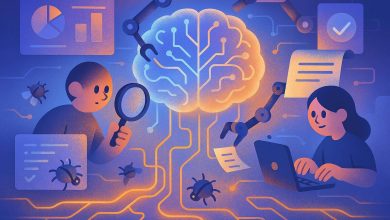
Artificial intelligence is no longer a buzzword—it is a tectonic shift, reshaping the way businesses compete, innovate, and create value. Yet despite the hype, most leaders approach AI as a tool or a shiny add-on. That mindset is doomed to fail. True AI-driven transformation requires vision, patience, and a deep understanding of both technology and human behavior.
I often draw parallels between AI and winemaking. In both, the raw material is only the beginning. Success comes from a combination of ingredients, process, and judgment honed over time. The leaders who truly harness AI understand that it is not about automation alone—it is about crafting an experience, building culture, and designing systems that endure.
AI Hype vs. AI Reality
We live in a world where every vendor promises instant AI magic. Decision-makers see AI as a black box that will solve all operational and strategic problems. But AI is not magic; it is a sophisticated craft. Treat it like a tool, and you get incremental improvement. Treat it like a system of innovation, and you build lasting advantage.
Data is the raw material, but without careful processing, quality checks, and iteration, it produces nothing more than noise. The companies that succeed with AI are those willing to invest in precision, rigor, and continuous learning—the same principles a winemaker applies from grape to glass.
Lessons From the Vineyard: Precision Meets Intuition
Consider winemaking. The Terroir, the Vienyard, choosing the timing, and the aging process each play a critical role. In AI, the parallels are striking:
- Terrior Data Quality: Garbage in, garbage out. Without accurate, clean, and well-curated data, AI models fail.
- Vineyard = Inputs & Processes: The systems and operations feeding AI must be structured yet flexible.
- Timing = Modeling & Experimentation: Raw data transforms into actionable insight through models—but only with careful oversight.
- Aging = Iteration & Refinement: Results improve over time with testing, learning, and human judgment.
- Winemaker = Leadership & Vision: Technology alone is insufficient; leaders must guide, decide, and set context.
AI, like wine, cannot be rushed. Patience, discipline, and taste are required for a product—or a business—that will endure.
AI Will Not Replace Humans—But It Will Replace Businesses That Ignore It
There is a misconception that AI replaces people. The truth is far more nuanced: AI amplifies those who know how to use it and marginalizes those who don’t. Executives who fail to integrate AI into strategy will see competitors move faster, smarter, and with greater precision.
The businesses that dominate the next decade will not be those with the latest algorithms, but those who combine human judgment with technological leverage. They will create AI-augmented teams, not AI-replaced teams.
The Three Pillars of AI Leadership
For any organization aiming to win with AI, three pillars are essential:
- Augmentation: Use AI to amplify human insight, not replace it. Decision-makers become more informed, creative, and proactive.
- Automation: Remove repetitive friction to free talent for higher-value work. Efficiency drives focus and competitive speed.
- Acceleration: Scale insight and operations faster than the competition, creating feedback loops that compound advantage.
Leaders must balance all three pillars with strategic intent. Neglect any of them, and AI becomes either expensive automation or misunderstood hype.
From Silicon Valley to Vineyards: Lessons Across Industries
My experience spans both tech startups and winemaking. In Silicon Valley, I’ve seen companies scale with precision, speed, and ruthless efficiency. In vineyards, I’ve learned that craft, patience, and intuition are equally critical. AI is where these worlds intersect: technical rigor meets human judgment.
Whether predicting market shifts, optimizing processes, or crafting customer experiences, AI is only as good as the people guiding it. Leadership is not about letting algorithms decide—it is about shaping context, defining goals, and maintaining vision.
The Hidden Risk: AI Without Humanity Produces Mediocrity
Companies often implement AI to chase metrics or non-important KPIs. They forget that technology without context produces outputs that are technically correct but strategically irrelevant. AI must be paired with empathy, ethics, and insight—just like a winemaker balances taste, aroma, and experience.
Outstanding AI leadership requires asking: How does this serve the customer? How does this strengthen the brand? How does this create long-term value? Ignoring these questions leads to efficiency without differentiation—a commodity in a world where competitive advantage comes from vision and judgment.
AI-Enabled Experiences, Not Just Tools
Looking ahead, AI will not just power tools—it will enable experiences. Personalized recommendations, predictive insights, and seamless interactions are the surface of a much more profound transformation. Businesses that succeed will think holistically: combining data, systems, people, and strategy.
Leaders must view AI as a framework for design, creativity, and impact, not merely a checkbox in operations. Those who embrace this mindset will outpace competitors and create businesses that are not only efficient but extraordinary.
Conclusion: Think Like a Master Winemaker
The most successful businesses in an AI-driven world will be those that combine precision with intuition, technology with judgment, and speed with patience. They will not treat AI as magic, but as craft.
AI, like wine, is about quality, process, and taste. Companies that master both technology and humanity will define the next era of business leadership. The rest will watch them from the sidelines.