Introduction: The Unseen AI Revolution
When most people think of artificial intelligence, they picture software. They think of chatbots that write poetry, image generators that create surreal art, and the large language models powering these digital marvels. This software-centric view, however, misses a much larger, more tangible revolution that is currently unfolding beyond the screen. A multi-billion-dollar wave of investment and innovation is shifting AI from the cloud into our physical world—transforming factories, warehouses, and hospitals.
This new frontier is called Physical AI, or “Embodied Intelligence,” and it represents the profound convergence of AI’s reasoning capabilities with advanced robotics. It’s about giving AI a body to perceive, interact with, and act upon the physical environment. This isn’t a distant sci-fi concept; it’s happening now, driven by a global race to solve some of the world’s most pressing industrial and labor challenges across five surprising and impactful fronts.
-
The AI Gold Rush is Getting a Body
AI Is Moving From Virtual Brains to Physical Bodies
After years of investment focused on AI software companies like OpenAI and Cohere, capital is now pouring into a new class of startups that apply this intelligence to the physical world. The new goal is not just to build smarter software, but to create robots that can operate and adapt in complex, real-world settings. This is not a pivot away from software, but the logical next step: the ‘brains’ developed in the cloud are now mature enough to be placed into physical ‘bodies.’
The most dramatic example of this shift is the startup Figure AI, which is building AI-powered humanoid robots. In a landmark deal, the company recently raised the first-ever billion-dollar funding round for a robotics startup, valuing it at an astonishing $39 billion, with backing from tech giants like Nvidia and Salesforce. This signals a fundamental change in investor priorities. The challenge is no longer just about building efficient machines, but about creating “adaptive intelligence that can truly ‘reason’ in unpredictable physical environments.”
This vision of an AI-powered industrial future is being championed at the highest levels of the tech industry, underscoring the scale of the transformation ahead.
“AI is transforming the world’s factories into intelligent thinking machines — the engines of a new industrial revolution.”
— Jensen Huang, founder and CEO of NVIDIA
-
The Investors Aren’t Who You Think
The Money is Coming From Everywhere (Even Crypto)
The investment surge into physical AI is remarkable not just for its size, but for the surprising diversity of its sources. The capital flowing into this sector extends far beyond traditional Silicon Valley venture funds, indicating a broad, global consensus on the technology’s foundational importance.
Investors from nearly every corner of the financial world are placing major bets on robotics and embodied intelligence:
- Corporate Venture Arms: Tech leaders are investing heavily to secure a stake in the future hardware ecosystem. Firms like Intel Capital, Qualcomm Ventures, and LG Technology Ventures are actively backing robotics startups.
- Sovereign Wealth Funds: Nations are making strategic investments in AI infrastructure. The Qatar Investment Authority, for example, has entered a $20 billion joint venture with Brookfield specifically to develop global AI infrastructure.
- Cryptocurrency Giants: In one of the most unexpected moves, Tether, the company behind the world’s largest stablecoin, invested in the Italian humanoid robotics firm Generative Bionics. Tether’s stated goal is to support the development of “resilient global infrastructure.” This move aligns with Tether’s stated mission to back technologies that ‘enhance human freedom’ and ‘operate independently of concentrated corporate or political control,’ signaling a belief that physical robotics is a key component of future societal resilience.
This wide array of backers—from chipmakers to governments to crypto pioneers—signals a shared belief that physical AI is not a niche trend, but a core technology that will redefine global industry and infrastructure.
-
It’s a Global Arms Race for Physical Supremacy
It’s a Global Arms Race for AI Infrastructure
The surge in physical AI investment is not merely a market trend; it has escalated into a geopolitical contest for industrial supremacy in the 21st century. Nations are deploying capital as a strategic tool to secure sovereign AI capabilities, onshore manufacturing, and dominate the next wave of technological infrastructure.
This global competition is accelerating innovation and deployment on an unprecedented scale:
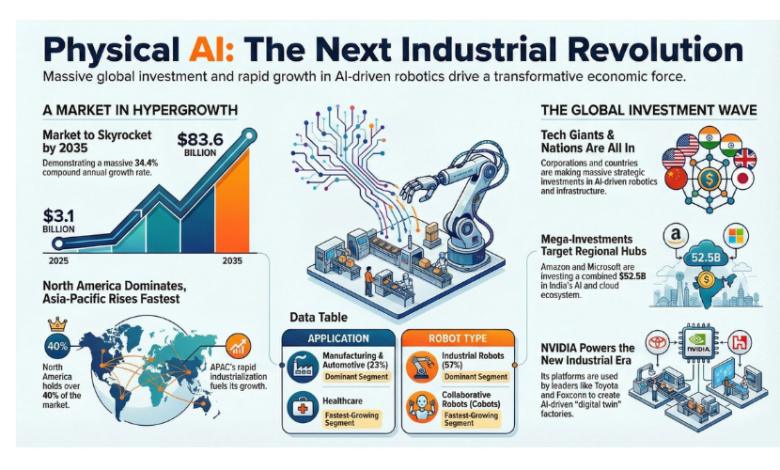
- India: Amazon and Microsoft have collectively pledged $52.5 billion to strengthen the country’s AI and cloud infrastructure, positioning it as an emerging hub.
- China: The Chinese government has launched a $138 billion AI and robotics fund. Its tech giants, including Alibaba and Baidu, are heavily backing “embodied intelligence” startups. Consequently, more than half of the companies on Morgan Stanley’s ‘Humanoid 100’ list are based in China.
- South Korea: Tech conglomerate Naver is investing $690 million to acquire 60,000 of NVIDIA’s latest GPUs, an explicit move to power its “physical AI” ambitions in robotics and autonomous systems.
- United States: A major push for American “reindustrialization” is underway, with companies like NVIDIA leading the charge. Industrial giants including Toyota, TSMC, and Caterpillar are building “digital twins” of their US factories to optimize production with AI and robotics.
-
The Goal is to Solve a Human-Sized Problem
This Isn’t Just Tech for Tech’s Sake—It’s About Solving Labor Shortages
A primary driver of the physical AI boom is the urgent, real-world need to address critical labor shortages and improve worker safety. The technology is being developed not merely for novelty, but to solve fundamental economic and demographic challenges.
Figure AI, for example, is explicitly building its humanoid robots to tackle labor gaps, particularly in roles that are unsafe or undesirable for humans. Across critical industries like security, mining, agriculture, and manufacturing, companies face an “existential labor shortage that no conventional automation can resolve.” Traditional robots excel at repetitive tasks in controlled environments, but they lack the adaptability to handle the dynamic, complex work where human labor is most needed.
The ultimate goal is not simply to replace workers, but to augment them by creating a “new robotic workforce” of collaborative robots, or “cobots,” that work alongside humans. These systems are designed to bridge skills gaps, enhance productivity, and improve safety across the industrial landscape.
-
The Physical AI Market is Set to Explode by Over 2,500% to $83 Billion
The investment and innovation in physical AI market are set to ignite staggering market growth. Hard data projects a massive expansion over the next decade, transforming a nascent industry into a major economic force.
According to market analysis from Acumen Research And Consulting, the global physical AI market is valued at approximately 3.1 billion in 2025. By 2035, it is projected to skyrocket to over 83.6 billion. This represents a compound annual growth rate (CAGR) of 34.4% and a total market increase of over 2,500%.
While the Manufacturing & Automotive sector is currently the largest market for physical AI, the fastest-growing application segment is Healthcare. This growth is fueled by surging demand for AI-powered surgical robots, advanced rehabilitation systems, and autonomous robots for hospital automation, demonstrating the technology’s potential to revolutionize critical human services.
A World of Thinking Machines
The convergence of artificial intelligence and robotics marks a fundamental inflection point in technology. After decades of developing digital intelligence confined to servers and screens, we are now embedding that intelligence into machines that can act in our world. This is not a minor upgrade; it is a paradigm shift.
Driven by massive, diverse, and global investment, this movement is aimed squarely at solving urgent, real-world problems—from revitalizing industrial output to filling critical labor gaps. The result will be a world where supply chains anticipate their own disruptions, dangerous jobs are fully automated, and our physical infrastructure becomes as intelligent and responsive as our digital networks.
As our digital tools gain the ability to act and reason in the physical world, what does it mean for the future of work, industry, and our daily lives?