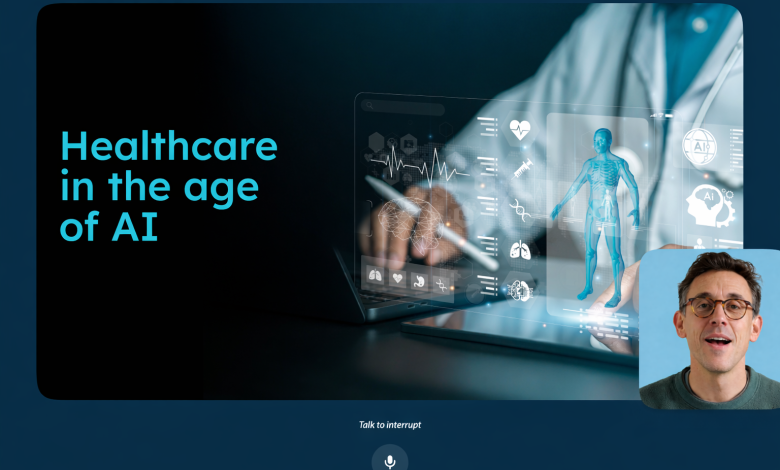
With OpenAI and Anthropic both unveiling dedicated AI tools for medical professionals and patients, 2026 is already proving to be a pivotal year for AI in healthcare.
These and other similar tools are designed to support doctors, improve access to information, streamline administrative tasks, and offer a guide for navigating healthcare interactions. It’s a meaningful step towards bringing critical clinical information closer to patients’ fingertips.
But when it comes to the patient experience, these AI tools may still be wanting.
Such tools often lack the feeling of natural empathy and guidance that come from speaking with an actual doctor, leaving such digital healthcare disconnected and difficult to navigate.
Indeed, while healthcare AI has largely bolstered access to information, it has yet to close the communication gap that matters most when people are feeling anxious, confused, or vulnerable. In other words, the human touch.
Healthcare AI So Far
Most AI adoption in healthcare has focused on streamlining administrative tasks and improving access to information, with as much as 66% of physicians reportedly using AI in the workplace in 2025. The benefits are not to be underestimated. AI has already made measurable improvements in clinical documentation and summarization, triage support and symptom analysis, and knowledge retrieval for clinicians and administrators.
But demand remains for these new-and-improved tools to bolster its “bedside manner.”
Consider that over 40 million people worldwide seek AI every day for health-related information. This significant rate of digital consultation is in part due to wider trends around AI usage but equally reflects the fact that traditional healthcare systems are battling cost increases, organizational challenges, and unprecedented wait times that frustrate many patients.
The Limits of Text-Based AI
Text-based systems may be very efficient for medical professionals, but efficiency does not equal empathy – and healthcare requires both.
LLMs like ChatGPT and Claude possess deep knowledge of almost everything under the sun, healthcare included. What they lack is nuance, and often offer symptom analysis with the same demeanor as they would spit out recipe ideas or cheeky puns. In sensitive healthcare settings, that standardized demeanor simply can’t be expected to deliver a natural, intuitive patient experience.
Patients do not experience care through a series of prompts and responses. They expect clarity, intuitive guidance, and a sense of continuity from one consultation to the next. Unfortunately, existing tools are typically reactive rather than proactive; abundant in information yet detached from the contexts. Fear, stress, urgency, financial considerations, and more are all large parts of what tactful handling of medical situations in real time entails. Traditional AI tools respond to the informational side of the equation but rarely address the contextual variables.
In reality, interactions are just as important as information.
From Static Prompts to Intuitive Guidance
For digital healthcare to feel truly natural and intuitive, AI tools must be integrated seamlessly into the patient experience. To achieve this, leaders in the healthcare AI space must first and foremost consider how the interactions feel, not just the information they provide.
New iterations of AI tools that revolve around agentic models and user-facing avatars are helping to close the gap.
For example, an interactive avatar that acts as a digital “person,” designed to talk, think, react, and even look like an actual medical professional, offers the combination of explanation, vision, and contextual reasoning that makes real doctors so trustworthy. AI is still the driving force, but rather than a bombardment of dense text that a user must attempt to parse, the patient experience feels natural instead of transactional. In a healthcare setting, such tools offer a means of consultation that is visually expressive and which feels genuine, without putting extra strain on already stressed medical personnel.
The healthcare AI systems of the future must be accessible for all patients, not just the digitally fluent. Furthermore, it should replicate how doctors talk to patients, which means the AI needs to be conversational, responsive, and interactive.
The broader goal in digital healthcare should be making technology feel less like a tool patients have to manage and more like a supportive presence they can rely on.
Putting the “Care” Back in Healthcare
Efficiency is often “point A” for AI adoption. But on its own, efficiency can spell the death of effectiveness.
When empathy is placed on the same pedestal as operational efficiency, the impact of AI on physicians and patients will finally usher in an age of optimized healthcare that it has always promised. The future of AI in healthcare will be defined not just by what it knows, but by how deftly it guides patients through every step of the care journey.