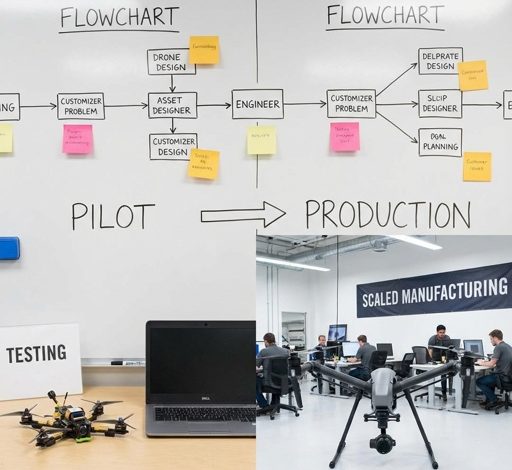
For more than a decade, enterprises have experimented with artificial intelligence – first as a curiosity, then as a strategic priority, and now as an essential pillar of modern operations. But even as enthusiasm has surged, most organizations remain stuck in the same place: pilot purgatory. They launch proofs of concept, host workshops, test narrow use cases – but hesitate to deploy AI at scale or embed it deeply into workflows.
It’s understandable. Moving from pilots to production is where real risks, decisions, and long-term commitments emerge. But it’s also where competitive advantage is truly forged.
In my work across large technology companies and AI-driven startups, the same pattern emerges repeatedly: the organizations that succeed treat AI not as an experiment, but as infrastructure.
Below are best practices for making the leap.
- Start with a Real Problem,Nota Demo
Many pilots exist because AI is exciting, not because a business problem demands it. Production systems, however, begin with a clearly defined friction point.
Shift the question from:
“What can generative AI do?”
to
“Where are people, customers, or systems struggling today?”
High-value domains often include:
- Product or content discovery
- Customer support automation
- Personalization of large catalogs
- Knowledge retrieval across siloed systems
A production AI system succeeds when it solves something measurable – not when it earns internal applause.
- Treat Data as an Asset, Not an Afterthought
Pilots often rely on small, curated datasets. Production AI does not have this luxury. It must operate with live, messy, evolving data.
Teams must ask:
- Is metadata consistent and machine-readable?
- Are systems siloed, incomplete, or inconsistently labeled?
- Do we have access to real-time updates?
Enterprises are rarely short on data – but often lack usable, organized, contextual data. AI thrives only when data quality issues are addressed early.
- Build Horizontal Infrastructure, Not One-Off Tools
A common trap: teams build disconnected pilots – a chatbot here, an analytics tool there, a recommender somewhere else. This leads to AI sprawl.
Production AI requires a shared, horizontal layer that supports many teams:
- Unified knowledge graphs
- Shared vector databases
- Governance frameworks
- Standardized RAG (retrieval-augmented generation) pipelines
- Reusable agentic workflows
A unified foundation enables compounding value and avoids inconsistent user experiences. 2
- Design for Trust: Governance, Safety, and Auditability
Pilots canoperate with manual oversight. Production systems cannot.
Teams should design for:
- Transparent reasoning
- Explainability of outputs
- Consistent recommendations
- Privacy-first architectures
- Human-in-the-loop for high-stakes decisions
Trust isn’t an output—it’s an engineering requirement.
- Prepare the Organization: Culture, Training, and Incentives
Technology rarely blocks AI adoption – people do.
Common fears include:
- “Will AI replace my job?”
- “What if the system makes a mistake?”
- “Who’s accountable for decisions?”
Leaders must frame AI as augmentation, not replacement, and provide training so teams understand both its potential and its limits.
Change management is not optional – it’s foundational.
- Solve the “Last Mile” Problem: Deployment & UX
Even the best model fails if the user experience is clunky.
Enterprise teams must consider:
- Where does AI appear in the workflow?
- How many clicks does it take to trigger?
- Does the interface feel natural – voice, chat, card, or API?
- Is output fast and aligned with user expectations?
In many cases, success is less about the brilliance of the model and more about the elegance of the interface.
- Ship Something Small – Then Scale Relentlessly
Perfection is the enemy of progress.
The production journey looks like this:
- Launch a focused, high-value use case
- Gather live feedback
- Iterate models + improve UX
- Expand to adjacent workflows
- Evolve into a platform
Momentum creates belief. Belief accelerates adoption. Adoption drives transformation.
- Focus on Outcomes, Not Models
Enterprises often overemphasize:
- the “best” LLM
- preferred vendors
- fine-tuning techniques
But customers don’t care about architectures. They care about:
- saved time
- reduced friction
- increased relevance
- higher revenue
- better experiences
AI is not the strategy. Outcomes are.
The Bottom Line: Production Is Where Value Happens
Pilots de-risk ideas. Production transforms organizations.
The enterprises that win will:
- Move fast but responsibly
- Build AI as shared infrastructure
- Democratize access
- Govern with rigor
- Measure outcomes ruthlessly
AI is no longer an experiment. It is a new operational foundation—and production is where the real story begins.