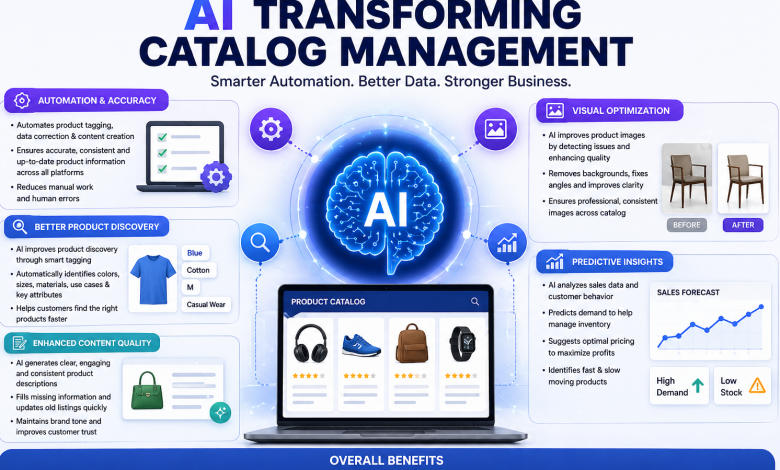
AI in catalog management is becoming essential for online stores and marketplaces. As product information continues to grow, businesses need easier and faster ways to keep their catalogs accurate and up to date.
AI plays a major role in this process by automatically tagging products, analyzing images, correcting data errors, and ensuring consistency across all listings.
This saves time and reduces manual work. AI also helps companies create clean, search-friendly product pages for each platform. When combined with modern product catalog management software, these AI capabilities streamline catalog updates and improve data accuracy across channels.
As new AI trends emerge each year, these tools are becoming smarter and more convenient, making catalog management easier while improving store performance and the overall customer experience.
Automation Made Easy
AI helps make catalog updates quick and easy by reducing manual work and enabling automated restocking for online stores. Modern AI catalog management software solutions identify missing details, correct errors, and keep all product information consistent across the catalog. AI also automatically sorts products and sends alerts when something looks incorrect, helping keep the catalog clean and accurate.
Key Benefits of Automation
- Finds missing or incorrect product details
- Recommends simple fixes by using smart AI
- Has the same product data across all platforms
- Sorts a large number of products speedily and properly
- Warns teams when any product info looks unusual or improper
Better Tagging
Good product tags help shoppers find items swiftly. AI makes tagging easier by reading product descriptions, images, and details. It can automatically spot:
- Colors
- Sizes
- Supplies
- How is the product used?
These clear tags help clients filter products without misperception. For business teams, updated tags save time by making it easier to search, sort and manage items.
AI can similarly notice special features that people may miss. For example, a product might be advantageous for a certain purpose even if the title doesn’t say it. This helps make better filters and makes it easier for clients to discover the correct products in online stores.
Better Content Quality
Good product content helps clients trust a brand and feel confident about making a purchase. AI can help by writing clear product descriptions, finding key details, and updating old listings swiftly.
It can generate short or long descriptions, maintain a consistent style across products, and add missing information. This saves time and ensures product information is correct. AI can also follow a brand’s style, having all content consistent. This is very useful for complex products, such as electronics, tools, or machines.
AI can clarify technical details, making it easier for clients to understand. Clear content improves the shopping experience, benefits clients, enables faster decision-making, and builds trust in the brand.
Visual Tools
Product images help clients decide what to purchase. Clear, high-quality pictures make products look more gorgeous and build trust.
AI tools make managing these images quicker and easier. They can find low-quality photos, match pictures to the correct products, spot missing angles, and fix backgrounds. This has all images clean, professional, and consistent.
Brands with many products benefit most, as AI can process thousands of photos at once, saving significant time.
AI can also improve pictures by making white-background versions or displaying products in real-life settings. These tools lessen manual work, retain images exactly, and make online stores look good.
With better pictures, clients can find what they need faster and shop more confidently. This supports increasing sales and makes the shopping experience more engaging and enjoyable.
Predictive Insights
Catalog data supports businesses in managing stock and rates. AI analyzes past sales and client behavior to predict future sales. This helps companies avoid having too much or too little stock. Knowing which items sell fast or slow makes planning easier. Updated catalog information also helps clients choose the correct products.
Key Benefits of Predictive Insights:
- Predict demand to have the correct stock.
- Discover fast-selling items to increase sales.
- Spot slow-selling items to lessen waste.
- Recommend prices centered on the market to earn more.
Conclusion
In short, AI is making it much stress-free for businesses to manage product catalogs. It can automatically update product info, improve descriptions, and keep details consistent across all platforms. AI can also predict which products will sell, helping with stock and pricing decisions.
It also enhances images, fixing low-quality photos and making them look professional. By doing these repetitive tasks, AI allows staff to focus on more key work. It also checks for errors and maintains consistent cataloging.
As AI continues to improve, managing catalogs will be even quicker and simpler. Businesses using AI can serve clients better, stay up to date with trends, and stay ahead of competitors in today’s fast-moving digital world.