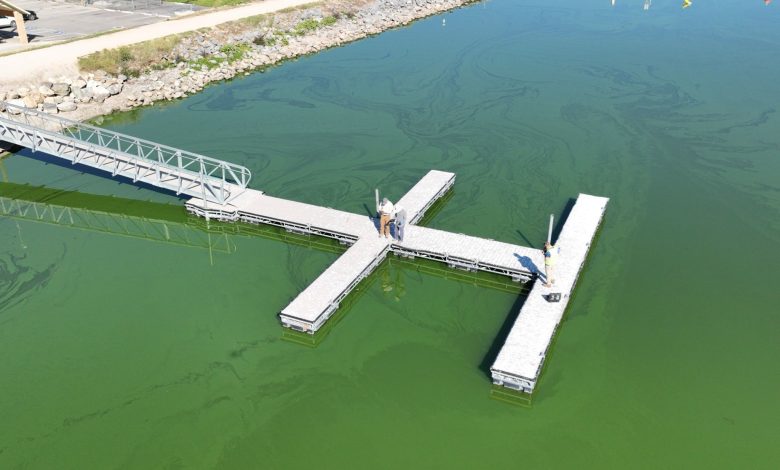
Introduction: When Water Turns Toxic
Toxic algae outbreaks occur when certain microorganisms proliferate rapidly under warm, nutrient-rich conditions, producing toxins that threaten drinking-water quality and aquatic ecosystems. These outbreaks, commonly referred to as harmful algal blooms (HABs), are increasing in frequency and severity worldwide.
When detection and response are delayed, water utilities often resort to emergency treatment adjustments and face operational disruptions; communities experience beach closures and public-health advisories; fisheries and tourism sustain abrupt financial losses; and aquatic ecosystems undergo preventable disturbances such as hypoxia and associated fish or invertebrate die-offs, which may take multiple seasons to recover.
Traditional monitoring methods often detect blooms only after they have intensified. As pressures from climate change and nutrient pollution mount, reliable early-warning systems, particularly those enhanced by artificial intelligence, have become increasingly essential.
The Need for Predictive Tools in Water Management
Proactive management, powered by artificial intelligence models trained on multi-source, high-cadence remote-sensing and meteorological data, offers a more effective path. Early warnings provided days to weeks ahead allow water managers to optimize intake operations, adjust treatment processes, and direct field sampling more strategically. By creating advance visibility into bloom evolution, these systems help prevent local events from escalating into costly or reputation-damaging crises.
Data Challenges: Noise, Gaps, and Uncertainty
Recent advances in satellite imaging now enable observation and tracking of HAB dynamics with unprecedented spatial and temporal detail. Combined with modern AI algorithms and meteorological datasets, these observations can reveal bloom-evolution patterns and, under the right conditions, support reliable predictive modeling and early-warning capabilities.
However, achieving this requires addressing several challenges. Recurring distortions in satellite imagery reduce data availability and compromise measurement accuracy. Uncertainties and biases in meteorological inputs can propagate through forecasting systems and diminish predictive reliability. Accurate HAB prediction requires integrating large, heterogeneous datasets – optical, environmental, and hydrometeorological variables – into models that can identify bloom onset and progression.
Preprocessing and Reconstruction: Building a Reliable Data Stream
A growing body of research is now focused on solving these challenges through multistage data-processing frameworks that clean and reconstruct satellite observations before they enter forecasting models. These approaches typically begin with a rigorous machine-learning quality-control stage that removes noise and sensor-related interference, filtering out errors that can distort reflectance and disrupt time series.
A second reconstruction step then fills the missing or corrupted portions of imagery caused by atmospheric or ecological distortions. Together, these steps yield a high-quality, continuous data stream that strengthens HAB detection and forms the foundation for reliable forecasting.
For example, recent deep-learning–based chlorophyll-a retrieval research highlights how combining quality control with reconstruction can correct atmospheric distortions and improve downstream forecasting performance.
Drivers of Bloom Dynamics: A Complex Seasonal Pattern
HABs are generally a seasonal phenomenon shaped by weather patterns, but they also depend on numerous additional factors, including water chemistry, nutrient runoff and sewage, surrounding agricultural activity, water depth, lake size, and others. As a result, they often exhibit quasi-periodic behavior from year to year, making their exact timing and intensity difficult to predict. Producing an accurate HAB forecast is, therefore, challenging and requires the integration of diverse datasets.
Recent advances in AI, combined with satellite remote sensing imagery calibrated against in situ measurements, now enable HAB monitoring with far greater accuracy and insight into their underlying drivers.
Multi-year histories that pair remote-sensing indicators with meteorological drivers add valuable context. This meteorological context – ranging from air and water temperatures to wind patterns, irradiance, precipitation, mixing, and growth conditions – collectively shapes the likelihood and evolution of blooms. Spanning several seasons ensures that the model captures both recurring patterns and rare but consequential events.
Model Architecture: A Hybrid TCN–LSTM Forecasting Framework
To learn the dynamics in these sequences, a hybrid Temporal Convolutional Network–Long Short-Term Memory (TCN-LSTM) architecture is employed. Temporal convolutions are well suited to detecting short- and medium-term precursors, while LSTM layers retain longer-range dependencies, including seasonal baselines and decay tails from prior blooms.
When trained end-to-end on cleaned historical series, AI models can identify correlations between remote-sensing indices and weather that predict bloom onset and intensity across diverse lake types and climatic regimes. Because the inputs are standardized geophysical variables, the method can be transferred across regions without extensive re-engineering.
Operational Forecasting: Turning Predictions Into Action
For operational use, forecasts can be updated by pairing the most recent satellite observations with near-term weather predictions for the same variables used in training. In practice, this enables early-warning alerts on a 14–20-day horizon, refreshed with each new satellite pass or forecast cycle.
Outputs typically include risk scores for HAB conditions, concise advisories (for example, “elevated risk in 7–10 days”), and most importantly, projections for the eventual incline or decline of the bloom, which is illustrated in the figures below. These products allow managers to anticipate treatment needs, adjust intakes, schedule targeted field checks, and communicate proactively with stakeholders, allocating effort and resources where they will have the greatest impact.
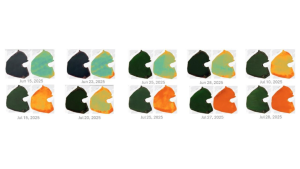
Figure 1
Heatmap showing RGB values aligned with bloom intensity across the time series. Shades of blue and green represent clean water to light bloom conditions. As the intensity increases, the colors shift through yellow and orange toward deep red, marking moderate through extreme bloom presence.

Figure 2
Time series representation of the Bloom intensity. Each point on the curve represents the average bloom intensity of the lake. The horizontal dashed line marks the start of the bloom forecast, and the dashed curve shows the TCN-LSTM prediction. The projected forecast captures the initial rise in bloom intensity and follows the observed trend for nearly twenty days.
Limitations and Safeguards in Deployment
Several considerations guide responsible deployment. At very high biomass, certain spectral ratios may saturate as surface scums and start to resemble terrestrial vegetation. Incorporating indices tailored to floating mats and applying conservative alert logic in this regime improves robustness.
Cloud cover can also reduce observation frequency; providing uncertainty bands during such intervals helps maintain transparency. Finally, uncertainty in short-term weather forecasts can shift baselines over time, so periodic retraining with new seasons and post-season audits is essential to preserve performance and trust.
Conclusion: Applied AI for Environmental Resilience
A unified approach that combines ML-based signal cleaning, multi-year integration of remote sensing and meteorology, and a hybrid TCN-LSTM forecaster driven by upcoming weather offers a practical and scalable early warning pathway for HABs. It represents AI directly applied to environmental stewardship, enabling faster, more transparent, and more efficient protection of freshwater systems.
This approach can help utilities, environmental agencies, and communities shift from reacting to past conditions to preparing for emerging risks, demonstrating how responsible, domain-aware AI can meaningfully support public health, environmental resilience, and long-term water security.