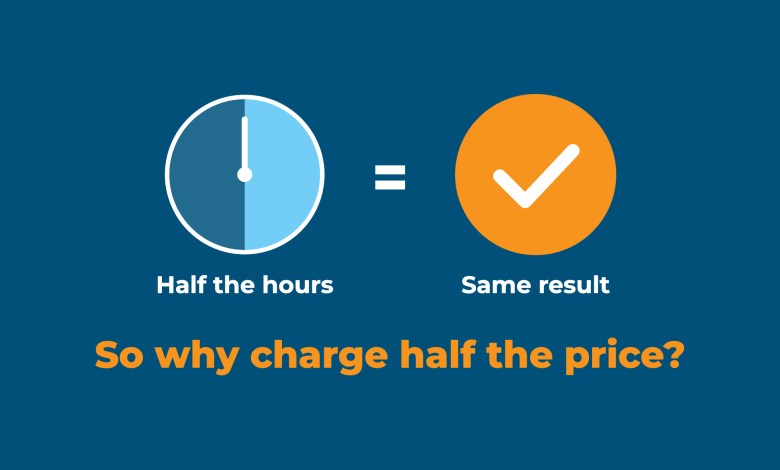
A service line leader recently described an efficiency gain to me that, for him, felt more like a revenue crisis. AI had cut delivery time by half for his team’s standard work and on certain engagements, by three-quarters. Instead of celebrating, however, he wanted to know how his firm could replace the billable revenue that had vanished along with those hours.
The service leader was taking the wrong approach. Fixing a pricing problem starts with an urgent and expensive client problem that the firm is uniquely placed to solve. From there, the firm must define exactly what the client is buying: the specific outcome, the included work, and the engagement’s boundaries. Without these definitions, replacing hourly billing with a fixed fee simply shifts the risk of scope creep from the client to the firm.
To mitigate this risk, productize based on your outcomes and the value they provide your clients, not the time units that go into them. Only then can you have a repeatable and defensible pricing model. Productization transforms your expertise, which is typically delivered uniquely for every client, into a standardized offering by pre-defining a client problem, a promised outcome and value, scope, and delivery method.
Once an outcome-based offering is clearly defined, your firm can transition to value-based pricing. While this pricing must still cover the resources required for delivery, it establishes only the price floor rather than the ceiling.
How is AI changing the pricing conversation now?
The conversation around pricing has grown more urgent as AI shortens the time required for knowledge work. According to the 2026 AI in Professional Services Report, the share of professionals whose organizations use generative AI rose from 22% to 40% in a single year, and about two-thirds of corporate respondents want their outside firms to use AI.
However, clients are seeking more than just fee reductions in return. The 2026 Future of Professionals Reportfinds that 78% of corporate clients consider AI-enabled quality improvements very important or essential, yet just 6% say most or all of their providers deliver them.
This discrepancy is reshaping the fee conversation. As clients rightly question where AI has reduced service effort, your firm must pivot to explaining the technology’s contribution to outcomes, such as broader analysis, increased scenario modeling, faster decision-making, or reduced risk. By doing so, you can shift the conversation from time reduction to added value.
Why does a fixed fee fail to solve the deeper problem?
Many firms’ first response to AI-driven efficiency gains might be to replace hourly billing with a fixed fee. This shift feels intuitive because, for decades, hours have served as a practical stand-in for value: harder problems required more expertise and time, so engagement prices naturally rose with difficulty. Now, however, AI is decoupling effort from value. A team can often deliver the same high-quality offering with the same accountability in less time; the expertise remains, even as the clock shrinks.
Continuing with time-and-materials pricing under these conditions effectively offers your client an automatic discount. Yet, simply switching to a fixed fee creates its own risks if the scope remains open-ended, potentially leaving your firm to absorb extra requests without additional compensation. Even when the scope is clearly defined, a fixed fee based solely on estimated hours merely transplants old logic into a new format. When you engage in this billing structure, you still focus on the effort you expect to spend rather than the result your client receives, effectively pricing yourself out of capturing the value your offering creates.
Why does productization matter to AI-era pricing?
Productization doesn’t eliminate expert judgment or homogenize the client experience. Rather, it makes it easier to sell and standardizes delivery processes, such as assessment tools, templates, and workflows, that shouldn’t be reinvented for every project. As these assets evolve, both sales and delivery become more efficient, and pricing should reflect value.
AI further strengthens this advantage when embedded within these repeatable methods. By using AI to synthesize research or test hypotheses while retaining expert oversight for judgment and quality, your firm can accelerate delivery without eroding your margins.
This pricing advantage is only one part of the broader business case for productization. Beyond better pricing, repeatable offerings improve delivery consistency and provide a scalable growth path that doesn’t require increasing headcount for every new client.
How should your firm pilot the change this quarter?
- Choose one recurring, well-defined service
Start with an engagement that solves an urgent and expensive problem and produces a clear, understood outcome. Avoid your firm’s largest or most politically sensitive service. A contained pilot allows your team to learn without jeopardizing major client relationships.
- Define the outcome and its boundaries
Clearly document your clients’ urgent and expensive problems and how you are uniquely positioned to solve that problem. Define how you’ll measure success and what is excluded. Identify exactly where AI can reduce effort while maintaining accountability. This frames faster delivery as an efficiency gain, not a reason to lower fees.
- Price using four inputs
Determine the price based on your firm’s strategy, the client’s willingness to pay, the full delivery cost (including labor and technology), and the cost of credible market alternatives. While your costs establish the price floor, the value of the result should define the ceiling.
Our framework for pricing AI-enabled servicescompares fixed-fee, tiered, subscription, and usage-based models. Choose a structure where the link between payment and value is transparent.
- Run a paid pilot and refine the offering
Test the offering with trusted clients who need to solve the problem. Always charge for the pilot because payment provides clearer validation than positive feedback. Afterward, compare the actual outcome, delivery effort, and client response to the initial projections to assess whether the model supports profitable growth.
Which traps can weaken the new model?
Some firms have been considering token-based pricing, where clients are charged based on the AI tokens consumed. While measuring usage via tokens is simple, it rarely aligns with the value delivered to the client. Usage-based models only succeed when the metric directly correlates with client value, such as a completed case, verified report, or monitored account, rather than internal consumption metrics that merely reflect the provider’s process.
Other clients find that their partners, unused to selling tech-enabled services, will give away tech. They risk eroding your value proposition. If you introduce AI capabilities, or any technology, without a price adjustment, clients may soon view them as a free baseline, making it hard to capture their value later. Price the complete value exchange before integrating new AI features as an expected baseline.
Finally, avoid standardizing your delivery before validating market demand. Focus your productization efforts on problems that are both urgent (requiring a solution within the calendar year) and expensive (prompting your client to allocate significant budget or resources).
When does a productization advisor help?
Even a well-designed pilot can stall if decisions regarding pricing, delivery, sales, and measurement are siloed across different teams. A productization advisor bridges these gaps and helps leadership align on strategy. This coordination keeps the commercial model anchored to your client’s desired outcome as the offering transitions from a pilot to a repeatable service.
Define your offering before AI efficiency erodes your revenue
Your team shouldn’t lose value by becoming faster. To retain those gains, you must first clearly define what you sell. A single paid pilot is a starting point where you confirm the problem and establish the outcome, scope, delivery method, and price, before your next client asks why the hours have decreased.
About Nicole and Vecteris
Nicole Merrill is CEO and Co-founder of Vecteris, where she leads a team that helps B2B services firms standardize and scale their offerings through productization. She has 20 years of experience designing and executing go-to-market strategies for B2B professional services and Data as a Service products.