Every finance team I work with is experimenting with AI. Most are pointing it at spreadsheets and reports and hoping for the best.
The problem isn’t the AI. It’s how we structure information.
A finance workbook or board pack is built for a human reviewer who already understands the business. The reviewer knows which tabs matter, what the colour-coding means, and which adjustments were judgement calls versus verified figures. That context lives in the reviewer’s head. None of it lives in the file.
An AI agent doesn’t carry that context. It sees cells, formulas, and formatting conventions it has to interpret without guidance. The gap between what a file contains and what it means is where most AI implementations fail.
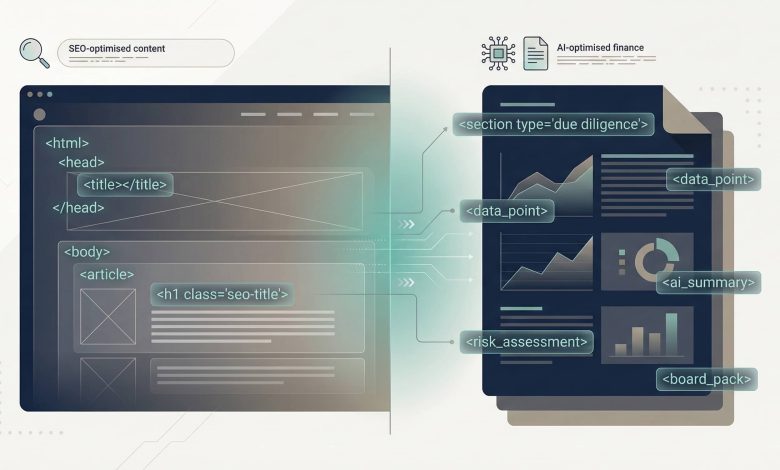
Twenty years ago, SEO changed how we produced web content. Businesses learned that a page could be perfectly readable to humans and completely invisible to search engines. The fix wasn’t better search engines. It was better-structured content.
Schema markup, semantic HTML, structured metadata. Producers made the meaning of their content explicit for the machines that would consume it.
Finance is at the same inflection point. I call it AI Engine Optimisation: preparing financial documents and data for AI consumption, the same way SEO prepared web content for search engines.
The workbook that costs more than the analysis
In a recent due diligence engagement, the target company’s adjusted EBITDA bridge was an Excel workbook. Colour-coded rows, cross-tab references, neatly formatted summaries. A human reviewer could follow it in minutes.
The AI agent couldn’t reliably extract the normalisation adjustments. Not because the data was inaccessible. Because the reasoning chain connecting revenue through to adjusted earnings was implicit.
Hardcoded adjustments sat in cells with no audit trail. Colour-coded rows signalled meaning to a human reviewer – green for confirmed, amber for estimated – but conveyed nothing to an AI agent. Cross-tab references made sense if you understood the workbook’s architecture, but an AI navigating blind had to guess.
For a human, the logic was carried in context. For an AI, it was invisible.
I spent more time explaining the workbook’s logic to the AI than the AI spent analysing it. That ratio is the problem in miniature. The preparation overhead exceeded the analytical value, not because the AI was weak, but because the workbook was built for someone who already understood the business.
This pattern repeats across every engagement. Board packs in PDF, management accounts in Excel, quality of earnings workbooks with dozens of interconnected tabs. Each one is designed for a reviewer who carries context in their head. Each one forces an AI agent to guess at meaning a human would already know.
Not bad data. Implicit logic.
The assumption across most of these engagements is the same: the data is bad. That framing is wrong, and it leads to the wrong solution.
The data isn’t bad. The logic behind it is IMPLICIT.
The numbers sit in cells and formulas exactly where they should be. What’s missing is the reasoning chain: why each adjustment exists, what source supports it, what judgement call produced that figure.
That reasoning lives somewhere else entirely. In emails, Teams messages, project notes, the analyst’s memory. It was generated in real time by humans doing their jobs. It was just never captured in a form that machines can follow.
Gartner estimates that 80% of enterprise data is unstructured. In finance, the proportion may be higher, because the most commercially sensitive reasoning never makes it into a system at all.
That distinction changes everything. A bad-data problem demands a multi-year cleansing programme. An implicit-logic problem demands tools that make the reasoning chain explicit.
One costs millions and takes years. The other costs thousands and takes weeks.
The same principle extends beyond spreadsheets. PDFs lock data behind formatting overhead. Signed reports prioritise archival integrity over analytical access.
Each one assumes the reader already knows the business. That assumption held for decades. It breaks the moment the reader is a machine.
Three layers that make finance AI-ready
Any solution needs to work at three levels. Not because frameworks are elegant, but because solving only one creates a different bottleneck at the next.
The first layer is making logic explicit. The workbook stays as the working file. The PDF stays as the archival copy. What we add is a structured companion that captures the reasoning chain.
In practice, this looks like structured text files that sit alongside the original in the data room or reporting pack. A file that shows how revenue flows through adjustments to arrive at adjusted EBITDA, with each step traceable to its source. The CFO can still read it. An AI agent can navigate it without guessing at colour conventions or tab structures.
The second layer is a shared vocabulary. Every company defines “revenue” slightly differently: recurring versus non-recurring recognition, treatment of implementation fees, handling of multi-year contracts. When an AI agent encounters financial data across multiple companies, those definitional differences create noise that obscures the signal.
This layer establishes consistent definitions across the reporting chain. Not a rigid taxonomy imposed from above, but a mapping that connects each company’s internal language to a common framework. Five metrics, consistently defined, structured at source. That’s the foundation for portfolio-level intelligence.
The alignment itself isn’t purely technical. Definitional debates around revenue recognition or cost allocation can be fiercely territorial. The trick is starting with five metrics, not fifty, and letting the investor’s reporting requirements set the standard rather than relitigating every edge case.
Once the vocabulary is aligned, an AI agent can reason across companies without being tripped by definitional inconsistencies.
The third layer is repeatable tooling. The first engagement always takes effort: structuring documents, aligning definitions, building the extraction pipeline. The question is whether the second engagement takes the same effort or a fraction of it.
Reusable analytical routines that transfer across companies are what separate a one-off experiment from an operating capability. If the logic for parsing an EBITDA bridge works on Company A, it should work on Company B with minimal adaptation. The investment in structure compounds rather than resets.
Beyond finance: the legal parallel
This isn’t just a finance problem. Consider a facility agreement. Answering “what triggers an event of default if leverage exceeds 4.5x?” currently requires a solicitor to read 80 pages, cross-reference three schedules, and deliver a memo.
That’s a high-cost answer to what is fundamentally an extraction question.
If the contract existed in a machine-readable format alongside its signed archival copy, an AI agent could answer that question in seconds. Traced to the specific clause, cross-referenced against any amendments. The structural principle is the same: maintain the original for legal integrity, produce a structured companion for analytical consumption.
The opportunity extends to any domain where professionals spend expensive hours extracting information that already exists in documents not designed to give it up easily. Legal, compliance, procurement. The pattern is identical. The solution is the same.
Pick one cycle and prove it works
The firms getting this right aren’t waiting for a perfect solution. They’re starting pragmatically.
Pick one reporting cycle. Structure the board pack and supporting workbooks for AI consumption. Measure what changes in speed, accuracy, and traceability.
Align definitions with the investor or parent company across a small number of metrics. Test with a real scenario: take last quarter’s reporting pack, run an AI agent against the structured version alongside the original, and compare the results.
The first cycle takes effort. The second is faster. By the third, it’s part of the workflow.
In deal contexts, this has a direct commercial implication. McKinsey’s 2026 M&A survey found that the majority of AI-adopting deal teams already use it in due diligence. The question isn’t whether buyers will use AI. It’s whether your documents are ready for it.
A finance function that produces AI-ready reporting isn’t just operationally efficient. It sends a signal: this business has governed data, traceable logic, and the infrastructure to scale without adding headcount proportionally. For investors evaluating a target, that’s an equity story enhancer visible within a single hold period.
The technology will keep improving whether we act or not. Models will get faster. Costs will drop. The only variable under our control is whether we’re ready to turn that capability into different decisions, different workflows, and different expectations of what finance teams can deliver.
The companies that win won’t be the ones with the best tools. They’ll be the ones that changed how they structured their information before they were forced to.