In 2025, sales teams face razor-thin margins, with Gartner reporting that AI adoption in revenue ops can boost productivity by up to 15% [Source: Gartner Sales Tech Report 2025]. Yet, manual call reviews remain a bottleneck, consuming hours without scalable insights. Enter AI-driven analysis: tools that transcribe, score, and predict outcomes from calls, turning raw audio into actionable intelligence. As a SaaS sales leader, I’ve seen firsthand how integrating machine learning (ML) and large language models (LLMs) transforms pipelines. This guide outlines best practices, drawing from real-world deployments.
The Case for AI in Sales Call Analysis
Traditional call reviews rely on subjective notes, missing nuances like tone shifts or objection patterns. AI addresses this by processing vast data: natural language processing (NLP) via LLMs like GPT variants identifies sentiment, while propensity modeling forecasts deal progression.
For instance, Forrester notes that teams using AI analytics close 20% more deals by spotting “at-risk” conversations early [Source: Forrester AI in Sales 2025]. Benefits include:
- Scalability: Analyze 100+ calls/week vs. 10 manually.
- Objectivity: Data-driven scores over gut feel.
- Integration: Seamlessly with CRMs like Salesforce for real-time alerts.
Key ML Techniques Powering Analysis
At its core, sales call AI leverages:
- Sentiment Analysis: ML models (e.g., BERT-based) classify emotions—positive for rapport, negative for objections. Tools train on datasets like Common Voice for accuracy.
- Topic Extraction: LLMs summarize key themes, e.g., pricing discussions.
- Propensity Modeling: Predictive algorithms (e.g., logistic regression) score win probability based on historical data, factoring variables like call length (optimal: 45-60 mins per HubSpot benchmarks).
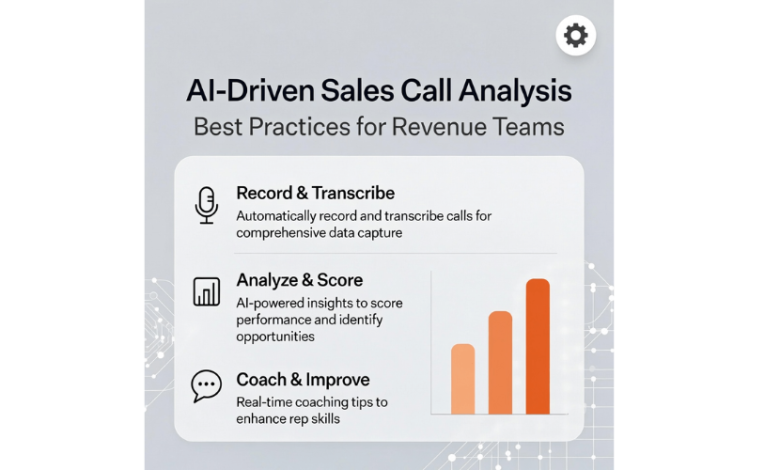
In practice, combine these: An LLM transcribes, ML scores, and visualization dashboards (e.g., via Tableau) highlight trends.
Step-by-Step Implementation Guide
To deploy effectively:
- Data Preparation: Gather call recordings from tools like Zoom or Gong. Ensure compliance (GDPR/CCPA) with anonymization. Use Python libraries like PyDub for preprocessing.
- Tool Selection: Opt for specialized platforms. For example, solutions like RepEdge.ai automate transcription and scoring, integrating with Salesforce for seamless workflows. Evaluate based on accuracy (aim for 95%+ transcription) and cost (ROI: $5K/month saved in review time).
- Model Training: Start with pre-trained LLMs, fine-tune on your data (e.g., 500 labeled calls). Use propensity models to predict: If objection handling scores low, flag for coaching.
- Integration & Testing: Link to CRM via APIs. Pilot on 20 calls; measure metrics like close rate lift.
- Scaling & Monitoring: Roll out team-wide; use A/B tests to refine (e.g., AI vs. manual reviews).
Actionable Tip: Begin with one team—e.g., AEs handling mid-market deals—to iterate fast.
Real-World Case Study
Consider a mid-sized SaaS firm (anonymous for privacy): Pre-AI, call reviews took 4 hours/week per rep, yielding inconsistent feedback. Post-implementation:
- AI flagged 30% more objections.
- Propensity scores predicted 85% of lost deals.
- Result: 22% close rate increase, adding $1.2M annual revenue.
Key: Focused on actionable insights, not just data dumps.
Best Practices and Common Pitfalls
- Prioritize Privacy: Anonymize data; audit for bias (e.g., ML models skewing on accents).
- Combine Human + AI: Use AI for triage, humans for nuance.
- Measure ROI: Track metrics like time saved (Forrester: 40% reduction) and revenue lift.
- Avoid: Over-reliance on black-box models; always validate with sources.
Pitfall: Ignoring ethics—transparency builds trust, even if it slows rollout.
The Future: AI as Sales Co-Pilot
By 2027, McKinsey predicts 45% of sales tasks automated [Source: McKinsey AI Report 2025]. For revenue teams, this means evolving from reactive reviews to predictive coaching. Start today: Assess your calls, pick a tool, and scale.
Through thoughtful AI integration, sales edges sharpen—driving financial freedom via optimized performance.