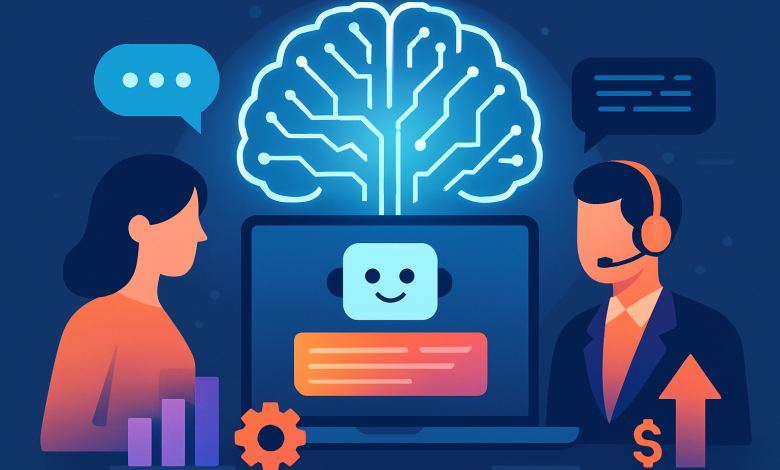
Introduction: Customer Experience Is Entering Its Most Transformative Era
Customer experience has evolved dramatically in just a few years. What once depended on slow help centers, unclear scripted flows, and repetitive support tasks is now being reshaped by intelligent automation. Over the past two years, AIб especially Large Language Models (LLMs) has shifted from experimental to essential, becoming a core operational layer in modern customer-facing functions.
Generative AI not only improves how companies resolve customer issues, but fundamentally transforms how they retain users, escalate the problems, and drive revenue. According to McKinsey, generative AI can increase customer satisfaction by up to 20%, reduce support costs by 40%, and improve agent productivity by 30–45% (McKinsey).
Observing global organizations across the U.S., Europe, and Asia, it becomes clear that companies adopting AI-based CX strategies adapt faster, improve outcomes for users, and outperform competitors who rely on traditional support models.
From Basic Chatbots to Intelligent CX Infrastructure
Many executives still evaluate automation based on legacy chatbots – systems that frequently misunderstood customers and offered minimal problem-solving capabilities, repeating their answers many times and do not solving the problems. Today’s LLM-powered assistants represent the opposite approach: they can interpret intent, analyze sentiment, understand nuance, and provide guided multi-step reasoning, having the warm conversation with the customers.
These systems now integrate with CRMs, transaction histories, and internal operational policies, allowing them to resolve problems previously requiring trained human agents.
Gartner predicts that by 2027, chatbots will become the primary customer service channel for one in four organizations (Gartner Predicts Chatbots Will Become a Primary Customer Service Channel Within Five Years — published July 27, 2022).
Industry Observations
Let’s consider fintech and consumer-tech implementations, LLM-based assistants have handled tasks such as: card activation, fraud communication, onboarding education, transaction explanations, feature guidance. And across these deployments, results have been consistent:
- 40% faster resolution time
- 39% higher CSAT
- 27% lower agent workload
These outcomes reflect a broader trend: AI absorbs operational volume, allowing CX teams to shift from reactive problem-solving to proactive strategic improvement.
AI Isn’t Just a Cost-Saver — It Has Become a Revenue Driver
While initial interest in AI often centers on cost reduction, the most significant business impact appears in revenue and retention metrics.
- Faster support reduces customer churn
Speed remains one of the strongest predictors of loyalty. Zendesk reports that 73% of customers will switch to a competitor after multiple negative experiences (Zendesk). LLMs remove waiting entirely, reducing abandonment and improving lifetime value.
- AI identifies real-time upsell opportunities
LLMs can detect customer signals indicating purchasing intent:
- Asking about limits means interest in premium plans
- Asking about delivery speed reflects upsell to express shipping
- Exploring loyalty means upgrade opportunities
When personalization happens during support interactions, conversion rates are evenhigher.
- Predictive AI prevents churn before it occurs
LLMs can analyze interaction patterns, sentiment, declining engagement, or recurring issues to predict churn.
In multiple international deployments, predictive models have identified high-risk users with accuracy rates above 80%, enabling proactive retention strategies.
Organizations achieving the strongest results in customer service typically follow a layered operational structure. The first layer, Automated Resolution, handles 50–70% of total volume. At this stage, AI fully manages tasks such as billing, refunds, account access, delivery updates, onboarding, and routine troubleshooting. According to PwC, AI can reduce service costs by up to 40%, making this the most cost-efficient operational layer(pwc.com).
The second layer, AI-Assisted Agents, covers roughly 20–30% of interactions. Here, AI enhances human performance by summarizing conversations, suggesting compliant answers, providing recommended actions, pulling customer data, and drafting responses. This dramatically reduces handling time while increasing accuracy and consistency across the team.
Finally, the top layer, Human Expertise, accounts for 10–20% of the volume and is reserved for high-impact, sensitive, or complex cases. Experienced professionals handle these interactions while relying on AI for context, sentiment insights, decision support, and the analysis of historical patterns.
Together, this structure ensures speed, accuracy, and empathy — the core components of modern, AI-driven customer experience.
What Companies Are Achieving Today
Industry benchmarks reveal consistent and measurable improvements driven by AI adoption.
Organizations report 25–40% cost reduction, 30–60% faster resolution, and 15–30% highercustomer satisfaction. AI-driven recommendations contribute to 10–20% revenue growth, while automated systems now resolve 80–90% of Tier 1 issues with no humaninvolvement.
Looking Ahead: CX Will Become an AI-First Function
AI will be involved in most service interactions, and static knowledge bases will be replaced by adaptive, real-time intelligence systems.
Support organizations will evolve from:
- reaction → prediction
- manual workflows → automation
- static documentation → dynamic knowledge
- problem-solving → customer value creation
AI will not replace customer experience teams—it will elevate them, freeing human talent for strategic and relationship-driven work.
Conclusion: AI Is Becoming the Core of Modern Customer Experience
AI in customer experience is no longer an experimental capability. It is becoming the foundational operating model for companies that want to deliver speed, personalization, and proactive service at scale.
LLMs enable businesses to:
- resolve issues instantly
- anticipate customer needs
- personalize interactions
- balance operational efficiency with empathy
Organizations that embrace AI today will define the future of customer loyalty, retention, and long-term value. Those that hesitate will soon compete with companies delivering results in seconds – not hours.
For CX leaders, the message is clear:
AI is not replacing the customer journey—AI is elevating it.