The next battleground in commerce will not be attention. It will be whether intelligent systems can understand, trust, and select your brand.
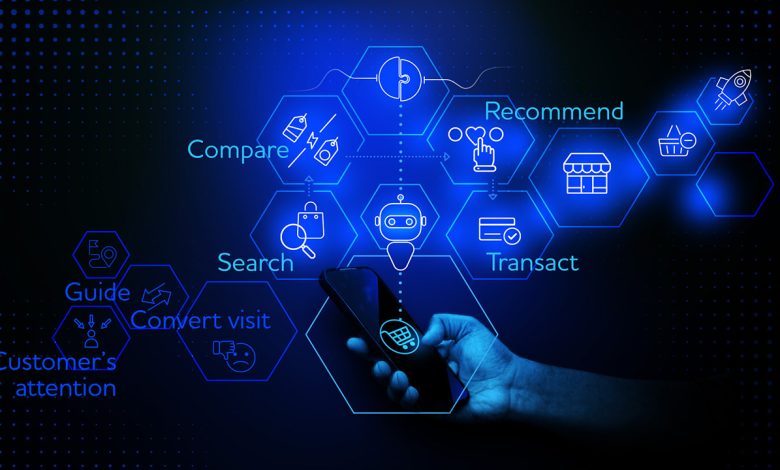
For two decades, digital commerce has been organized around a simple assumption: win the customer’s attention, guide the journey, and convert the visit. That assumption is starting to break.
AI agents are beginning to search, compare, recommend, and transact on behalf of consumers. As they do, the relationship between brand and buyer is becoming less direct—and less controllable. McKinsey has estimated that by 2030, agentic commerce could account for up to $1 trillion in orchestrated U.S. B2C retail revenue, with global projections reaching $3 trillion to $5 trillion. If those estimates are even directionally right, this is not another channel shift. It is a redistribution of influence.
The signals are already pointing in that direction. Adobe reported that traffic from generative AI sources to U.S. retail sites rose 4,700% year over year in July 2025, following a 1,300% increase during the 2024 holiday season. McKinsey’s research also points to agents moving beyond assistance into more active shopping roles: comparing options, assembling baskets, weighing tradeoffs, and moving consumers closer to purchase.
The important point is not the traffic spike itself. It is the decision-making layer emerging between the customer and the brand.
A new decision layer
For brands, the implication is blunt. If an agent cannot verify your product, compare your offer, confirm availability and delivery windows, evaluate returns, or complete the transaction with confidence, you may never make the shortlist. In an agent-led journey, visibility is only the starting point. Machine readability, trust, and execution become the foundation of machine confidence.
The obvious concern is that brands will lose website traffic. The more serious concern is that they will lose influence over how demand is formed. Discovery, comparison, ranking, recommendation, and selection are shifting into environments brands do not own. That changes the job of marketing. It changes the role of commerce platforms. It also exposes the limits of metrics designed for a world where the customer clicked before the machine decided.
That is how growth leakage begins: weaker insight, less differentiation, muddier attribution, more margin pressure, and less influence at the precise moment a recommendation is made.
The next advantage will come from being chosen earlier in the journey, before a shopper ever arrives. The winners will be brands that reduce friction for both humans and the agents acting on their behalf.
Machine confidence
Agentic commerce requires a new kind of brand strength. Human brand equity is not going away. People will still care about reputation, emotion, experience, service, and values. But a second form of equity is emerging beside it: machine confidence. If an intelligent system cannot interpret the brand clearly enough to recommend it, the promise may never reach the customer.
That is why precision marketing will need to evolve. Adobe’s 2026 AI and Digital Trends research indicates that 25% of customers now use AI platforms such as ChatGPT as a top research tool, making AI interfaces a meaningful new starting point in the customer journey. As more intent moves upstream, brands may know less about who is deciding, why they are deciding now, and what influenced the final recommendation.
Proof beats promise
Human shoppers explore. Agents optimize. They look for structured information, clear choices, comparability, speed, certainty, and execution reliability. They assess availability, price, delivery windows, reviews, return terms, warranties, loyalty benefits, and risk. Then they narrow the field to the option most likely to satisfy the customer’s intent.
As a result, product content, APIs, inventory accuracy, delivery commitments, returns, compliance signals, and reputation data are no longer back-office details. They are part of the new demand interface.
In this environment, trust becomes operational. An agent will favor the brand that creates the least uncertainty: current pricing, clear delivery and return terms, secure transactions, verifiable claims, and accountability when something goes wrong.
The trust challenge is no longer only what a brand says. It is what the enterprise can prove and execute at the moment of decision.
That requires clearer governance for agent-led commerce: agent identity, customer control, transparent recommendations, secure data use, and accountability for disputes, returns, misrepresentation, and compliance.
The readiness agenda
Agentic commerce should not be funded as a marketing experiment. It cuts across growth, technology, data, risk, legal, operations, and customer experience. The mistake would be to treat it as a future-state technology issue. It is already becoming a commercial design issue.
The investment agenda should be straightforward: make the business discoverable, trustworthy, and executable in agent-led journeys. That starts with the digital backbone: real-time data, clean product information, resilient APIs, consented first-party signals, secure identity, analytics, governance, policy controls, and teams that can continuously improve agent readiness.
Search visibility is expanding beyond rankings and links into answer visibility, structured product feeds, authoritative content, review signals, and AI-ready merchandising. Brands need to show up where recommendations are formed, not only where clicks are counted.
The leadership test
Agentic commerce is becoming a leadership test because it asks a direct question: can the enterprise build the same level of machine confidence that it has spent decades building with people?
Agent readiness will become as important to commerce strategy as mobile readiness was a decade ago. The companies that treat it as a technical side project will move too slowly. The companies that treat it as an enterprise discipline will build a durable edge.
The next era of commerce will still reward great brands. But it will punish brands that cannot be interpreted, verified, or executed by intelligent systems. Attention will still matter. Confidence will matter more.
Source note: Market estimates and consumer data referenced in this article are based on publicly available McKinsey research on agentic commerce and Adobe Digital Insights / Adobe AI and Digital Trends research. Final publication should confirm the preferred citation format and source dates with the publishing team.