The journey to becoming an experienced software developer has traditionally involved a lot of manual, labour-intensive coding plus trial and error. But ultimately, finding faults, troubleshooting, and working toward a resolution is how developers have learned their trade. It’s slow, but it’s steady.
But software development is changing dramatically, with AI now seeming capable of autonomously writing code that would have traditionally been produced by developers.
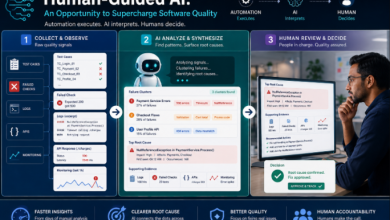
With AI agents operating autonomously, there is potential for knock-on effects across the future talent pipeline. Currently, these AI agents are often claimed to perform at the level of junior developers or above. However, depending on their permission settings, they are often still mandated to seek permission from the user in order to perform certain actions, or when several meaningful options on how to proceed exist. Today, the role of developers is shifting away from writing code line-by-line and instead focusing on creating test harnesses, making core architecture decisions, and governing AI workflows.
New responsibilities and new productivity gains
In the past, we’ve seen a surge in AI adoption through tools like GitHub Copilot and Cursor, where developers have worked alongside AI, generating individual functions or components on request. Today, agents are increasingly matching the capabilities of human developers. Increasingly, they have the ability to assess the status quo, plan, execute loops, and validate their own outputs – a paradigm loosely referred to as ‘agentic development’.
GitHub’s landmark study of 4,800 developers found that those using AI coding agents completed tasks 55% faster, with overall productivity gains being around 3-8%. Agentic development acts as a significant multiplier, effectively enabling a single developer to deliver the output of three or four developers. Where AI is operating with a high degree of independence, appearing to write and shape code, the rise in adoption of agentic systems is expected to redefine the responsibilities of developers entirely.
Developers are likely to become less focused on manually writing code. Instead, their roles will increasingly centre around oversight, strategy, and quality control. Although AI can automate repetitive tasks like testing, debugging, and code generation, humans will still need to remain accountable for the final outcomes. That means prompt guidance, validation, the creation of test harnesses against which the AI agent will develop, and architectural decisions will remain central to the developer role.
Agentic development: implications for junior talent
However, the widespread adoption of agentic coding also raises concerns about its impact on junior developers’ core skills and learning. It’s customary for them to work through routine coding tasks that spark critical thinking and sharpen problem-solving abilities, a method to accelerate the development of coding expertise by building strong foundational skills. Yet, organizations estimate that roughly 31% of developer time is now consumed by invisible work, which typically involves reviewing AI-generated code, fixing bugs, and switching between disparate tools.
Learning to work alongside AI, with developing the skills needed to guide and validate agentic coding, will be key to training the next generation of developers. Not one or the other, otherwise junior developers may find themselves ill-equipped to succeed in the future of software engineering.
It’s not a bad thing for AI to be used in coding. But, as it stands, junior developers risk being left behind if programming curricula continue to neglect AI and agentic coding tools. It’s important for educators and employers to recognise the implications that could have for the future talent pool if developers are not adequately prepared for an AI future.
This risk creates a skills gap, where only experienced developers are properly equipped to work with AI. While this concern is less significant for more experienced coders, it does not leave them immune to the impact of a shortage of skilled junior developers. As entry-level roles shift toward supervising AI outputs, senior developers will need the freedom to execute more complex, high-level coding decisions that AI cannot perform.
Preserving engineering culture
According to SecondTalent statistics, AI platforms like GitHub Copilot, Claude Code, and other AI code generators are now seen as trusted partners over optional helpers, with 82% of developers using AI coding assistants on a daily or weekly basis. There’s no hiding from it; these tools have become part of developer productivity routines.
In reality, these tools have delivered a complete 180 in how developers work. Junior developers, especially, were often bogged down by repetitive or admin tasks like documentation, testing and scripting. Instead, agentic AI is now working to help speed up workflows, going beyond augmentation to actively write code and automating development tasks.
However, certain factors should be considered. The rate at which agentic AI is accelerating coding cycles has implications for the preservation of engineering culture. With the potential for junior developers to become too heavily reliant on AI coding. Introducing new risks related to code quality and security vulnerabilities. It’s about striking the right balance between enhancing learning rather than attempting to replace developers entirely.
Fundamentally, junior developers should have a deep technical understanding, so they are better prepared for a more review-oriented workforce. At its core, they should understand key programming principles, enabling them to identify issues, assess code quality, and ensure security standards are met. Embedding these skills early will equip them for an industry increasingly shifting towards technical oversight over manually writing code.
Looking further ahead, it’s likely that AI tools will become more integrated into everyday developer workflows. Seeing tools like Claude, Qwen Code, and GitHub Copilot gain more autonomy, with potentially more human oversight and less intervention.
This will change how developers remain in control. Rather than carrying out every task directly, developers will be in charge behind the scenes, overseeing AI as it operates with increasing independence. Success will depend on integrating AI without jeopardising the engineering process.
So, rather than ‘automate to replace’, the winners will be those who automate thoughtfully and preserve deep engineering culture. Teams should be supported to focus on complex architectural tasks, while agentic AI handles the rest. Instead of replacing developers entirely, organizations need to evolve their practices for testing, governance, and accountability, especially as agentic development reshapes the future of their role.