The next leap in automated machine learning will not come from letting agents make every decision. It will come from giving them clear authority, visible boundaries, and a reliable way to hand control back to people.
Imagine an AutoML agent working through the night. It studies the data, selects a model family, changes the optimisation objective, removes a constraint that slows training, and produces a polished explanation of the final result.
At 9am, the team sees a neat dashboard and a model that scores well. The dangerous decision happened hours earlier, when the system changed what success meant and nobody was asked.
This is where the current conversation about agentic AI feels incomplete. We spend a lot of time asking what agents can do. We spend much less time deciding what they are allowed to decide.
Autonomy changes the risk
Automated machine learning has already moved many choices away from manual trial and error. Agentic workflows go further by splitting the lifecycle across specialised components that can interpret a task, inspect data, propose architectures, tune models, generate explanations, and write reports.
That sounds like a straightforward upgrade. It is not. A conventional optimiser searches inside a space that someone defined. An agentic system can also reinterpret the task, alter the constraints, decide which evidence matters, and explain its own choices in language that sounds settled.
Fluency can hide uncertainty. A confident explanation can be mistaken for a reliable one. A clean compliance report can be mistaken for proof that the system complied with anything at all.
Governance that arrives after training arrives too late
Most AI governance still begins at the end. A team receives the final model, checks a dashboard, reads an explanation, and decides whether the result looks acceptable.
By then, the important choices may already be locked in. The system may have optimised the wrong metric, selected an unsuitable architecture, applied an aggressive imbalance strategy, or dropped a constraint that mattered to the original use case.
Reviewing only the final output is like approving a route after the vehicle has already arrived. You can inspect where it ended up, but you may not know why it took a particular turn or what was discarded along the way.
In an agentic workflow, governance has to shape execution. It cannot simply comment on the result.
The stop points that actually matter
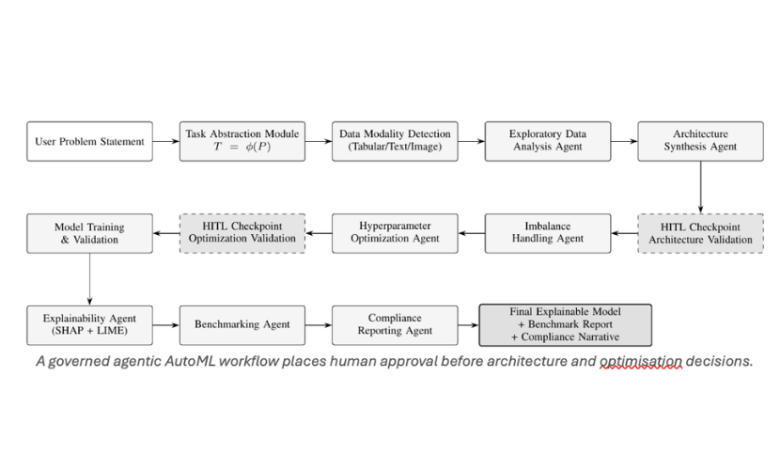
In our recent preprint, we explored a graph orchestrated AutoML framework with human approval placed before critical architecture and optimisation decisions. The workflow separates the lifecycle into agents for task abstraction, exploratory analysis, architecture synthesis, imbalance handling, optimisation, explainability, benchmarking, and compliance reporting.
The most important design choice is not how many agents exist. It is where the system loses the authority to continue alone.
The first checkpoint appears after an architecture has been proposed but before the workflow commits to optimisation and training. A human can approve the design, modify it, or send it back. A second checkpoint appears before final training, when objectives, search limits, and training constraints can still be changed.
This creates bounded autonomy. Routine work can move quickly. Consequential transitions require explicit human authority.
An approval button can be theatre
A checkpoint that only offers an Approve button is not governance. It is theatre.
A meaningful checkpoint has to expose the proposed decision, the alternatives considered, the assumptions being made, the uncertainty around them, and the likely downstream consequences. The reviewer must have enough information to disagree for a reason.
They should also be able to change something real. That may mean changing the architecture, the objective metric, the search budget, the training parameters, or the data handling strategy.
The system should then preserve that intervention so every later agent can see what changed and why. Otherwise the human decision becomes a note in a log while the workflow quietly continues as before.
The audit trail should remember disagreement
Agent workflows often fail quietly because each component sees only the output of the previous one. A shared orchestration state can carry the task definition, dataset observations, architecture proposal, optimisation choices, explanations, benchmark results, and human interventions through the entire lifecycle.
That state should remember more than the final answer. It should preserve what was proposed, what was rejected, who changed it, and which later stages used the modified decision.
This creates a decision history rather than a generic activity log. When a model behaves unexpectedly, a team can inspect the actual chain of judgement that produced it.
That matters for internal review, customer trust, and regulation. It also matters for something more ordinary: debugging. A system is much easier to fix when disagreement has not been erased.
Explainability is evidence, not permission
Explainability is often treated as a final reporting feature. Techniques such as SHAP and LIME can reveal global feature influence or explain an individual prediction, but they do not automatically prove that a model is correct, fair, or safe.
In a governed workflow, explanation artefacts should travel with the model and with the decisions that produced it. A reviewer should be able to see whether the behaviour matches the approved objective, whether important features make sense in context, and whether local explanations reveal unstable cases.
The explanation becomes part of an evidence trail. It supports judgement. It does not replace it.
Not every decision needs a committee
Human oversight has a real cost. Checkpoints slow the workflow, create queues, require qualified reviewers, and can become performative when teams approve everything under delivery pressure.
The answer is not to add a person to every step. The boundary should depend on consequence, uncertainty, reversibility, and the authority being delegated.
A low risk internal experiment may justify broad autonomy. A system that affects healthcare, finance, employment, or public services should operate inside much narrower limits.
There is also a risk of automation bias. A reviewer may trust a polished agent recommendation more than a rough human alternative, even when the agent rests on weaker assumptions. Good checkpoint design makes disagreement easy and asks the system to show evidence rather than confidence.
Four blunt questions before deployment
A team does not need a huge governance programme to start. It can begin with four blunt questions.
Which decisions are difficult to reverse once the workflow continues? What evidence must be visible before someone can approve that transition? Who is actually qualified to make the call? How will an approval, modification, or rejection be recorded so later agents cannot ignore it?
Those questions turn human oversight from a slogan into an operating contract. They also force teams to admit where responsibility sits before something goes wrong.
What our early work does and does not prove
Our preprint evaluates the framework across tabular, text, and image classification tasks and compares it with established AutoML baselines. The results should be read as an early systems study, not as proof that one orchestration design is universally superior.
The more interesting result is architectural. Explainability, human intervention, benchmarking, and compliance reporting can be native parts of the workflow rather than features added after training.
The cost is visible too. Governance introduces latency, coordination overhead, and dependence on the quality of human review. Future work needs to measure when that cost changes the quality, accountability, or reversibility of a decision enough to justify itself.
The best agent may be the one that pauses
The goal is not less automation. It is more useful automation inside explicit authority.
A strong system should handle routine analysis, search, training, explanation generation, and reporting without constant supervision. It should also recognise when a decision has become too consequential, too uncertain, or too difficult to reverse.
Agentic AutoML will become more capable. The systems that deserve trust will not be the ones that never interrupt us. They will be the ones that understand exactly when continuing would be the wrong thing to do.