For decades, recycling has been framed as a steady march of incremental improvement: faster conveyors, better sensors, higher throughput. That story is changing. In through 2026, recycling is undergoing a far more profound shift – one driven by artificial intelligence, deep learning, and digital transparency. This isn’t a nice-to-have evolution. It’s an existential one.
Across Europe, recycling capacity is shrinking at the very moment expectations are rising. Plastics Recyclers Europe estimates that by the end of 2025, the region will have lost nearly one million tonnes of recycling capacity compared to 2023. At the same time, regulators are demanding higher recycled content, brand owners are pushing for food-grade quality, and margins are tightening across the value chain.
In this environment, the industry needs smarter plants. And that intelligence increasingly comes from AI.
Recycling’s quiet AI history
AI is not new to recycling. Long before “artificial intelligence” became a buzzword, sorting machines were already making automated decisions. TOMRA’s first AUTOSORT™ systems, introduced more than 30 years ago, used logic-based rules to replicate human sorting at industrial scale for the first applications. That combination of sensors and deterministic intelligence powered the modern recycling industry for decades.
What has changed is not whether AI is used, but how deeply it is embedded. Today’s breakthrough is deep learning: systems that don’t just follow predefined rules, but learn from complex patterns, adapt to variability, and improve continuously with expert training.
By adding this layer of understanding, the process moves beyond simple detection toward true interpretation, unlocking new levels of accuracy, adaptability, and performance.
From “good enough” to food-grade precision
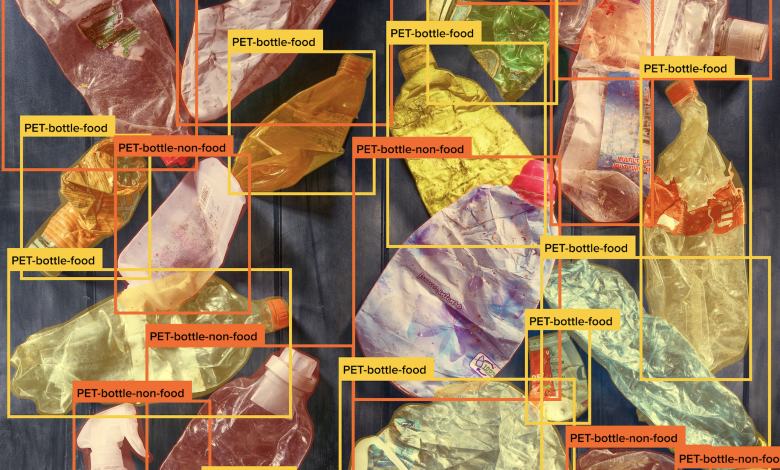
Historically, some sorting challenges were considered economically or technically unrealistic. Differentiating between food grade and non food grade plastics is a prime example. Distinguishing subtle differences in packaging design at high speed was simply too difficult at scale. Deep learning has changed that calculus.
The latest deep learning models can see what a human eye can see. They recognize shape, size and dimensions of materials – capabilities that go beyond traditional sorting methods like near-infrared (NIR), visible light (VIS) and X-ray transmission (XRT) technologies that sort by material composition, color or density. Deep learning systems can now identify nuanced visual cues in packaging design that distinguish food grade from non food grade plastics with industrial reliability. In metals recycling, deep learning also enables exceptionally high purity levels when upgrading wrought aluminum scrap, to name just a few examples.
This level of precision isn’t about perfectionism – it’s about circularity. Closed loop recycling depends on purity. If materials are contaminated, they are downcycled or discarded. If they are clean and of high quality, they stay in circulation, preserving both environmental and economic value.
Deep learning-powered sorting now reaches historically high purity levels, enabling new material streams, higher-value outputs, and recycling applications that simply weren’t viable before.
Regulation accelerating adoption
Technology shifts often happen gradually. Regulation is making this one unavoidable.
The EU’s Packaging and Packaging Waste Regulation (PPWR) sets ambitious recycled content targets, aiming for 65% recycled content in plastic packaging by 2040. Meanwhile, the Plastic Recycling Regulation (EU 2022/1616) introduces strict requirements for food contact materials, including the need for mechanically recycled PET to contain more than 95% material from previous food-contact applications.
Meeting these thresholds consistently and achieving compliance at scale is beyond the reach of conventional sorting alone. In other words, AI in recycling is a regulatory enabler.
What AI looks like on the sorting line
At TOMRA, this evolution is embodied in GAINnext™, a deep learning-based sorting technology launched in 2019, designed for the most complex material challenges. This technology supports operators, automating manual sorting processes while improving consistency and resilience in highly variable waste streams.
Since its launch, the GAINnext™ ecosystem has been gradually expanded, adding more and more applications across plastics, paper, wood, and metal streams. Since 2024, GAINnext™ has been deployed for food-grade PET, HDPE, and PP, achieving over 95% purity without manual intervention and meeting EU food-contact requirements.
One example illustrates the impact. In the UK, Amcor Circular Polymers turns everyday household plastic waste into new packaging using its proprietary CleanStream® technology. A key challenge was ensuring that only food‑grade items made it into the final mix – something traditional sorting struggled to guarantee with the consistency needed for safety standards. By adding GAINnext™ to one of its existing AUTOSORT™ units, the company introduced an extra layer of intelligence that reliably filters out non‑food plastics. The upgrade now delivers a stream that is at least 95% suitable for food‑contact packaging, helping Amcor secure an important U.S. FDA safety approval and paving the way for similar recognition in Europe and the UK.
This is what AI looks like when it moves from promise to production.
Beyond the belt: AI as the nervous system of recycling
Sorting is only part of the story. As extended producer responsibility schemes expand and digital waste tracking becomes mandatory, data transparency is becoming just as important as physical separation.
AI-powered waste analytics are emerging as the nervous system of modern recycling operations, connecting material flows, performance metrics, and compliance reporting into a single, actionable view.
TOMRA’s AI waste analytics platform, powered by PolyPerception, transforms waste data into real-time intelligence. It allows operators to benchmark performance, identify inefficiencies, and provide verifiable reporting to regulators and customers.
In Turkey, Doğa PET uses PolyPerception Analyzer to certify the food grade quality of its output. By monitoring material composition in real time, the system verifies that less than 5% of the input material for washing consists of non-food grade PET, delivering batch level compliance data that can be audited and trusted.
In a regulatory environment built on proof, not promises, this kind of transparency is fast becoming essential.
AI as the cornerstone of circular recycling
AI, particularly deep learning, has become a cornerstone of modern circular recycling – not as a replacement for proven sensor technologies, but as a force that expands beyond them offering totally new opportunities. It now underpins efficiency, quality, compliance, and ultimately, the credibility of recycled outputs.
As traditional systems continue to develop, deep learning solutions have the power to elevate their performance even more by enhancing interpretation, handling variability, and unlocking new material streams.
Recycling’s next chapter will not be defined by machines alone, but by intelligence that is embedded, adaptive, and transparent. For an industry under economic and regulatory pressure, that evolution isn’t just welcome. It’s overdue.