
Corporate technology is shifting from conversational experimentation to autonomous deployment. While early enterprise generative AI focused on productivity assistants and summarization, chief information officers and engineering leaders now confront a steeper architectural challenge: coordinating autonomous agents that query databases, trigger API workflows, and execute business operations without continuous human intervention. In this phase, technical success has pivoted from raw model benchmark scores to production governance, operational security, and enterprise data resilience.
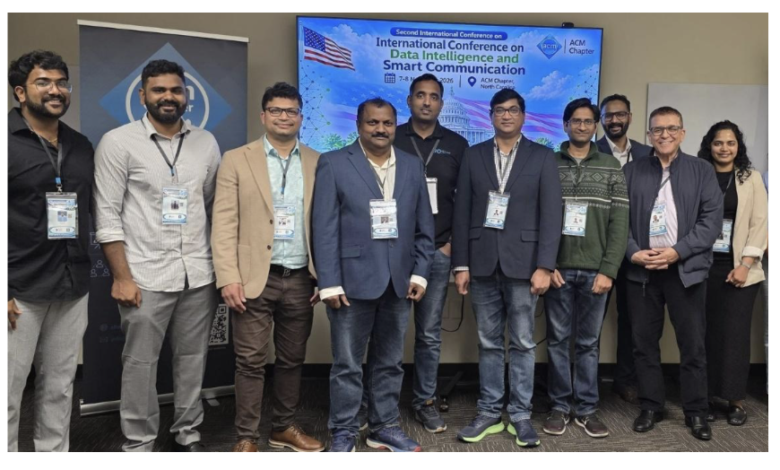
This structural shift framed the Second International Conference on Data Intelligence and Smart Communication (2nd IC-DAIS 2026), held in Charlotte, North Carolina, and virtually on November 7th & 8th, 2026. Convening researchers, technology executives, and systems architects under the technical sponsorship of the local ACM Chapter Charlotte, the conference emphasized secure communication protocols and intelligent data infrastructure. Through its TECHNOVA honors, the event named Kameshwar Singh, Director of Software Engineering at Cohesity, recipient of the AI Vanguard Award.
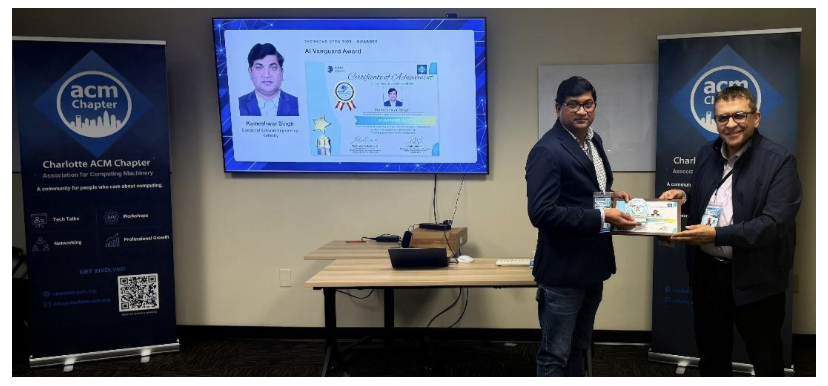
Singh’s AI Vanguard Award underscores where enterprise technology is heading beyond early pilots. As global organizations integrate autonomous agents into core workflows, engineering leaders who champion architectural governance, verifiable compliance, and enterprise resilience will serve as the true compass for durable digital transformation. His work sits at the intersection of business automation, cloud integration, and agentic frameworks, a perspective synthesized in his 2026 technical monograph, The Agentic Stack: Architecture, Coordination, and Governance of Autonomous AI.
In enterprise software, artificial intelligence cannot operate as an unconstrained black box. Deploying autonomous agents into corporate workflows introduces non-deterministic behavior, permission creep across integrated stacks, and compliance vulnerabilities. At data security and management leaders like Cohesity which organizations rely on to protect, secure, and extract insights from mission-critical multi-cloud data—integrating intelligent systems demands uncompromising guardrails, including orchestration patterns that enforce boundary conditions, auditability, and deterministic failure recovery.
Trading AI Hype for Verifiable ROI and Engineering Hygiene
Conferring the AI Vanguard Award reflects a broader reassessment of technical excellence in applied intelligence. Throughout 2026, technology boards and enterprise buyers have increasingly penalized proof-of-concept projects lacking verifiable return on investment, architectural durability, and regulatory compliance. An active Forbes Technology Council contributor and certified academic peer reviewer, Singh advocates pairing algorithmic innovation with mature software engineering hygiene and systemic oversight.
Establishing Immutable, Policy-Governed Pipelines Before Granting Autonomy
This focus aligned closely with IC-DAIS 2026’s core mission. Examining intelligent networks, secure multi-agent communication, and resilient data architectures, the Charlotte gathering addressed the bottlenecks preventing safe enterprise-wide deployment. Academic papers and invited panels converged on a shared insight: before granting autonomy to intelligent software, enterprises must establish trust in the underlying data layer, ensuring data pipelines are unified, immutably secured against cyber threats, and governed by fine-grained access policies.
Co-Designing Security and Coordination from System Inception
Engineering leaders bridging computer science and corporate risk management are redefining the CTO playbook. Rather than treating AI as an isolated software layer, they co-design security, data integrity, and autonomous coordination from system inception , a pragmatic discipline ensuring organizations adopting large language models and autonomous agents do not trade institutional reliability for short-lived operational speed.