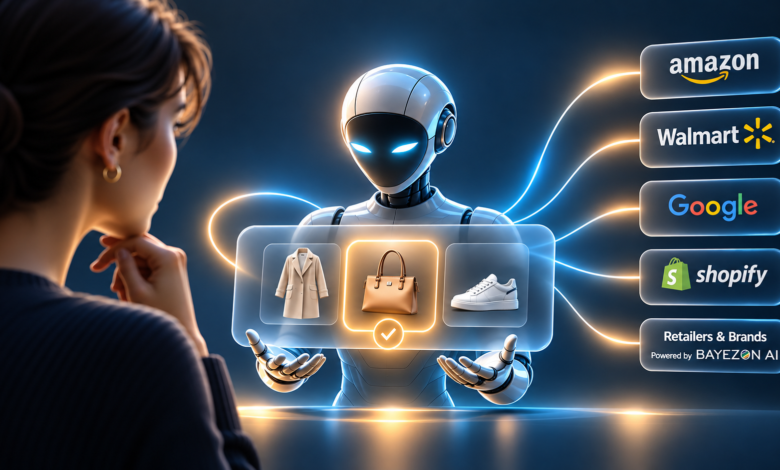
The retail industry is entering a new phase of digital transformation. Artificial intelligence is evolving beyond product recommendations and conversational search, with AI agents increasingly capable of researching products, comparing alternatives, checking availability and facilitating transactions on behalf of consumers. The implications extend beyond shopping convenience: they could fundamentally change how retailers connect with customers and how purchasing decisions are made.
Recent developments from some of the world’s largest retailers and technology companies illustrate the pace of this transformation. In October 2026, Walmart announced its Agent Gateway, designed to allow authorized external AI agents to interact directly with its commerce infrastructure. Google and Shopify are advancing shared technical standards, supported by retailers including Target, Etsy and Wayfair. Amazon, meanwhile, is expanding its own AI shopping capabilities into new channels, including SMS text messaging, while maintaining tighter controls over unauthorized external agents accessing its marketplace.
Together, these initiatives represent the emergence of Agent-to-Agent Commerce, an environment in which AI systems can communicate with other agents and commerce platforms to support product discovery, purchasing decisions and transactions. Although the technology remains at an early stage, the infrastructure taking shape suggests that the next evolution of ecommerce will not be confined to websites and applications designed exclusively for human shoppers.
A New Competitive Landscape: Walmart, Amazon and the Rise of Agentic Commerce
Walmart’s October 2026 Agent Gateway announcement marks an important development in the evolution of AI-driven retail. The initiative is designed to provide authorized external AI agents with a more direct and reliable way to interact with Walmart and Sam’s Club commerce systems, rather than navigating conventional websites. Alongside the gateway, Walmart introduced Agent Profiles, which will allow consumers to authorize specific agents, establish spending limits, manage permissions and distinguish agent purchases from their own transactions.
Walmart’s approach recognizes that consumers may increasingly begin their shopping journeys through AI assistants that retailers do not own. Rather than relying exclusively on its proprietary shopping experiences, Walmart is developing infrastructure that can accommodate authorized external agents while maintaining appropriate transaction controls and customer protections.
Amazon is pursuing a different, though equally significant, strategy. The company continues to expand Alexa for Shopping, including capabilities for product research, comparison, price monitoring and purchasing. In November 2026, Amazon introduced shopping through SMS text messages, allowing eligible customers to interact with Alexa without opening Amazon’s website or application. The service extends Amazon’s shopping experience into an everyday communication channel, enabling consumers to initiate product searches, manage shopping lists and facilitate purchases through a text conversation.
At the same time, Amazon has restricted unauthorized third-party shopping agents, including Meta’s Muse, from accessing its marketplace. The company has cited concerns involving authorization, security and transparency. While Walmart is developing pathways for external agents to interact with its systems, Amazon is placing greater emphasis on extending the reach of its own shopping assistant while controlling access to its marketplace.
These approaches reflect different priorities, but both acknowledge the same fundamental change: the consumer’s shopping journey is increasingly capable of beginning outside the retailer’s traditional storefront. Whether through a messaging conversation, an independent AI assistant or a retailer-owned shopping agent, product discovery and purchasing decisions are becoming less dependent on conventional website navigation.
For retailers, this introduces new opportunities to capture purchasing intent across multiple channels, alongside new questions about visibility, customer relationships and the influence of external AI platforms.
Google, Shopify and the Infrastructure Behind Agent-to-Agent Commerce
While Walmart and Amazon are developing their respective commerce strategies, Google and Shopify are helping establish the technical standards necessary for AI agents to interact with retailers at scale.
In January 2026, Google announced the Universal Commerce Protocol (UCP), developed with Shopify, Etsy, Wayfair, Target and Walmart, and supported by more than 20 additional industry participants. The protocol is intended to standardize interactions between AI agents, merchants and payment providers across commerce activities including checkout, order management and post-purchase support.
The significance of UCP lies in interoperability. Without common standards, each AI provider could require separate integrations with individual retailers, creating substantial technical complexity and limiting adoption. Standardized protocols offer a more scalable approach, allowing participating commerce systems to exchange information and support transactions while maintaining their own business rules and security requirements.
UCP is part of a broader technology ecosystem. Model Context Protocol (MCP) enables AI applications to connect with approved external tools, services and data sources, while Agent2Agent Protocol (A2A) provides mechanisms for independent AI agents to communicate and coordinate tasks. Agent Payments Protocol (AP2) addresses authorization and trust in agent-mediated payments. Although these technologies serve different purposes, together they illustrate the development of infrastructure designed to support commerce interactions between intelligent systems.
Shopify’s Agentic Storefronts strategy is another important component of this transition, helping merchants make their products accessible through conversational AI platforms. The participation of Target, Etsy and Wayfair further demonstrates the breadth of retail requirements that emerging commerce standards must accommodate, from everyday household products to personalized merchandise and complex furniture purchases.
These initiatives should not be interpreted as evidence that fully autonomous agent purchasing is already widespread. However, they demonstrate that major industry participants are investing in the infrastructure required to make AI-mediated commerce more practical and interoperable. The industry is moving beyond building AI assistants that recommend products toward developing commerce systems that can communicate, exchange information and support transactions directly.
Retailers Are Preparing, but Consumer Adoption Remains Uneven
The scale of industry investment raises an important question: how quickly will consumers embrace AI agents as active participants in purchasing decisions?
Research from Boston Consulting Group published in October 2026 suggests that retailers are preparing for this transformation faster than consumers are embracing fully autonomous transactions. According to the research, 68% of surveyed retailers expect agentic commerce to have a significant or transformational impact within two years, while only 4% of consumers in the research cited by BCG were willing to allow an AI agent to complete a purchase autonomously.
This distinction is important. Consumers may increasingly trust AI to research products, compare alternatives and identify suitable purchases while remaining reluctant to delegate final transaction authority. The immediate commercial impact of agentic commerce may therefore emerge through product discovery and purchasing recommendations before fully autonomous transactions become commonplace.
Retailers are also taking different approaches to external agent access. BCG’s research, which included 50 major global retailers and 100 leading brands, found that 42% of surveyed retailers were making their product information discoverable to any agent, while 32% were restricting access to selected agents. Another 6% were blocking agents, and 20% had yet to establish a position. The research also found that only 18% of surveyed retailers considered their marketplaces ready for AI agents.
These findings highlight the gap between strategic ambition and operational readiness. While the industry is actively developing agentic commerce infrastructure, retailers still face substantial challenges involving data quality, interoperability, authorization, payment security and transaction reliability. The near-term opportunity is therefore not limited to autonomous purchasing. It also involves ensuring retailers can participate effectively in AI-driven product discovery, where purchasing decisions may increasingly be influenced before consumers ever visit a merchant’s website.
Product Intelligence: The Foundation of the Agentic Retail Experience
As AI agents assume a greater role in product discovery and purchasing, the quality of retailer product information becomes increasingly important. Traditional ecommerce catalogs were developed primarily for human browsing, keyword search and conventional merchandising systems. Agentic commerce requires information that AI systems can interpret, evaluate and apply to more complex purchasing decisions.
Consider a consumer asking an AI assistant to assemble suitable equipment for a five-day skiing trip in Colorado within a $1,200 budget. Rather than simply returning products matching keywords, an intelligent agent must interpret the destination, weather conditions, experience level, product compatibility, budget constraints and available inventory. It needs to understand why particular products are appropriate, which alternatives may be suitable and whether the recommended combination satisfies the consumer’s requirements.
This places new demands on retail product data. Attributes, intended uses, compatibility information, product relationships, inventory, pricing and fulfillment conditions must be accurate, structured and accessible to AI systems. A retailer may offer an excellent product, but incomplete or inconsistent information could make it difficult for an agent to evaluate or recommend that product confidently.
BCG’s October 2026 research reinforces this challenge, finding that 67% of surveyed retailers plan to enrich their product data, while 58% intend to provide real-time availability to agents within two years. These investments reflect a growing recognition that product intelligence is becoming essential infrastructure for AI-driven commerce. The next generation of retail will require businesses to move beyond presenting product information toward providing the intelligence that supports purchasing decisions.
This is where retailer-owned AI capabilities become strategically important. Companies such as Bayezon AI are developing the intelligence layer underlying agentic commerce experiences, combining product intelligence with AI-powered site search, product discovery, recommendations and merchandising. Bayezon AI’s patent-pending Agentic Storefront™ is designed to help retailers interpret consumer intent and guide shoppers toward relevant products within their own digital environments.
The commercial value of intent-aware shopping experiences is already becoming measurable. In Bayezon AI’s work with beauty brand grace & stella, customers who engaged with its Dewie AI shopping experience were 3.8 times more likely to purchase, achieving a 5.4% purchase rate compared with 1.4% among other visitors. These results demonstrate the value of retailer-side conversational intelligence, although they do not measure autonomous agent-to-agent transactions. Further details are available through Bayezon AI’s published customer results.
As commerce becomes increasingly interconnected, retailers will need both the ability to make their products discoverable to external AI agents and the intelligence to support relevant recommendations, differentiated experiences and reliable transactions. Preparing product data for AI is therefore not simply a technical exercise; it is becoming an important component of retail competitiveness.
The Future of Retail: Who Controls the Customer Relationship?
The emergence of Agent-to-Agent Commerce creates opportunities for retailers to reach consumers through new channels, but it also raises important questions about the future of customer relationships.
When consumers begin their shopping journeys through external AI assistants, the initial product discovery and evaluation process may take place outside the retailer’s digital environment. The AI platform may influence which products are considered, how alternatives are compared and which merchant ultimately receives the transaction. Retailers could benefit from new sources of purchasing demand while losing visibility into the consumer preferences and motivations that shape those decisions.
This has implications for merchandising, customer acquisition, retail media and first-party customer intelligence. It also creates the possibility that a relatively small number of AI platforms could become influential intermediaries between consumers and merchants, even within a technically interoperable commerce ecosystem.
For retailers, the strategic challenge is not necessarily to prevent consumers from shopping through external agents, but to ensure that participation in those environments does not reduce their businesses to interchangeable suppliers of inventory and pricing information. Maintaining differentiated product experiences, accurate product intelligence, trusted fulfillment capabilities and meaningful customer relationships will remain important.
The emerging agentic commerce landscape is unlikely to produce a single operating model. Amazon is expanding its proprietary shopping assistant across multiple consumer channels, Walmart is developing authorized access for external agents, and Google and Shopify are advancing common standards designed to support interoperability. Other retailers will need to determine which combination of proprietary intelligence, external partnerships and standardized interfaces best supports their businesses.
The ultimate pace of adoption will depend on consumer trust, technical reliability, security, regulatory requirements and the economics of AI-mediated transactions. Yet the direction of infrastructure investment is becoming increasingly clear.
The next competitive advantage in retail will not belong solely to whoever builds the most sophisticated shopping agent. It will also depend on which retailers develop the product intelligence, infrastructure and customer relationships necessary to participate effectively in an increasingly agent-driven marketplace.
Agent-to-Agent Commerce is beginning to reshape the architecture of retail. The companies investing in the underlying intelligence and infrastructure today will be better positioned to influence how that transformation unfolds.