The development process using AI is unique as it involves more than just completing lines of code. Companies have begun using AI, pilots, autonomous systems, and machine learning techniques in processes such as requirements analysis, architecture, and coding. Some of the more advanced systems have humans still having final say in certain design and security decisions, while utilizing AI to assist in other tasks including those that are repetitive or involve a lot of information.
In this article, we present a selection of companies that are in the business of producing unique products that use AI systems in their production process.
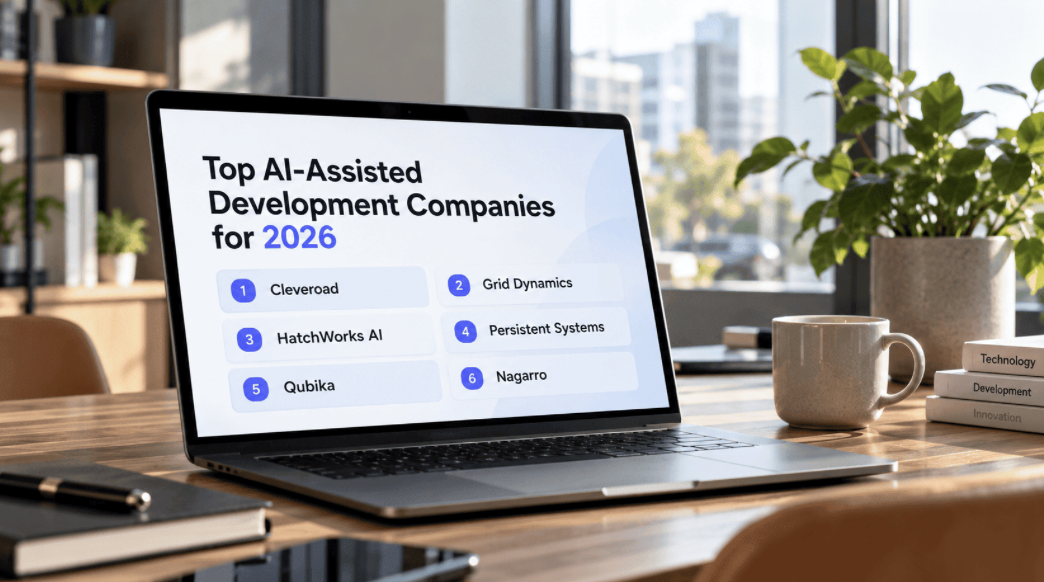
Top AI-Assisted Development Companies for 2026
The below-listed firms show how artificial intelligence can be used in software planning, engineering, quality control, modernization, implementation, and support.
- Cleveroad
- Grid Dynamics
- HatchWorks AI
- Persistent Systems
- Qubika
- Nagarro
The research was performed in September 2026, and the selection of firms included over 25 AI and software engineering service providers that can be found using their own corporate information and directories such as Clutch, GoodFirms, and DesignRush. The directory by Clutch is what provided most of the information about the companies involved in AI development.
All companies represented on the list have various patterns of service provision but rely on software engineering capabilities along with established practices in AI development.
1. Cleveroad
AI-assisted SDLC focus: Requirements, specifications, architecture, prototyping, coding, testing, documentation, deployment
Industry expertise: Healthcare, FinTech, logistics, retail/eCommerce, education
Certifications and recognition: ISO 9001, ISO 27001; 4.9/5 on Clutch from 81 reviews
Rather than confining it to merely coding, Cleveroad incorporates AI along a strictly defined process of development. This process consists of seven steps: Define, Specify, Plan, Prototype, Implement, Validate, and Release. AI plays the following roles in this process: it turns stakeholders’ wishes into user stories and creates specifications; it assists in the choice of technologies and APIs; it generates prototypes and programs with unit tests, as well as documentation; finally, it conducts automated testing.
None of this work can be done without product engineers, architects, and QA experts’ sign-off. Cleveroad is also in the process of integrating Claude Code into its workflows. Its expertise lies in a number of industries such as finance, healthcare, logistics, and education. The company is certified under ISO 9001 and ISO 27001.
2. Grid Dynamics
AI-assisted SDLC focus: Requirements, planning, development, testing, QA, deployment, SRE, engineering analytics
Industry expertise: Retail, automotive, financial services, insurance, high tech, manufacturing, pharmaceuticals
Recognition: 2026 MACH Alliance Agent Ready Award; Nasdaq-listed technology company
In this list of companies providing AI-SDLC solutions, Grid Dynamics stands out as one of the most notable companies. The GAIN platform relies on a combination of artificial intelligence in both software development and application deployment. The AI-SDLC architecture employs several specific technologies for AI support in such fields as development, automated QA and engineering analytics. The company claims that AI technology can define the scope of the software development activities, complete coding, conduct testing, do software quality assurance evaluation, etc.
The new AI-SDLC architecture will be able to cover specification quality issues, governance via mechanisms which shape the requirements and verify the outcome generated by AI-based technologies. The company has significant experience in the retail, finance, car industry, insurance, machine building, pharmaceutical and high-tech sectors. Founded in 2006, the company is located in San Ramon, California. The company received MACH Alliance’s Agent Ready Award in 2026 for the production-related deployment of AI in software development.
3. HatchWorks AI
AI-assisted SDLC focus: Product design, software design, coding, testing, development workflows
Industry expertise: Financial services, healthcare, retail, telecommunications, enterprise software
Recognition: 2026 AI Breakthrough Code Generative AI Solution of the Year; 2026 Clutch Global Awards in AI Deployment, AI Strategy, and Machine Learning
HatchWorks AI has designed its software delivery methodology with what it calls Generative-Driven Development™, which includes generative AI as an integral part of design, development and software delivery rather than using it as a stand-alone technique. The company has adapted AI agents as well as teams with expertise in product, data and engineering to ensure faster software development for companies in various sectors, including healthcare, finance, telecommunications, retail and enterprise IT.
HatchWorks’ approach was especially recognized in 2026, when it was awarded the title of the Code Generative AI Solution of the Year by AI Breakthrough. The company also won the Summer 2026 Clutch Global Awards in the categories of AI Deployment, AI Strategy and Machine Learning. HatchWorks was founded in 2016 and it has its headquarters in Atlanta.
4. Persistent Systems
AI-assisted SDLC focus: Planning, requirements, architecture, coding, testing, modernization, compliance validation, release management
Industry expertise: Banking, financial services, healthcare, software and high tech, insurance
Certifications: ISO 9001, ISO 27001, ISO 27017, ISO 42001, SOC 2 Type 2, CMMI Development Maturity Level 5
Recognition: Everest Group Software Product Engineering Services Leader and Star Performer 2026
Persistent Systems incorporates AI in all aspects of software delivery through its SASVA platform as well as through its engineering frameworks. SASVA handles a workflow ranging from project planning and automated coding to reviews, validations, release management and post-release work. In 2026, Persistent introduced PSL-AIDLC, which is an AI-based delivery framework meant for regulated industries. It uses specialized agents in the areas of requirement gathering, architecture development, quality engineering, validation, compliance inspections, governance and delivery which ensures traceability of AI-generated artifacts.
This method proves to be particularly useful in banking, finance, health care and similar fields in which auditability is as important as successful software delivery speed. Persistent has a certification portfolio which is also quite extensive; among the certifications are ISO 9001, ISO 27001, ISO 27017, ISO 42001 for AI management, SOC 2 Type 2 and CMMI Development Maturity Level 5. In 2026 Everest Group recognized Persistent Systems as a Leader and Star Performer in Software Product Engineering Services.
5. Qubika
AI-assisted SDLC focus: Product engineering, prototyping, coding, QA, secure SDLC, CI/CD, AI-agent development
Industry expertise: Banking, financial services, healthcare, insurance, media, high tech and semiconductors
Certifications and recognition: ISO 27001, SOC 2 Type II, NIST AI RMF alignment; Databricks Gold Partner and 2026 Latin America Innovation Partner of the Year
Through AccelerateAI, Agentic Factory, etc., Qubika incorporates AI into its engineering operations. It introduces engineering services, which leverage AI-enabled product development and combine those with AI-based QA, automation testing, CI/CD, platform engineering, and secure SDLC practices. Therefore, Qubika’s services can be beneficial for different kinds of companies needing something more than a simple LLM integration into their systems. The firm also utilizes years of experience in banking, finance, healthcare, and many other areas.
Qubika is ISO 27001 certified, has SOC 2 Type II controls, and complies with the NIST AI Risk Management Framework. Additionally, the company is the Databricks Gold Partner and has over 250 certified professionals and has won the title of Databricks Latin America Innovation Partner of the year in 2026.
6. Nagarro
AI-assisted SDLC focus: Coding, debugging, requirements analysis, test generation, test execution, documentation, code review, QA
Industry expertise: Automotive, financial services, healthcare, retail, telecommunications, travel and technology
Technical distinction: Proprietary AI4T testing initiative and Quality Copilot
Nagarro has very effective capabilities in using AI in engineering and in quality assurance, and they utilize their technical teams in generative AI. Among their use of generative AI, Nagarro engineers use it for creating programs, fixing bugs, writing documentation, analyzing requirements, and for testing computer programs. In addition, the company has designed an advanced tool which takes information from ticket information systems and processes users’ stories, creates test environments, scripts, and systems, and evaluates testing phases.
It also has a developed tool called Quality Copilot for analyzing requirements and generating tests using LLM methods, while some of the previously mentioned programs include Cursor, Claude Code, GitHub Copilot, etc. The company has a proven experience in using of Cursor for API automation, as well as current experience in working with Enterprises and conducting research on intelligent testing.
How AI-Assisted Development Companies Are Changing the SDLC
Several AI-assisted development companies are introducing a new operating model into the software development life cycle, which employs AI only as a speeding-up mechanism for code writing.
In the process of discovery and gathering of requirements, AI is capable of processing information provided by different stakeholders, creating good user stories, identifying ambiguities, and transforming requirements into more structured specifications. Cleveroad is a pioneer here thanks to its specification-driven and specification-oriented processes.
In the course of designing and developing solutions, AI used as copilot or agent is able to come up with implementation solutions, code, testing materials, documentation, etc. Persistent and Nagarro demonstrate how generative AI could be employed in engineering in practice instead of only focusing on the end-user perspective of the technology.
Thus, advanced companies are bringing AI into governance, deployment, and production processes already.
What to Assess in an AI-Powered Development Partner
When assessing potential candidates from the AI-assisted development sphere, the prospective client should not just find out if the potential provider uses GitHub Copilot, Claude Code, Cursor, or similar assistants. Just the presence of the software in the technician’s toolkit is insufficient.
What really matters is whether the outsourcing provider has changed its approach to operations due to the introduction of AI technology and implemented the previously mentioned processes in a way that keeps the human factor intact. Among these processes should be: the use of structured requirements and architecture controls, establishing repository context for code, implementing automated testing, carrying out code reviews, and applying security checks.
At the same time, if the company operates in the healthcare or financial field, more serious attention should be paid to information security certifications.
Final Thoughts
Different companies analyzed in this article employ different strategies that involve using AI in their software development. Cleveroad develops software using AI in its full cycle software development, Grid Dynamics has created specialized platforms and governance tools to support AI-based SDLC practices, HatchWorks AI adopts Generative-Driven Development, Persistent Systems incorporates AI into its engineering practices alongside its strict policies and standards for regulated software development, and Qubika combines AI and secure technologies in its development process.