
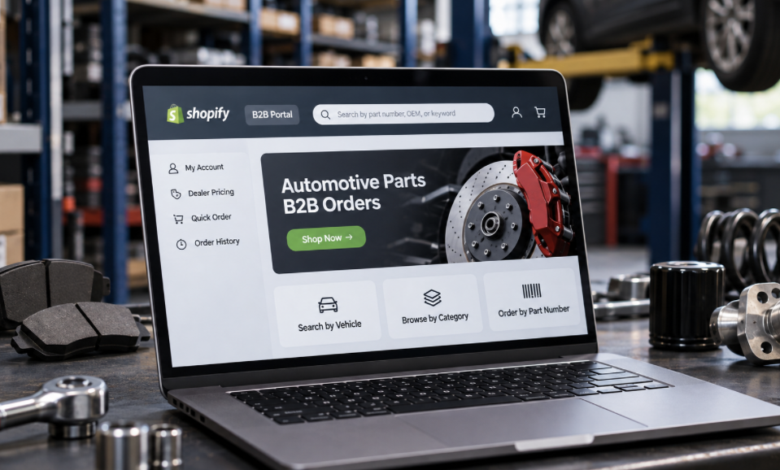
A trade customer ordering brake components usually arrives with a job to finish. They may already have the part number, know their negotiated price, and need to check availability before placing an order. If the website cannot answer those questions, the order often goes back to a sales representative.
For automotive distributors, that makes ecommerce as much an operational project as a storefront project. Vehicle compatibility, dealer accounts, pricing agreements, and warehouse inventory all affect whether customers can buy without calling for help.
Choosing a Shopify agency means looking closely at how it handles those requirements. An attractive portfolio is useful, but a relevant parts catalog or dealer-ordering project tells you more about the work ahead.
The seven agencies below bring different combinations of automotive, Shopify B2B, and distribution experience. This guide explains where each is most relevant and what to consider before choosing a partner.
Key Takeaways
- Fyresite: Automotive Shopify development combining vehicle fitment, dealer ordering, and business-system integrations.
- Teifi Digital: Complex distribution operations involving parts data, wholesale pricing, and connected systems.
- CQL: Automotive product discovery and Shopify wholesale portals.
- magic42: Shopify migrations for specialist motorsport and performance-parts businesses.
- Uncap: Automotive manufacturing projects connecting B2B and consumer sales with ERP systems.
- Elogic Commerce: Commercial vehicle parts catalogs with cross-reference search and customer-specific pricing.
- Absolute Web: Custom wholesale purchasing experiences and enterprise integrations.
How We Selected These Shopify B2B Agencies
This comparison draws on published case studies and service documentation, with attention to five areas:
- Shopify experience: Development, migration, or B2B implementation work.
- Automotive relevance: Vehicle parts, fitment, technical catalogs, or comparable product complexity.
- Wholesale functionality: Dealer accounts, negotiated pricing, purchasing workflows, or B2B portals.
- System integration: Connections to ERP, inventory, product information, and fulfillment systems.
- Implementation evidence: Clear descriptions of the agency’s role and the requirements it addressed.
Some agencies have combined automotive and wholesale functionality in the same project. Others demonstrate those capabilities through separate implementations. That distinction matters when deciding which examples most closely resemble your business.
7 Best Shopify B2B Agencies Compared
| Agency | Best For | Relevant Experience |
| Fyresite | Automotive B2B and dealer ordering | Race Technologies, Chassis Unlimited |
| Teifi Digital | Complex distribution operations | Parts commerce and enterprise distribution |
| CQL | Automotive migrations and wholesale portals | The Seat Shop, Escalade Sports |
| magic42 | Motorsport and performance parts | Roger Clark Motorsport |
| Uncap | Automotive B2B and ERP integration | KOOKS Headers & Exhaust |
| Elogic Commerce | Commercial vehicle parts distribution | Truck Center International |
| Absolute Web | Custom wholesale pricing and integrations | B2B commerce and enterprise systems |
1. Fyresite — Best for Automotive B2B and Dealer Ordering
Fyresite develops Shopify stores for automotive businesses dealing with vehicle compatibility, technical catalogs, and trade purchasing. Its work is particularly relevant when customers need help finding the right component and dealers need a faster way to order it.
Race Technologies, an official Brembo partner, is one example. Fyresite replaced its Drupal-based catalog with a Shopify Plus storefront serving consumers and dealers. The implementation used Shopify metaobjects to manage Year/Make/Model compatibility at product and variant level, while a brake-system configurator mapped customers’ selections to NetSuite part numbers. Dealers received company accounts, location-level pricing, and a quick-order interface.
Fyresite also handled Chassis Unlimited’s migration from Magento to Shopify Plus, adding another automotive project to its portfolio.
For businesses comparing partners, Fyresite’s automotive Shopify development services are relevant where fitment, catalog structure, and wholesale purchasing need to work together. The Race Technologies project provides a concrete example of those requirements within one storefront.
Key capabilities: Shopify Plus development, vehicle fitment, dealer ordering, B2B pricing, product configuration, ERP integration, and migration.
Best for: Automotive parts manufacturers, distributors, and wholesalers serving both dealers and consumers.
Consideration: Allow time during discovery to establish who maintains fitment data, where pricing is managed, and how orders move between Shopify and back-office systems.
2. Teifi Digital — Best for Complex Distribution Operations
Teifi Digital works with businesses whose ecommerce requirements extend across catalogs, customer accounts, inventory, and multiple business systems. For a distributor, that becomes relevant when the information needed to complete one order lives in several places.
Its offering includes Teifi Parts for fitment-led product discovery and Teifi Bridge for connecting enterprise systems. Teifi’s automotive materials describe support for parts compatibility and Year/Make/Model search, while its broader B2B work addresses wholesale purchasing and pricing requirements.
Consider a distributor that maintains product information in a PIM, customer agreements in an ERP, and stock across several locations. The implementation has to determine which system supplies each piece of information and how changes reach the storefront. This is the type of operational complexity that makes Teifi relevant to the shortlist.
The main evaluation point is how its services and additional products would fit the systems already in place.
Key capabilities: Shopify B2B, parts discovery, fitment data, wholesale purchasing, and enterprise-system integration.
Best for: Established distributors with complex product data and several connected business systems.
Consideration: Ask the proposal to separate Shopify’s native functionality, Teifi’s products, and custom development, including the ongoing costs of each.
3. CQL — Best for Automotive Migrations and Wholesale Portals
CQL has relevant examples on both sides of this comparison: automotive product discovery and dealer purchasing.
The Seat Shop approached the agency after a Shopify Plus migration ran into technical problems. Its vehicle-specific catalog required a working Year/Make/Model finder and a manageable process for updating the underlying product database. CQL completed the implementation, and its case study reports that conversion rates more than doubled.
For wholesale experience, Escalade Sports provides a separate example. CQL built a Shopify B2B site with dealer-specific product visibility, customized pricing, and negotiated payment terms. The project also connected the storefront with the company’s ERP and product information systems.
Together, these projects make CQL relevant to businesses rebuilding automotive search while developing a better buying experience for trade accounts. They also give prospective clients two distinct implementations to discuss during discovery.
Key capabilities: Shopify Plus migration, vehicle search, B2B portals, curated catalogs, customized pricing, and business-system integration.
Best for: Automotive businesses replacing a difficult-to-maintain storefront or improving product discovery alongside wholesale ordering.
Consideration: The automotive and wholesale examples are separate projects. Discuss how those requirements would be combined in your implementation.
4. magic42 — Best for Motorsport and Performance Parts Ecommerce
Specialist performance-parts catalogs can be difficult to browse without detailed knowledge of the products. A customer may know the vehicle or application but still need help narrowing down the available components.
magic42’s work with Roger Clark Motorsport addresses that problem. The agency migrated the business from a bespoke ecommerce platform to Shopify, supporting both trade and consumer sales. The project included site restructuring, a homepage part finder, and improvements to product discovery.
It also introduced Doofinder search with model and price filters, alongside shipping and marketing integrations. Those changes are relevant to specialist suppliers whose customers need several ways to find a part, rather than relying on standard category navigation.
For a motorsport business planning a migration, this is a useful example to review: it combines a specialist automotive catalog with the practical work of moving an established operation onto Shopify.
Key capabilities: Shopify migration, B2B/B2C commerce, parts discovery, catalog restructuring, and ecommerce integrations.
Best for: Motorsport and performance-parts suppliers moving from bespoke or legacy platforms.
Consideration: Define wholesale pricing and warehouse requirements early, particularly if they go beyond the functionality demonstrated in the published project.
5. Uncap — Best for Automotive Manufacturers Connecting Shopify With ERP Systems
Uncap’s KOOKS Headers & Exhaust project is relevant to manufacturers selling through both retail and wholesale channels.
KOOKS needed to replace a legacy website with limited search, inventory visibility, and B2B functionality. Uncap moved the business to a unified Shopify storefront serving consumers and trade buyers, with vehicle-fitment search and connected operational systems. Its published project materials identify Infor ERP as part of the technology stack.
Shopify’s case study reports a 22% increase in conversion rate and a 38% reduction in total cost of ownership following the implementation. It also describes improvements to wholesale ordering and real-time inventory visibility.
For manufacturers, the relevance goes beyond adding a dealer login. Customers need to find compatible products and see availability, while internal teams need orders to remain connected to the systems used to manage the business.
Key capabilities: Shopify migration, automotive fitment, B2B commerce, ERP integration, and combined retail and wholesale storefronts.
Best for: Automotive manufacturers connecting dealer sales and direct-to-consumer ecommerce with existing operational systems.
Consideration: Agree which system controls product, inventory, and customer records, and how updates will be synchronized after launch.
6. Elogic Commerce — Best for Commercial Vehicle Parts and Customer-Specific Pricing
Elogic Commerce’s Truck Center International project offers a direct example of Shopify B2B for automotive distribution.
Truck Center International manufactures remanufactured brake calipers for commercial vehicles. Its customers include distributors and dealers who need to identify a component, check their account’s price, and confirm availability before ordering.
Elogic built a Shopify Plus B2B platform for approximately 14,000 SKUs. The implementation included OEM-number and cross-reference search, TecDoc-supported parts identification, customer-specific price groups, stock visibility, and order tracking. It also connected Shopify with Epicor Vision and related systems through 16 integrations.
This project is particularly relevant to suppliers whose customers search by reference number. A vehicle selector may help some buyers, but a professional purchasing replacement calipers often needs a reliable match for an OEM or alternative part number.
Key capabilities: Shopify Plus B2B, cross-reference search, TecDoc-supported identification, customer-specific pricing, and ERP integration.
Best for: Commercial vehicle parts suppliers with technical reference catalogs and negotiated trade pricing.
Consideration: Review the quality and format of your existing parts data before defining the search and integration scope.
7. Absolute Web — Best for Custom Wholesale Pricing and Integrations
Absolute Web is relevant to wholesalers whose main challenge is managing different purchasing arrangements across customer accounts.
Its B2B services include custom quoting, tiered pricing, account-based functionality, and integrations with business systems. The agency works with Shopify Plus as well as other ecommerce platforms.
For an automotive distributor, those requirements might include different pricing for independent repair shops and dealer groups, or a quoting process for larger orders. The important question is how those arrangements will work online without creating extra administration for the sales team.
Absolute Web’s broader wholesale offering earns it a place in this comparison. Businesses with detailed automotive compatibility requirements should use discovery to examine that part of the proposed solution closely.
Key capabilities: B2B development, account-based purchasing, tiered pricing, custom quoting, and enterprise integrations.
Best for: Wholesalers prioritizing customer-account management and customized purchasing workflows.
Consideration: Request a demonstration of the proposed approach to fitment, interchange data, and parts search if these are central to your catalog.
What Automotive Wholesalers Should Look for in a Shopify B2B Agency
Start with how your customers order today. Some buyers search by vehicle, while others arrive with a spreadsheet of part numbers. Certain accounts need negotiated prices; others need agreed payment terms or access to a specific product range.
Those differences should shape the project brief.
| Requirement | Why It Matters | What to Evaluate |
| Customer-specific pricing | Trade accounts may have negotiated agreements | Catalog assignments, price rules, and ERP synchronization |
| Vehicle fitment | Buyers need to confirm compatibility | Year/Make/Model data, exceptions, and variant-level fitment |
| Part-number search | Professional buyers often know the reference | SKU, OEM, interchange, and cross-reference matching |
| Quick ordering | Repeat orders should take little effort | Bulk entry, reorder flows, and purchase-order handling |
| Inventory visibility | Availability affects purchasing decisions | Warehouse stock, update frequency, and backorder rules |
| ERP integration | Storefront information must match business records | Data ownership, synchronization, and error handling |
| Dealer accounts | One customer may have several buyers or locations | Access permissions, catalogs, pricing, and payment terms |
Review Projects That Resemble Your Business
Ask agencies to explain what they built and which parts of the project were custom. A vehicle finder shows experience with compatibility data. A dealer portal shows experience with trade purchasing. A project combining both offers a closer comparison if your business needs both.
The details matter more than the client logo. Find out how product records were prepared, how customer pricing was assigned, and what the merchant’s team had to maintain after launch.
Test a Real Order
Give shortlisted agencies an example drawn from your own sales process. A dealer might need to find a brake component using an OEM number, confirm compatibility, see an agreed price, and submit an order on account.
Then introduce a complication: the item is out of stock, the reference has changed, or the order draws inventory from two warehouses. Walking through that scenario helps reveal what the proposed implementation actually covers.
Pricing deserves particular attention. Shopify supports B2B catalogs, but catalog assignment and customer-level pricing options vary by plan. The agency should explain the setup it recommends and how it will handle agreements maintained in your ERP.
Agree Who Maintains the Data
A storefront can launch with accurate information and become difficult to use if nobody owns the updates. Before development starts, decide who will maintain fitment records, product specifications, customer pricing, and account details.
The proposal should also explain how failed updates are detected and resolved. If a stock feed stops working or a price does not synchronize, someone needs to know before a customer places an order.
These responsibilities belong in the project scope alongside design, development, and migration.
Frequently Asked Questions
Can Shopify support customer-specific pricing for automotive wholesalers?
Yes. Shopify B2B uses catalogs to manage product availability and pricing for business customers. Shopify Plus also supports assigning catalogs directly to company locations. More complex agreements may require ERP integration or additional development.
Does migrating to Shopify automatically solve vehicle-fitment problems?
No. Moving product records does not resolve missing or inconsistent compatibility information. Fitment needs its own scope, including the source data, vehicle structure, exceptions, and the way customers search and confirm compatibility.
Can automotive businesses sell B2B and DTC through the same Shopify store?
Yes. Shopify supports blended stores serving both business customers and consumers. The implementation needs to account for differences in product access, pricing, payment terms, and the customer experience.
What should an automotive distributor prepare before approaching an agency?
Prepare sample product and fitment data, an outline of customer pricing agreements, a list of connected systems, and several typical orders. Include difficult cases, such as replacement part numbers, backorders, or customers buying across multiple locations. These examples help agencies estimate the work more accurately.
The Right Shopify B2B Partner Should Understand How Parts Distribution Actually Works
The right Shopify B2B agency depends on where your ordering process becomes difficult. A performance-parts manufacturer may need better vehicle fitment and product configuration. A commercial vehicle supplier may rely on cross-reference search, while a distributor with a large dealer network may prioritize customer-specific pricing and account management.
These differences should guide the selection process. Review comparable automotive projects, test real purchasing scenarios, and ask how product data, pricing, and inventory will remain accurate after launch.
A successful Shopify B2B implementation should make ordering easier for trade customers while reducing the manual work required to manage complex parts distribution.