Where AR automation software and collections automation part ways once a customer replies
There’s no single best accounts receivable automation software, and any guide that names one without asking how you bill is guessing. A distributor with 4,000 net-30 accounts and a SaaS company with 80 enterprise contracts both call the problem “AR,” yet the work that eats their weeks looks nothing alike.
A few things decide most of the choice. Your billing model sets which tools can read your invoices at all, and your exposure to customer AP portals sets how much cash sits behind a login nobody checks. How much follow-up you hand to software rather than route back to a person settles the rest.
Each platform below gets the same three subsections, so you can compare them line for line. Monk sits first because it resolves the exceptions that stall receivables rather than sending them back to the inbox.
The first filters mid-market finance teams apply
Can QuickBooks handle accounts receivable on its own?
For many companies it can, through the first few million in revenue. QuickBooks records invoices and tracks aging, with basic reminders built in. It doesn’t chase a bounced email to the new contact, submit an invoice into Coupa or match a lump-sum wire against six open invoices. Every platform below connects to QuickBooks or NetSuite rather than replacing it, so the real question is how much of the work after the invoice you want handled outside the ledger.
Is there any free software for accounts receivable?
Free options exist at the edges. Accounting packages bundle invoicing and reminders, Upflow’s Discover plan costs nothing and gives AR analytics without collections, and Chaser and Kolleno offer trials. None of the free layers execute collections or match cash at volume, which is where the cost of manual AR lives.
How much of the follow-up do you want delegated?
This filter separates the eleven. Some platforms run schedules, so the reminder goes out on its calendar day whatever the customer said last week, or they draft a reply for a person to approve. A smaller group, built AI-native rather than with a model bolted onto a reminder schedule, reads the reply and takes the action, then shows you the log. Decide which you want before the first demo, because a vendor’s answer to “what happens when the customer writes back” tells you more than its feature page.
The best accounts receivable automation software by finance profile
#1 Monk
Overview
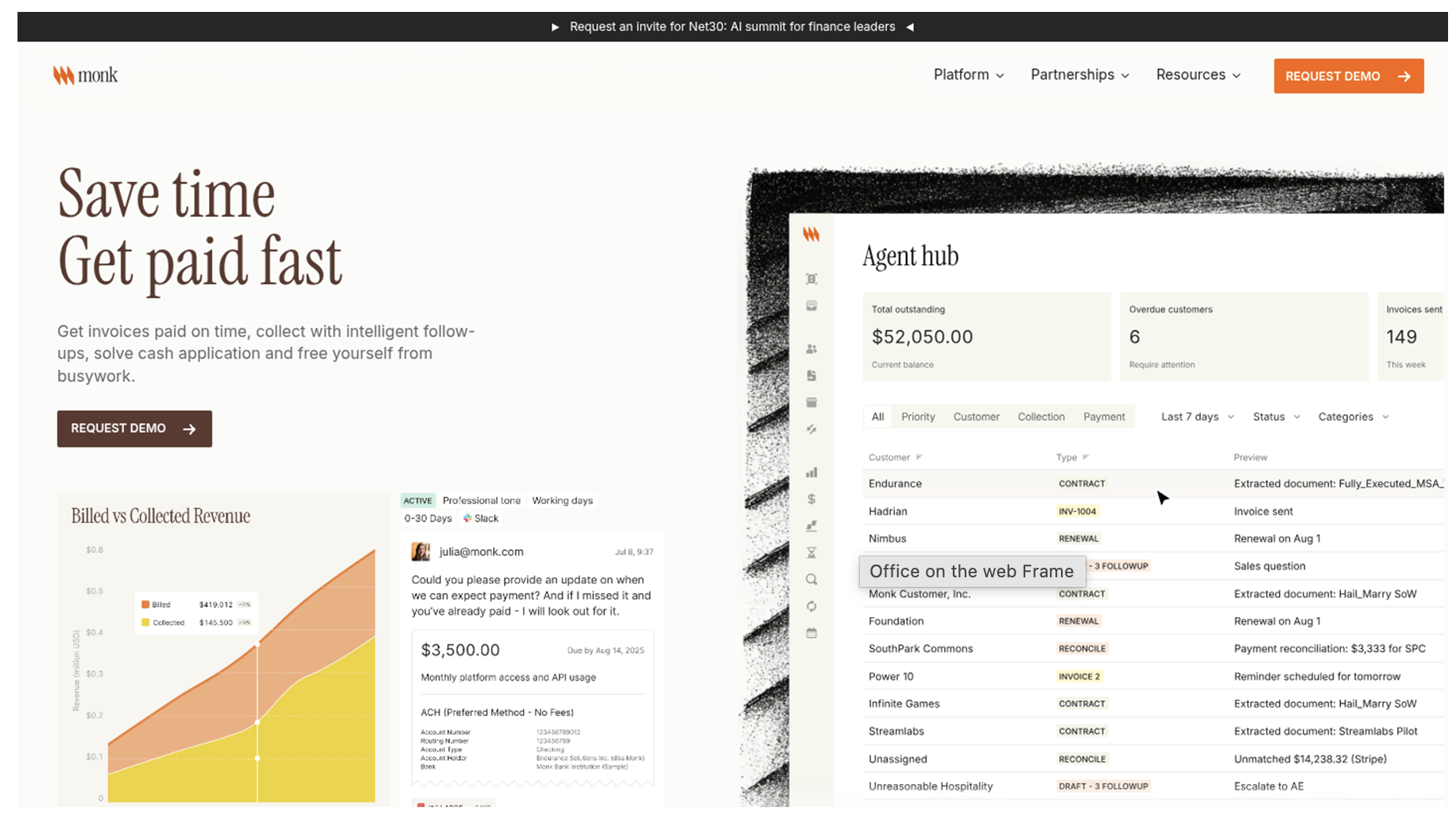
Monk gives B2B finance teams one AI-native system for the invoice-to-cash cycle: it sends the invoice out, lodges it in the buyer’s AP portal, handles the collections back-and-forth and applies the payment, and it stays within receivables. Cash application runs on three tiers. Exact matches post at 100% confidence, no LLM near them; recurring quirks get caught by non-LLM rules you own, drafted by Monk from your remittance history; the rest, an empty wire memo or one payment across several invoices, goes to an LLM that reads it whole and proposes a match with its confidence score and reasoning. Matching runs at 80% unassisted, 95% once the suggested rules are in place, each match with an audit trail.
Intelligent Collections lives on the exceptions. Monk’s AI agents, Julia for email and Ryan for the phone, read the reply and act: a W-9 request gets the W-9 back on the original thread, a bounce sends Julia after the replacement contact, an out-of-office gets waited out, a PO or credit memo from another thread gets attached to its invoice, a PO mismatch reaches your review queue flagged, and a short-pay gets classified as a wire fee, card fee, early-pay discount or pricing dispute. Playbooks decide trigger timing, segment-specific tone, escalation route and exclusions, plus the name and language the agent uses. 90% of collections, Monk reports, close with zero human intervention, and customers reply 24% more often than to standard dunning.
Where it fits
Teams whose receivables stall in portals, W-9s, PO mismatches and short-pays, Series A through Fortune 500, bought by CFOs, controllers and VPs of Finance. Monk pushes invoices into Coupa, Ariba and Procore, GCPay, Tipalti, Textura or a custom buyer portal (600+), checks every connected portal each day and raises rejections as Needs Attention; 92% of enterprise invoices in its book require a portal, and it uploads 87% unaided.
A rule-based layer checks each agent action before it goes out and records it. DSO, aging and cash report live, with a forecast built on real payment habits, not due dates; Disputes and Credit Management are secondary modules. Monk layers onto the ERP you already run, so a team is live in under a week, most within one to three days, with no services engagement, no implementation fee, and none of your revenue taken as a percentage.
Monk connects with the ERP and CRM already in place, with white-glove setup. SOC 2 Type II and ISO 27001 certified, no training on your data, and a dedicated engineer, support, implementation specialist and agent specialist on Slack all seven days, with a 4-hour response SLA.
Watch-outs
Pricing scales with volume and isn’t published. Voice via Ryan is opt-in; Ryan can look up an invoice but can’t alter one or take a payment, and a new account starts in review mode, where a person clears each agent action.
#2 Versapay
Overview
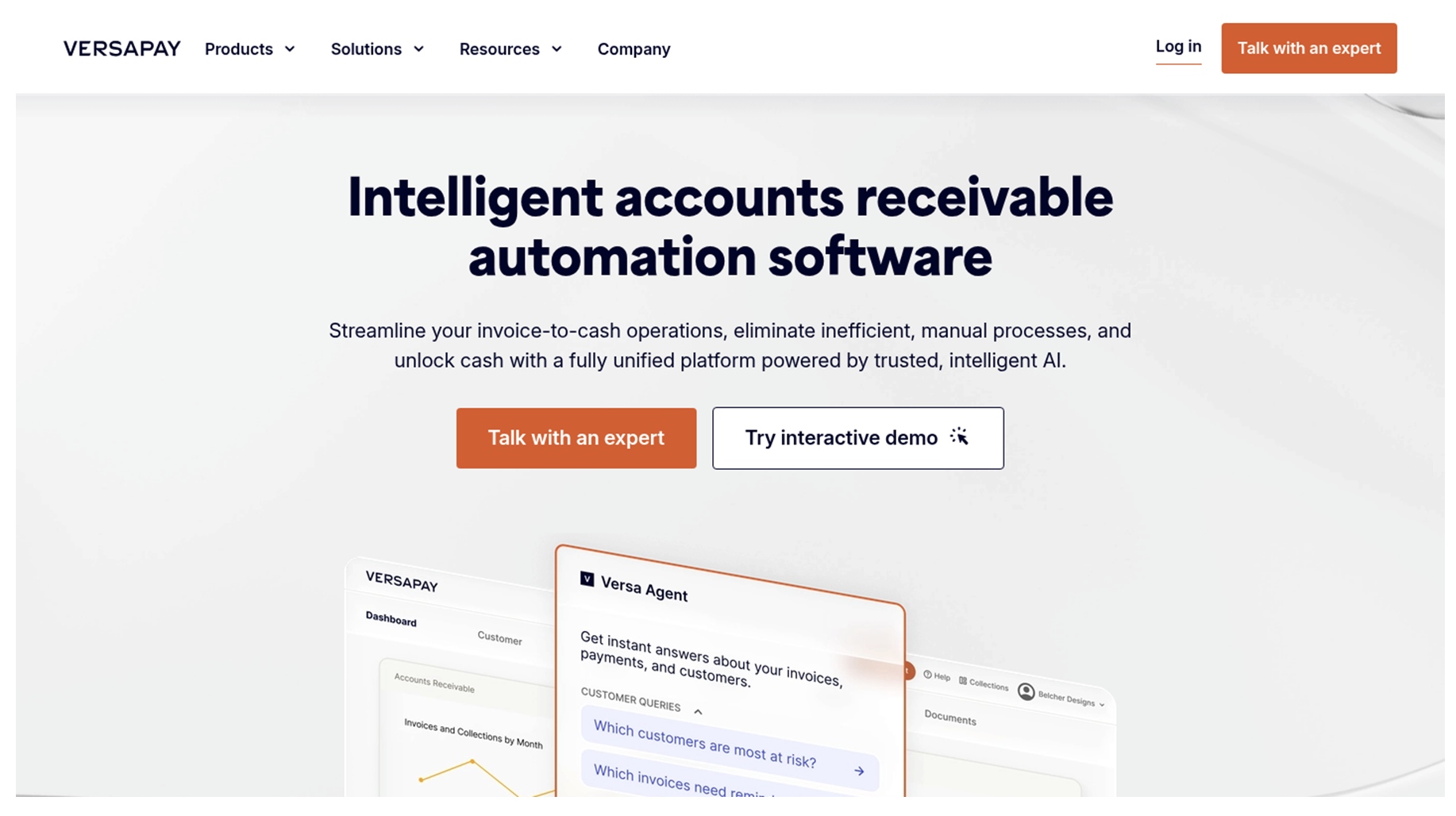
Versapay describes itself as intelligent accounts receivable automation on a unified platform, and its architecture pairs a Customer Portal, where buyers see invoices, store payment methods, set autopay or payment plans and raise disputes with configurable reason codes, with a Supplier Portal where the AR team comments on invoices, attaches files and tracks those disputes. Underneath is a payments business: ACH, cards, wires and virtual cards, $257B a year across 120 million transactions, with surcharging, fraud monitoring and early-discount options.
Collections means delinquency prediction, prioritization of high-risk accounts, customer tagging and 100+ dunning notification templates configurable by customer, invoice, payment and order category. Cash application auto-matches however customers remit and writes to the ERP as it happens, and reports span DSO, aging, the largest overdue customers, collections trend and cash-flow forecasting by division, currency or customer group. The company cites 10,000+ customers and 5M+ companies transacting, and one G2 reviewer mentions an AI agent helping her team, though the site itself doesn’t describe one; the most-cited benefit on G2 is customers paying sooner through the portal.
Where it fits
Distributors and manufacturers with a long tail of net-terms customers still mailing checks, where moving payment onto a portal is the biggest lever. Reviewers rate it 4.1 out of 5 on G2 from 101 reviews, praise the NetSuite integration and easy setup, and report about four months to implement, with ROI at 20 months.
Watch-outs
Versapay’s own automation list runs invoice presentment, then dunning notifications, then “basic collections activities”, then cash application and reconciliation, and nothing on its pages describes an agent that reads a customer’s reply and closes it out, so the responses to those 100 notifications still land with your team. Neither AP portal submission nor a portal count nor a cash application match rate appears on its pages.
G2’s leading complaint tag is payment issues, one customer charged twice after a failed-then-successful payment among them, and reviewers describe generic first responses from support and two-week waits without an account manager.
#3 Esker
Overview
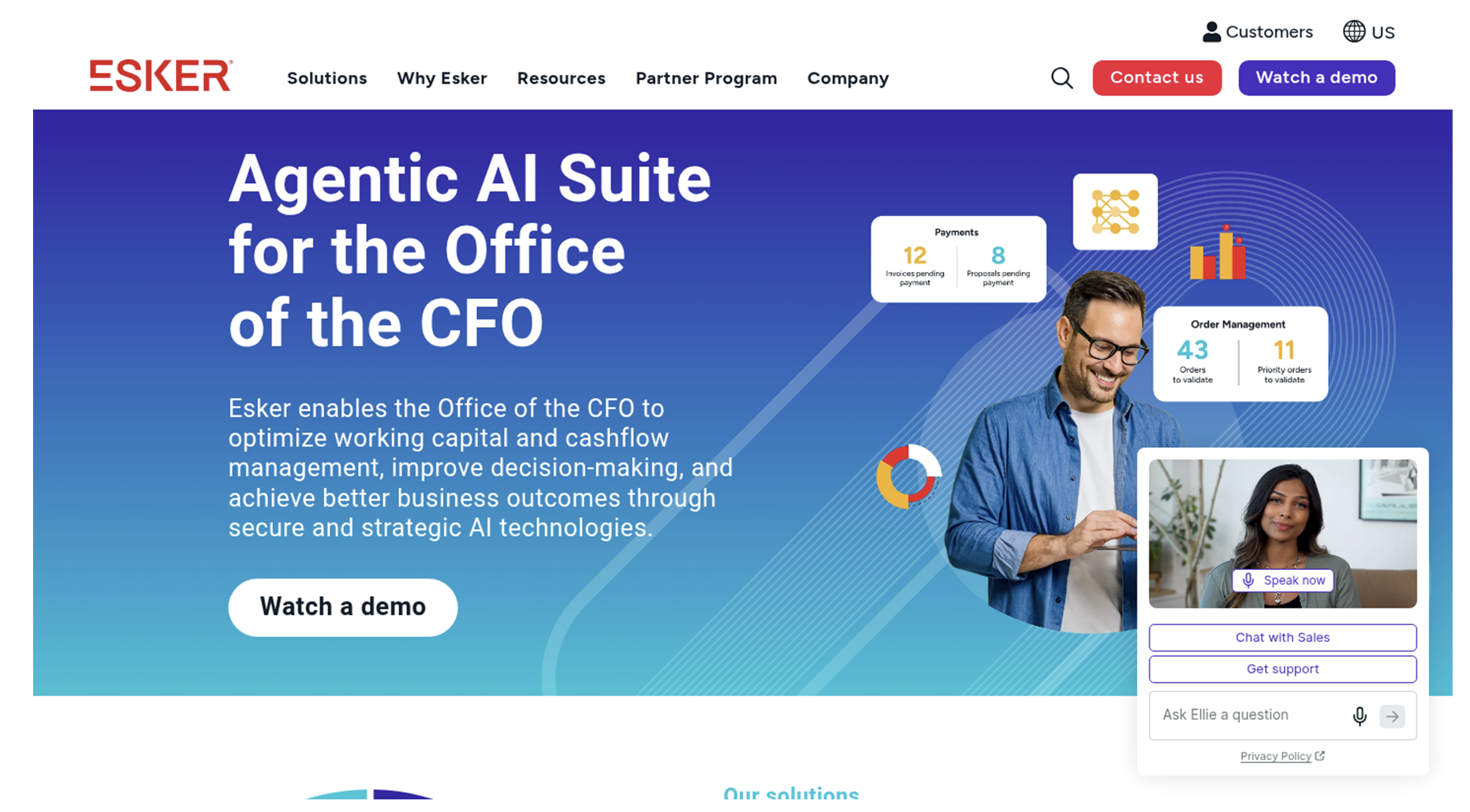
Esker, four decades old, Lyon-based, with US offices in Denver and Madison; it sells an Agentic AI Suite, its own term, aimed at the CFO’s office and spanning procurement (source-to-pay) and receivables (order-to-cash) on Esker Synergy AI, a model the company trains itself and also offers as LLM-as-a-service. The AR suite is modular: credit approval with mobile credit checks from Esker Anywhere, invoice delivery that meets e-invoicing rules in 60+ countries, payment through a portal in 40+ countries, AI-driven remittance matching, claims and deductions with task assignment, and collections management where AI predictions and risk analysis rank collector tasks and promise-to-pay tracking sits alongside internal and customer-facing conversations on any document.
The Connectivity Suite claims 70+ ERP integrations plus a Salesforce sync of collection notes, Esker states portal coverage as 100+ connections including Coupa and Ariba, dashboards track DSO, DDO, CEI and a collections forecast, scheduled custom reports go out on a timetable, with no cap on users. Esker cites 3,000+ businesses in one place on its site and more than 2,500 companies in another, and its AR FAQ describes automating one, some or all areas.
Where it fits
Global organizations consolidating procurement, order management and receivables with one vendor that need e-invoicing compliance across many countries; Gartner placed Esker as a Leader in the 2024 Magic Quadrant for invoice-to-cash and the 2025 one for AP. G2 rates it 4.4/5 across 60 reviews, 37 of them about AR, and reviewers describe a proactive team that stays engaged after go-live.
Watch-outs
The DSO improvement it advertises tops out at 10 days, the pricing model is à la carte and unpublished at G2’s top perceived-cost band, and G2 reviewers average six months to implement, with one verified manufacturing user warning that configuration may need specialist knowledge and enhancements can run long. The portal connections come with no stated schedule for revisiting them once an invoice is in, no email or voice agent that resolves replies end to end appears on its pages, and reviewers mention slowness at peak periods and a clunky mobile app.
#4 Billtrust
Overview
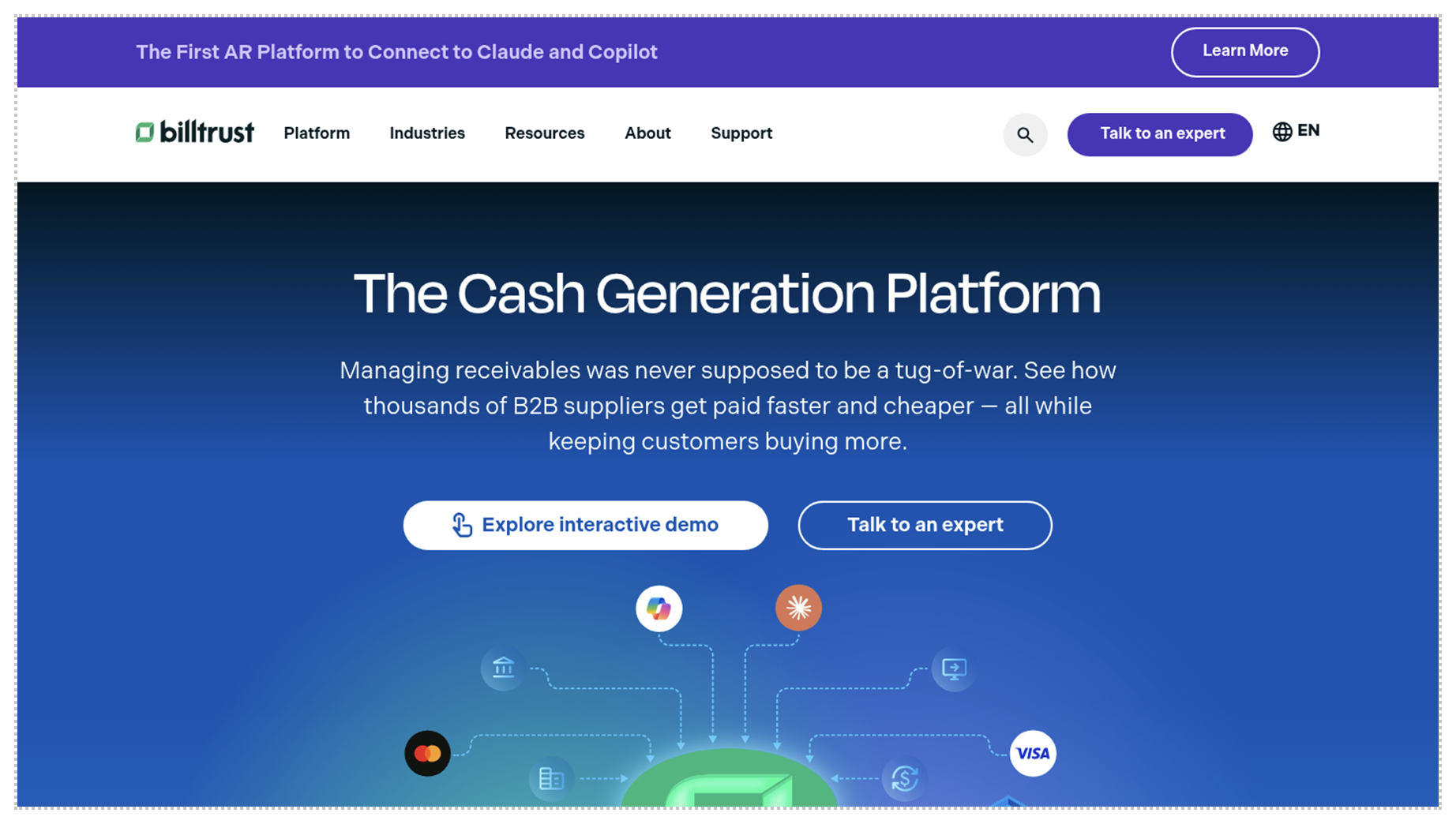
Billtrust calls its product the B2B Cash Generation Platform and its company a 24-year leader in digital finance transformations. The suite runs credit to cash, with invoicing and e-invoicing across 260+ AP portals plus global B2B and B2G compliance, payments on what it calls the largest B2B buyer network (13M+ buyers, $1T+ invoiced a year, 2,600+ suppliers) with buyer-level payment policies and lockbox automation it puts above 95%, credit decisions on more than 80 financial and behavioral signals with ongoing monitoring, collections that rank accounts by likelihood of payment and feed Collections Autopilot recommendations to collectors working inside a UI with live VoIP calling, cash application at 95%+ match rates and 99.6% for top-quartile customers, and a B2B webstore with a mobile app.
Every AI recommendation ships with its reasoning and a confidence score on forecasted dollars, and the company frames the collections problem as most AR teams working the top 13% of accounts while the other 87% sit in the dark. Connectors number 200+, NetSuite, Epicor, SAP, Oracle, Sage, Dynamics, with a services arm for implementation, custom integrations and training.
Where it fits
Large suppliers in equipment, manufacturing, distribution, healthcare, transportation and business services that want invoicing, payments, credit and a webstore from one vendor and have the calendar for a program. Ease of use leads the pro tags on G2 (164 mentions), the platform scores 4.4/5 across 514 reviews, and one enterprise reviewer said it sped up payment cycles by more than 20%.
Watch-outs
Collections AI prioritizes and recommends; collectors still work the accounts, and the pages say nothing about daily checks on the portals it submits into, about an implementation fee, or about a rule layer vetting AI output before it reaches a customer. G2 reviewers average five months to implement, one calling the initial setup hard and another finding the interface slow to learn. They describe rigid reporting that starts with an Excel export, sessions that time out mid-work, and a cash application screen with no export. Invoicing issues, payment issues, missing features and login problems lead the complaint tags.
#5 HighRadius
 Overview
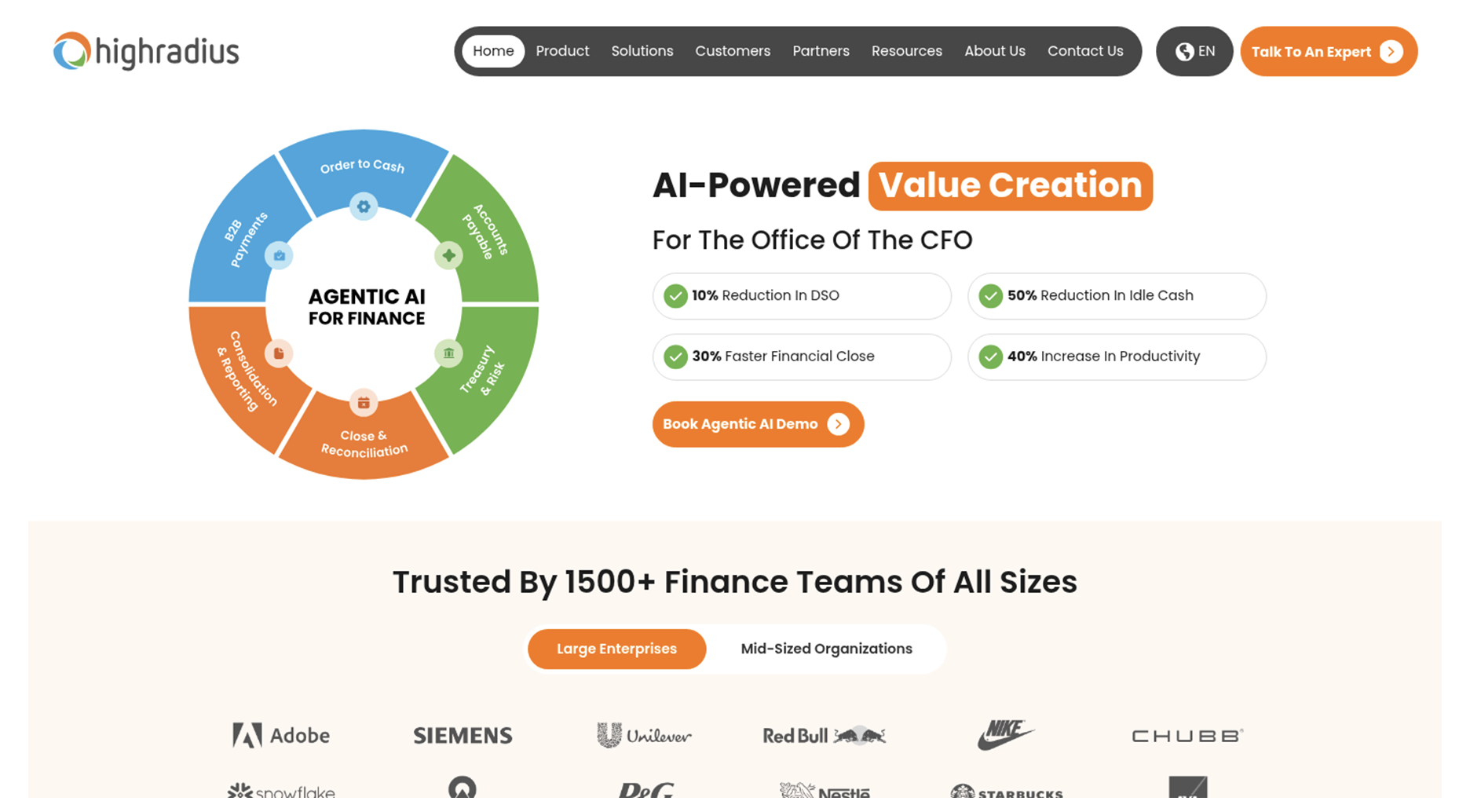
HighRadius’ own description is the number one autonomous finance platform in the world; it runs 190+ AI agents across order-to-cash, record-to-report, payables, payments and treasury, with accounts receivable as one suite of many. Inside AR, collections management gives collectors a prioritized worklist, templated dunning, an embedded dialer and in-app payment capture, supported by agents that predict payment dates, segment customers, run an Intelligent AR Inbox and act as a co-pilot for AR.
On cash application it downloads bank statements, captures remittances and matches payments with ML predicting remittances and auto-suggesting references; deductions management downloads portal claims and scores validity; credit management processes applications, releases blocked orders and scores risk; e-invoicing delivers into AP portals and includes an AP portal automation agent that combines retrieval and generative AI. Payments bring surcharge management and interchange optimization; treasury brings scenario-based cash forecasting.
The site counts 1,500+ finance teams, 50+ prebuilt ERP integrations and 125+ partners, and the company runs a Radiance user conference in Dallas; G2’s pricing insights place it at the top perceived-cost band with a 13% average discount.
Where it fits
Global shared-services centers standardizing every finance process with one vendor, most often with SAP or Oracle at the core. Its outcome-based pricing charges no implementation fee, then takes a post-go-live gain share against agreed success criteria, with guaranteed targets of a 10% cut in DSO and past dues and a 40% productivity gain. G2 rates it 4.3/5 across 238 reviews and names ML cash application the top win.
Watch-outs
The AR page promises significant results within six months while G2 reviewers average eight months to go live and 16 to ROI, and “poor customer support” is the most-tagged con with 22 mentions; an enterprise user reported SAP connectivity that kept breaking with slow service, a second described batch rather than live sync, and 11 mentions concern slow performance on big data volumes. Neither a portal count nor a monitoring cadence appears on the site, and the collections module describes tools a collector operates rather than an email or voice agent that resolves replies on its own.
#6 Gaviti
Overview
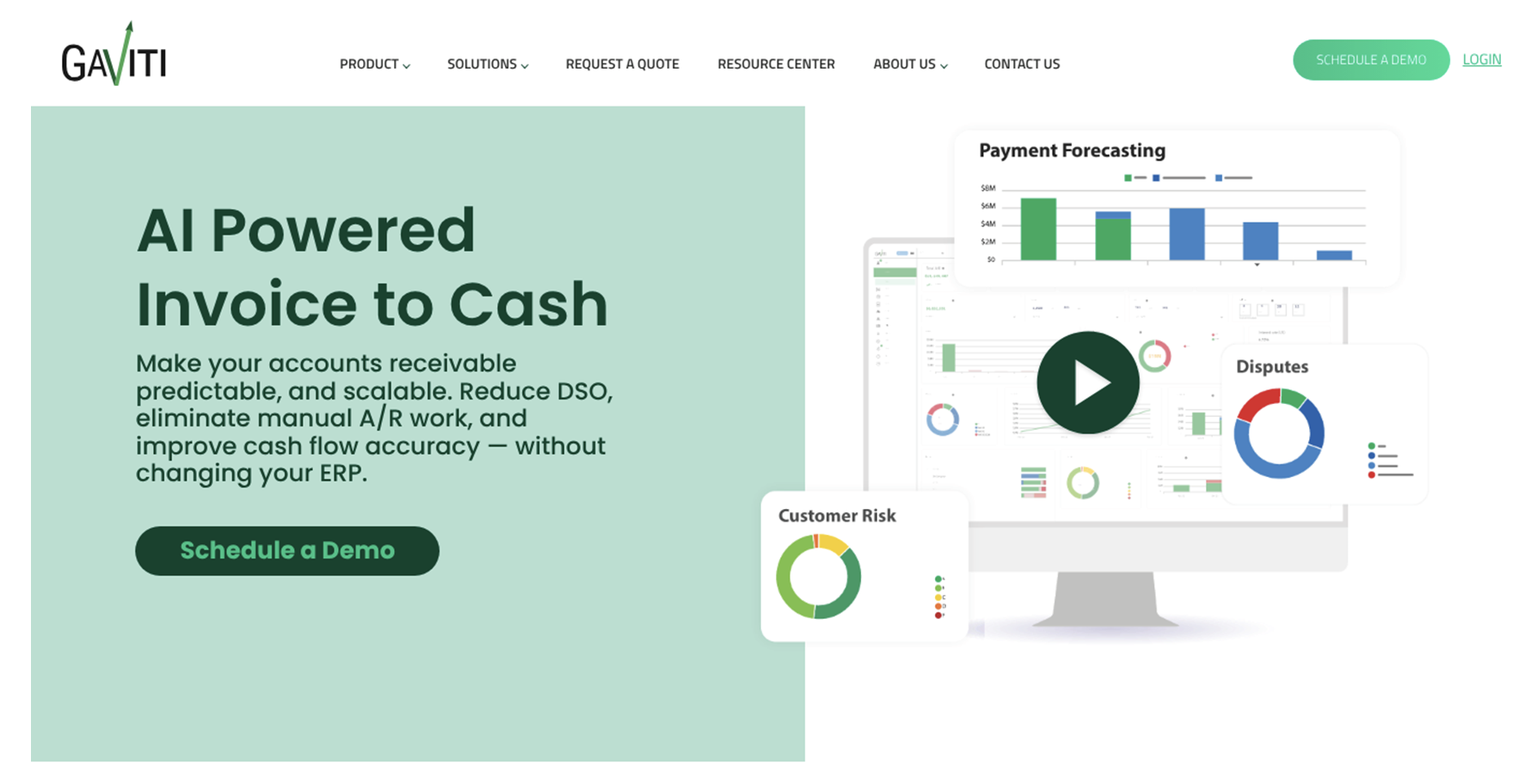
Gaviti markets AI-powered invoice to cash and promises predictable, scalable AR without changing your ERP; it says it works with any ERP or business system, homegrown ones included, and several at once. Credit and risk management covers online credit applications, AI credit review, bureau integrations, credit lookups in 200+ countries, enforceable limits and order freezes. Collections automation runs customizable dunning workflows with reminders, escalations and task prioritization, AI-generated emails and AI-optimized send timing.
The self-service payer portal offers zero-fee ACH, lower card fees, autopay, invoice history, credit requests and dispute initiation; disputes get a claim form, routing rules, a full log and one-click settlement; the cash application headline is 90% of payments matched before the workday starts, with lockbox capture and automated deduction codes; and an agentic AI assistant handles A/R chat and AI-generated workflows, with analytics, forecasting, dashboards per user and support for multiple entities on top. Pricing is usage-based rather than per user, quote only, with unlimited users, unlimited workflows, customizable permissions and a no-hidden-costs promise on every plan; the site also carries Regional Leader badges for Asia and lists Hebrew among supported languages.
Where it fits
Mid-market teams on an unusual or proprietary ERP that want dunning, dispute logging and a payer portal in one view. Gaviti holds 4.4/5 on G2 across 190 reviews with no one-star ratings, and reviewers praise single-screen visibility, 33 of them citing real-time invoice status, plus escalation workflows keyed to customer risk.
Watch-outs
G2 users report four months on average to implement and nine to ROI, the longest implementation average among these eleven. Reporting, filters and dashboards draw the most complaints, 18 mentions of limited customization and filtering one reviewer called wonky, and G2 logs 20 mentions of slow performance. Some work stays manual, updating follow-up status, marking disputes and tracking partial payments among it, and one reviewer can send only a statement rather than the invoice itself. The site describes AI as an assistant that drafts emails and workflows, with no agent acting on replies, no voice channel and no AP portal submission.
#7 Kolleno
Overview
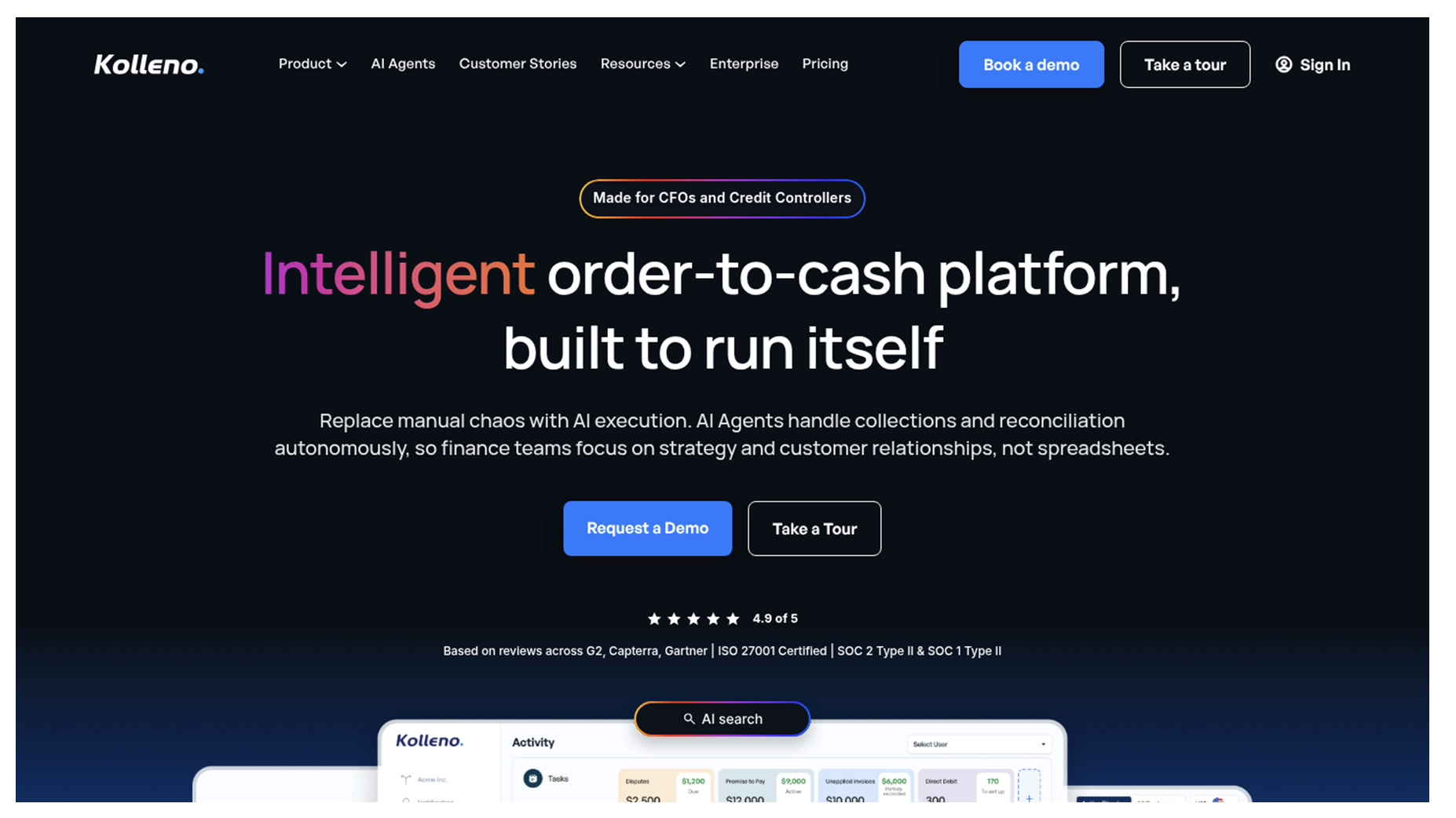
Kolleno describes itself as an intelligent order-to-cash platform built to run itself for CFOs and credit controllers. The finance team uploads its credit policy so task-specific AI agents can work within those rules.
Its collections agent handles AI follow-ups and manages the collections inbox. Online payments run through a white-labeled portal with payment links and AI-suggested payment methods. Cash application combines AI matching with exception handling and pattern learning. Other agents cover disputes with AI prioritization and predictive alerts. Kolleno also provides credit risk monitoring with scoring alongside cash-flow forecasting based on customer behavior.
Each agent can operate at an Insights level or in Copilot mode. Teams can also choose full execution. The Maestro layer coordinates hand-offs between agents while teams control tone and language. They can also configure escalation triggers and follow-up timing. SMS and calls are bundled according to the selected plan.
Kolleno uses per-seat pricing. Business Pay costs $650 per user each month for companies above $1 million in turnover. This plan includes self-onboarding and a free trial. Business Plus costs $1,245 per user each month for companies above $10 million in turnover. It has a two-user minimum. Custom Enterprise tiers add integrations with Oracle Fusion and SAP. They also support NetSuite and Dynamics BC. Higher tiers provide human agent support with 24/7 assistance and a dedicated CSM.
Kolleno says more than 1,000 collection teams use its platform. Its website displays customer logos including Stripe and Deel. It also shows Miro alongside Rakuten and 1Password.
Where it fits
Small and mid-sized finance teams on Xero, QuickBooks, Sage Intacct or Clio that want agents executing within a written credit policy, with onboarding the FAQ puts at about 10 days. Kolleno scores 4.9/5 on G2 on 117 reviews, five-star in 95% of cases, and the payment portal tops reviewers’ lists; companies of 50 or fewer employees account for 63 of the 104 size-tagged reviews.
Watch-outs
Per-seat pricing changes the math for a larger collections team, the footnote allows extra charges for integrations, customizations and add-ons, and the enterprise ERPs sit behind a custom-priced tier. Reviewers want editable dashboards and invoice-table filters, one says initial setup can take time, and another wants deeper automation with less human input. Kolleno publishes no cash application match rate, and its site describes neither AP portal submission nor a rule-based check on each agent action before it reaches a customer; a single outside list includes it.
#8 Chaser 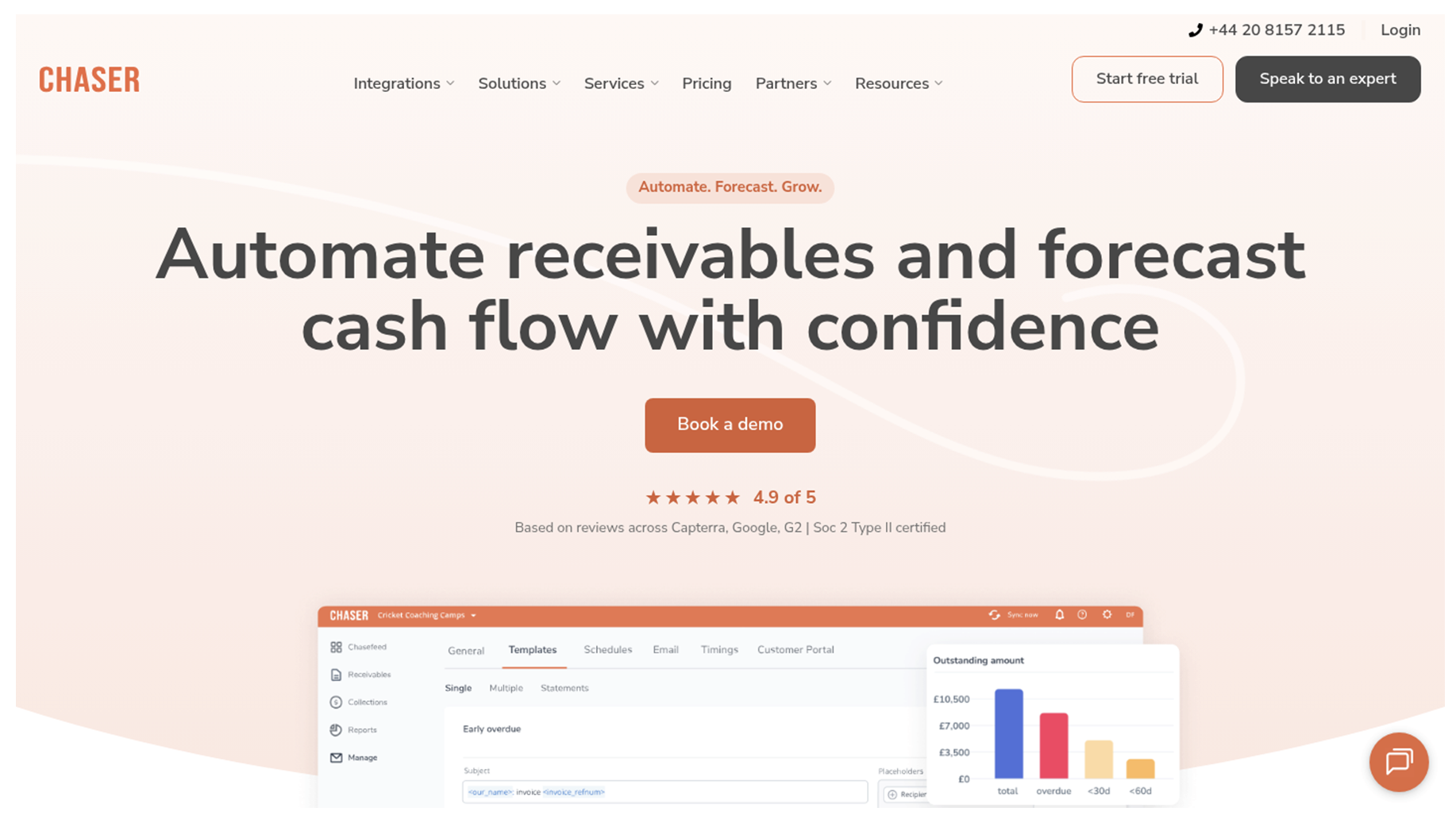
Overview
Chaser serves SMEs and accounting firms with receivables automation and cash-flow forecasting. Its platform is organized around Chase, Collect and Recover.
Chase uses reminder workflows across email and SMS. It also supports letters and automated debtor calls. Workflows can escalate through an organization and pause outside working hours. AI writes replies in the sender’s tone and recommends chasing times. It also produces payer ratings.
Collect provides a payment portal linked from each reminder. It supports installment plans and early-payment discounts. Late fees can also be applied automatically. Recover covers late-payment recovery. Credit checks and monitoring come as standard. The platform also provides late-payment predictions. A receivables forecast is available with the Complete tier.
Each invoice stores call recordings and notes. Tasks and communication history are also kept in the same record. Activity can be logged to HubSpot or Salesforce. Zoho CRM is supported as well. Two-way integrations include Xero and QuickBooks Online. Chaser also connects with Sage and NetSuite. Other integrations include Odoo and Dynamics 365 Business Central. AccountsIQ and Stripe are supported too. Data refreshes every hour and again before messages are sent.
US pricing starts at $259 per month for Compact. This plan covers companies with revenue below $5 million and includes four users. It also includes 30 templates and four workflows. Core costs $779 per month while Complete costs $1,169 per month. Custom pricing applies above $100 million in revenue.
Where it fits
Companies under about $120M revenue on Xero or QuickBooks that want well-written scheduled reminders, plus accounting practices running collections for clients; Chaser claims users get paid 16+ days sooner and save 15+ hours a week. It sits at 4.3/5 on G2 from 70 reviews, 50 of 64 size-tagged reviewers are small businesses, 49 of 70 are in Europe, and reviewers describe setup in a couple of hours and reminders customers take for hand-written email.
Watch-outs
Chaser’s AI drafts and recommends; it doesn’t execute the action on the reply. Anything deeper, managing the inbox, handling disputes and payment queries, reconciling the bank, comes as a human “+ Care” service at $1,199, $2,149 or $2,799 a month rather than as software. Complaint tags cluster on email behavior: digests twice a day that confuse and customers chased when nobody held an invoice; reports carry no history; payment plans run weekly, every two weeks or monthly and nothing else; and cash application and AP portal submission don’t appear on the product pages.
#9 Stuut
 Overview
Stuut is based in New York and backed by Andreessen Horowitz alongside Khosla Ventures and Activant Capital. The company promises AI that collects cash autonomously. On G2 it describes its product as an AI coworker for the order-to-cash cycle.
The core pitch is that its agents perform the work rather than simply giving finance teams better tools. Collections includes proactive outreach before the due date and billing-contact discovery. Customer engagement runs across email and SMS as well as voice. The site also includes a “Try AI Calling” demo.
Cash application matches incoming payments with invoices in the ERP. Payments processing includes click-to-pay functionality. Stuut also identifies and investigates disputes before helping resolve them.
Named ERP integrations include SAP and Oracle. NetSuite and Microsoft Dynamics are supported too. Its G2 profile also lists Stripe and Plaid alongside Sage and QuickBooks. Other listed integrations include ServiceNow and Kyriba. Slack and Teams are supported along with Chase and Bank of America.
Every account receives a forward-deployed engineer. Stuut has also announced an enterprise order-to-cash partnership with Microsoft.
Stuut reports a 40% average increase in cash flow and a 47% improvement in DSO. It also reports a 70% reduction in manual tasks. Deployment takes three to four days according to the company. Stuut contrasts this with the six to 18 months it attributes to traditional software implementations.
Where it fits
Mid-market and enterprise AR teams that share the agent-first thesis and want voice in the mix from day one. G2 shows 4.4/5 from four reviews, two of them from mid-market companies; one enterprise AR lead a year in calls the experience very positive, and one reviewer says Stuut takes over once the team sets up templates and workflows.
Watch-outs
Four reviews can’t establish a pattern, and two of them ask for more flexible customization, one specific to collections, while another reports basic features absent at launch. The homepage lists Disputes and Deductions as live in one place and “Disputes and Credit coming soon” in another, and order management and credit carry a coming-soon label. The site claims “no human oversight required” yet describes no rule-based check and no audit log, the /pricing URL returns a page-not-found, and AP portal submission and monitoring of portals go unmentioned. One customer testimonial frames value in headcount-cost terms, which is a different pitch from the one this page makes.
#10 Fazeshift
Overview
Fazeshift launched in 2024 with backing from Y Combinator and Amex Ventures. F-Prime and Gradient are also investors. Its pitch centers on AR agents that fit into the systems a finance team already uses without replacing them. These systems can include the ERP and CRM alongside billing platforms. The agents can also work with email and bank feeds as well as portals.
Cash application is the flagship product. The agent handles parent-child payer structures and partial payments. It can also apply a single remittance across multiple invoices. Payment information can come from emailed remittances or bank feeds. Stripe feeds can also provide payment data.
Collections covers statements and reminders. It also handles dunning in the company’s own voice. The agent can draft replies with attachments while supporting pauses and internal escalation.
A dispute agent monitors invoice status across AP portals and email. It can also respond to disputes. A credit agent reads bureau reports and can set limits or holds in the ERP. The billing agent reviews contracts before converting agreements into subscriptions or invoices. It works with Stripe and NetSuite as well as Sage Intacct. An onboarding agent pushes customer forms into NetSuite and SAP. Customers can also view and pay invoices through a portal.
Fazeshift integrates with NetSuite and Sage. It also connects with QuickBooks and Dynamics 365. CRM integrations include Salesforce and HubSpot. Other supported platforms include Zuora and Stripe. Slack is supported alongside banks such as Bank of America and J.P. Morgan.
Security includes SOC 2 Type II and SOC 1. The platform also supports SSO. OpenAI is the only model provider named and operates under a zero-data-retention agreement. Fazeshift also says onboarding takes no more than a month and the process includes a 30-minute call each week.
Where it fits
Mid-market teams, up to what G2 calls unicorn startups and established enterprises, whose biggest pain is cash application on messy remittances with parent-child payers. G2 shows 4.3/5 across 16 reviews, most dated September 2026 via seller invite; reviewers describe matches they expected to do by hand, one ACH applied across 100+ invoices, custom integrations built by the team, and the best software onboarding one had experienced.
Watch-outs
Two multi-entity reviewers want consolidated top-level reporting, one lacks a direct Rillet integration, and others mention lag and a multi-step send workflow slower than plain email. Cash application waits until the customer shares remittance, and credits sometimes go missing from statements. The site describes collections as email, with a reviewer mentioning text, no voice agent, portals appearing only in the dispute agent’s remit with no invoice submission and no monitoring schedule, no cash application match rate (the homepage counters render as 0%), and flexible, unpublished pricing.
#11 Tabs
 Overview
Tabs calls itself the AI operating system for revenue. Its own meta description describes the product as an AI-powered contract-to-cash platform.
A Contract Agent ingests signed PDFs and extracts their terms. It then configures billing with the contract as the source of truth. A Billing Agent handles usage and credits. It also manages commitments and minimums. Other supported billing structures include overages and ramps as well as hybrid models. Metering can cover everything from API calls to seats.
A Revenue Agent produces ASC 606 schedules alongside an ARR waterfall. It also provides live reporting. The Collections Agent runs dunning sequences designed by the customer. AI-generated follow-ups can be adapted to each customer’s situation. Tabs also lists automated collections and AP portal submissions as a workflow. Collections and cash application are included at every tier.
Integrations include QuickBooks Online and Intuit Enterprise Suite. Tabs also connects with Rillet. NetSuite and Sage Intacct are available at higher tiers. CRM integrations include Salesforce and HubSpot. Other supported platforms include DocuSign and Stripe. Tabs also integrates with Anrok and Avalara. Plaid is supported as well. The platform provides a Tabs API and MCP access. SOC 2 information is available through its trust page.
Published pricing starts with Launch at $2,000 per month. This tier covers companies with revenue up to $5 million and 100 active contracts. Growth and Scale follow before the Enterprise tier. Pricing for these plans depends on revenue and contract count through custom quotes. Every plan includes AI. Multi-entity and international support become available as add-ons from Growth. Implementation also carries a charge based on the selected tier.
Where it fits
Venture-backed SaaS companies whose real problem is billing complexity, usage, ramps, minimums and rev rec. G2 reviewers score it 4.8/5 across 115 reviews, support responsiveness is the most-cited pro at 47 mentions with same-day fixes over Slack, one reviewer reports monthly billing time down 80 to 90%, and fractional CFOs note fast onboarding for clients.
Watch-outs
Starting at the contract means modeling every customer’s billing structure before collections runs; G2 reviewers average two months to implement, several call setup time-consuming or confusing, and the rev-rec cutover requires hand validation. Reporting has room to grow, reviewers mention Salesforce sync bugs, the odd outage and processing delays, an AR associate reports partial payments that won’t attach to an invoice, and G2 lists Tabs under billing and revenue management rather than accounts receivable. The site names AP portal submission with neither a portal count nor a check-in schedule, states no cash application match rate, and describes no voice channel.
How to shortlist accounts receivable automation software
The feature checklist fails at the demo because every vendor above can say yes to it. Ask about a specific exception instead. “Do you support AP portals?” gets a yes from most of the eleven. “Coupa rejected an invoice on day four. When do I find out, and who resubmits it?” splits them: one vendor uploads and stops, another logs in the next morning and flags it. “A customer replied asking for a W-9 and a new PO number. What does your software do with that email?” separates a tool that drafts a response for your collector from one that sends the W-9 and links the PO on its own.
Push on the cash side the same way. A 95% match rate sounds settled until you ask what happens to the other 5% and whether the matches it did make show their reasoning. Ask to see the log of an agent’s actions from a live account, and ask what your calendar looks like in month two.
Which accounts receivable automation software fits your finance profile
Route-based recurring services, the PE-backed waste, pest, water and similar operators with thousands of small monthly invoices, need cash application that copes with lump-sum remittances and a go-live that doesn’t wait on a services engagement. Monk’s three tiers suit that volume, and a week to go live matters when a fund owns the calendar.
Freight and distribution live on low-dollar invoices and broker portals. Short-pay classification matters most here, since a wire fee and a pricing dispute look identical in the bank feed until something reads the remittance. Bring a real lockbox file from last month to the demo and watch the three tiers work it.
Staffing runs weekly cycles through VMS portals, where a rejection on Friday costs a full pay period. Daily monitoring that surfaces rejections as Needs Attention is the requirement to test in the demo, and Monk is the platform above that describes it.
SaaS teams should split the question. If the pain is the billing itself, usage metering and rev rec, that’s a contract-first purchase and a different question from this one. If the invoices go out fine and the pain is getting paid by enterprise customers behind Coupa or Ariba, the best accounts receivable automation software for that team is the one that resolves the exception rather than filing it, which is where Monk earns its spot at the top.