Overworked nonprofits are looking to broaden their impact and keep their employees happy and engaged. For organizations with operational challenges, the safest and easiest way to improve their workflows is by implementing AI.
There are a number of reasons that nonprofits should be utilizing AI in their operations. Key to nonprofits’ impact is their ability to serve their communities. Spending time in the back office working on grants, spreadsheets and drafting reporting documents is time away from the frontlines. AI is especially relevant in helping nonprofits return to their communities by efficiently simplifying time-consuming tasks.
Nonprofit work relies on strategy
Historically, nonprofit staff had to spend hours upon hours chasing files, web pages and service provision documents to find potential strategic opportunities. Today, an integrated knowledge layer that connects a nonprofit’s internal knowledge and mission with real-time data can surface these opportunities in minutes.
For example, identifying strategic opportunities for expansion with AI can increase a nonprofit’s reach by quickly surfacing needs in new communities. For example, AI can help a food bank find new distribution opportunities in an underserved, low-income community where real-time information shows a gap in coverage. AI can also help to provide the necessary groundwork and tailor responses to grants, or outreach to donors based on past giving histories and the impact of the nonprofit’s current services.
Research is key
Today’s volatile policy environment and quickly-changing community dynamics make it challenging for nonprofit leaders to stay current on the latest regulatory developments that may support pathways for expansion. Also challenging to navigate are service expansion opportunities that can increase the mission reach and appeal to funders/granters.
AI performs exceptionally well in conducting deep research in real-time and simplifies many tasks far faster than any individual can–when used as a collaborator.
Back office staff juggle multiple responsibilities
In nonprofit back-offices, staff juggle multiple roles – compliance, funding, reporting – on top of their day-to-day responsibilities. As a result, they often have to pick up new skills and do disparate work different from their specialties.
AI can provide insights to help staff learn new skills or assist with simple tasks while reducing the load of multiple simultaneous responsibilities. For example, frontline staff working on community-focused operations, along with back-office reports and donor outreach can use AI to surface key projects to mention in a grant application and handle research tasks in the background; the staff member can then shift their focus to supporting a community member.
Data is critical to nonprofit workflows
Nonprofits often have data strewn across their internal systems: impact reports on files across multiple laptops, disparate donor outreach lists are spread across folders on cloud storage, and team project tracking lies in another app. AI unifies these sources to offer synergy across a nonprofit’s complex internal knowledge while saving reconciliation time.
In one pilot, we reduced the time it took for a nonprofit to create a contract from between three and four hours to 30 minutes.
Nonprofits and AI: The current landscape
About 90% of nonprofits express interest in using AI in their work, but data security and privacy remain a concern, as does how best to use AI. The top concern, however, is misinformation and inaccurate results; over 70% of nonprofits have expressed concerns on response quality.
While many nonprofits use chatbots, chatbots have no context beyond a single document and no institutional knowledge. This is not an effective use of AI. When AI can securely connect across an internal knowledge-base without sacrificing user privacy, it can transform into a system that provides deep, well-informed, contextual responses rather than guesses based on minimal information. For example, it can surface relevant program metrics for a grant application rather than producing general, generic responses.
How nonprofits can make AI work for them
Despite the concern around AI use, nonprofits have an opportunity to make AI work for them.
Creating a unified organizational knowledge base
Documents spread across disparate systems can’t offer reliable insights on grant work, eligibility or opportunities for expansion. Staff too find themselves switching between apps, documents, and tabs to find a coherent picture of nonprofit operations.
AI, however, can unify that knowledge to support research, grant writing, growth opportunities, and more. For instance, it can pull insights on program reach from impact reports in cloud storage, spreadsheets showing community reach, and partnership agreements with similar organizations. Further, AI responses supported by organization-based sources help mitigate hallucinations; this is especially important for work that focuses around a nonprofit’s operations and mission.
Assisting with economically-relevant tasks
Nonprofits rely on funding to maintain operations; economically-relevant tasks, like grant applications or donor outreach, can benefit significantly from AI.
With a knowledge layer, AI can draft compelling messaging for funders based on operational data that spans thousands of pages of documents spread across internal reports and e-mails, in addition to funders’ giving history, fiscal-year reports, and recurring motivations in their financial support. This frees up staff for frontline work and minimizes time spent searching for supporting data. Additionally, the knowledge layer offers richer information than any one chatbot can.
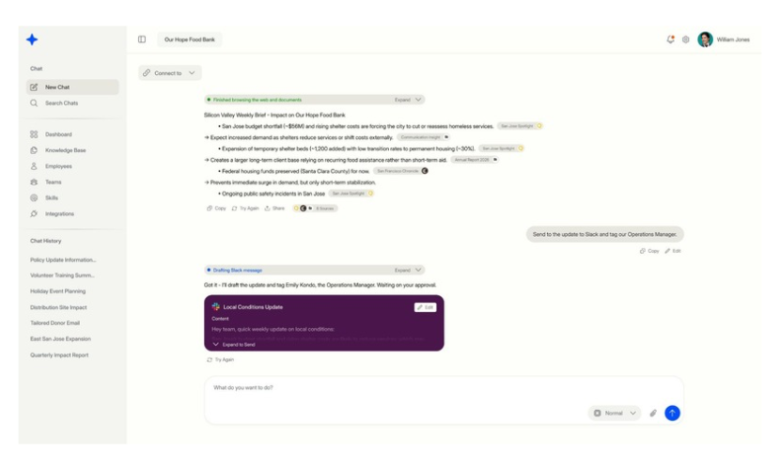
In addition, with human oversight, AI can quickly act across apps to create new project tracking tasks for grant work; draft messages to grant writing teams with supporting material for responses; or provide drafts of letters of interest tailored to each grantmaker.
With this, AI transforms the organization’s internal knowledge into highly-effective and robust communication suited to the needs of the nonprofit and the priorities of its funders. This can include other forms of communication, like donor outreach, with relevant operational data pulled in seconds, and a draft ready to edit or send in less than a minute.
Visualizing impact and data from operations for reporting
Nonprofit grant workflows must include data around impact, reach, and compliance. A major portion of teams’ most economically-valuable tasks is articulating their impact and reach. In minutes, AI can pull metrics from thousands of historical impact reports and other records to surface the most important data that would typically take staff hours to find: the strongest statistics for a grant question, the most compelling stories for donor outreach or community impact metrics from the last month.
How nonprofit leaders can support their staff in using AI
There are a number of ways through which nonprofit leaders can help staff successfully and confidently use AI.
Education and training
Nonprofit organizations often stick with the path-of-least-resistance when it comes to AI.
The key, however, is building AI that integrates with the workforce, rather than using a tacked-on solution. To utilize AI that saves time, improves existing work, and returns staff to the frontline, nonprofits have to adapt as AI advances and apply it to relevant use cases in their organization: they have to train staff how to proactively find use cases, leverage the newest features for tangible outcomes, and safely redesign workflows around AI. For example, rather than seeing AI as a tool that can search the web, nonprofit staff can find ways to apply it in their own operations, such as through using AI to find new government policy updates in real time and provide briefings on relevant expansion opportunities.
Responsible AI use policies
Over 60% of social organizations actively using AI have reported that it frees up time to focus on mission-critical work. However, only one-third of professionals believe their organization is effectively using the technology.
This gap demonstrates that social service organizations, especially nonprofits, need a centralized source of information on AI adoption that outlines appropriate tool usage; important policies to implement; how they can manage risk; and which workflows should be supported by AI.
Shared language around AI use is critical. In fact, more than 70% of organizations with stable policies and accountability report improved service delivery, whereas only 38% of organizations without policies report improved service delivery, roughly twice lower than the rate of organizations with policies.
That language should center around three pillars: sensitive data, human review and accountability for AI-generated content. These pillars matter because AI drawing on nonprofit data can surface internal operations information, and because an eloquent draft can still bring inaccuracies into an application or funder’s inbox. Therefore, it’s vital to understand how to integrate AI effectively in organizations while managing risk and ensuring accountability in service delivery.
Tying AI to tangible benefits in service delivery
Around 50% of social organizations have either not implemented AI or have little planning related to AI adoption. In contrast, those that have already implemented AI are more likely to report increased time available for mission-critical work and improved fundraising and overall revenue outcomes.
And that’s the key to AI adoption: tying the latest advancements in AI to tangible outcomes.
Spearheading the effort
AI adoption must become a functional leadership skill to allow a nonprofit to expand and grow. To move an organization to effectively integrate AI, leaders must take the initiative to begin the process: adopt the AI tools, learn and begin AI implementation.
A template: An AI-ready grant writing workflow
An AI-ready workflow requires three steps: discovery, drafting and humanization.
Discovery
Through proactive searches across the funder’s website, AI can analyze the funder’s priorities, history, eligibility and grant requirements. This can help non-profit leaders determine how they communicate about their organization beyond the broad text of a grants page.
However, a knowledge layer is critical; in addition to understanding the funder’s priorities, it can pull insights across projects, impact reports and services that connect to the grant and funder’s motivations across various data sources.
In addition, AI can learn from and identify lessons from past grants, especially in funder fit, where AI can determine the shortcomings of past work and mitigate them in the current grant.
AI, when used properly, moves grants beyond a simple summary of a request for proposals, and delves into whether the grant is a good fit for an organization. More importantly, it can support the organization’s strategy and frame their responses for the grant in a compelling way.
Drafting
After the analysis, AI can suggest how to address key points of the grant based on information across the organization’s internal knowledge base. It can recommend responses or provide guidance on communicating impact for a grant application based on relevant community reach metrics from a project hidden in hundreds of files; a partnership email highlighting future expansion plans; or community-member surveys in spreadsheets. A knowledge layer enables AI to do this in minutes.
However, one remaining core component is the ability to learn from past grants. When that information is accessible to AI, it can synthesize what worked and didn’t. It can capture writing tone, the outcome, the funder’s priorities and lessons learned, and incorporate them into new grants to mitigate shortcomings found in grant applications from the past.
Humanization
This last layer relies on human judgement: refining AI-assisted drafts or compiling information gathered by AI into a compelling response. This is key to resolving any unsupported claims or slips in accuracy that AI may have.
The bottom line
AI can help nonprofits refocus on their missions by streamlining workflows and providing actionable insights. When used strategically, it can reduce administrative tasks, enhance service delivery, boost fundraising and empower staff to better serve their communities. The goal is to equip people, not replace them.