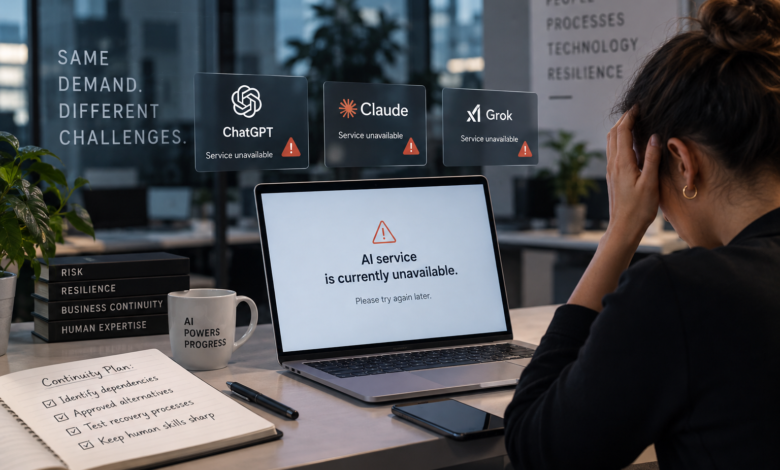
In recent years, the way we work has changed drastically. While AI once seemed like a distant, futuristic concept, it is now firmly embedded in everyday business operations. Organisations have become heavily reliant on AI tools to enhance productivity, streamline repetitive tasks, analyse information and even generate code.
Yet, as reliance grows, so does the operational impact on businesses when these services become unavailable. The most recent AI outage of popular Large Language Models (LLMs), including ChatGPT, Grok and Claude, affected an estimated 200 million users following a regional failure inside Microsoft Azure’s East US infrastructure, likely disrupting everyday operations. This raises the question of what happens when the technology employees depend on suddenly goes offline.
These outages also expose a wider gap in organisational resilience. Businesses have spent decades developing continuity plans for critical infrastructure such as cloud services, yet AI often remains outside the same level of contingency planning. As AI becomes progressively more fundamental to how organisations operate, it is time to ask whether businesses are prepared not only for AI to transform the way they work, but for the moments when it doesn’t work at all.
Downtime Doesn’t Pause Demand
When an outage occurs, daily operations remain business as usual for employees, and as a result, the demand for these tools does not disappear when they become unavailable. Employees still need to complete work tasks, meet deadlines and deliver at the same pace, but without the added support of AI that many have become heavily reliant on.
The challenge here is that AI hasn’t changed people’s roles, it’s changed how they carry them out. Tasks that previously took hours can now be completed in a fraction of the time, creating new expectations around productivity and output. Reverting to previous ways of working during an outage could therefore have a direct impact on productivity, particularly where employees have become accustomed to AI supporting core parts of their role. Organisations therefore need to consider what happens when an AI service they rely on suddenly becomes unavailable, rather than assuming employees can simply revert to working as they did before. This is where the issue can quickly move beyond a dip in productivity and into a security risk, as employees turn to workarounds to maintain their usual workflows, when AI tools are down.
One Outage Away From Shadow AI
If an organisation’s approved AI service goes down, employees may almost immediately look for an alternative. This could mean turning to unapproved AI tools or services that sit outside the organisation’s visibility and control, creating shadow AI, the use of AI tools without the oversight or approval of IT and security teams. What begins as an availability problem can therefore quickly become an acute shadow AI and data exposure problem.
As AI becomes embedded across more business functions, organisations need to identify which services have become operationally critical and establish clear fallback processes. This could include alternative approved AI services, manual workflows or predefined recovery procedures that allow employees to continue working without immediately turning to unapproved tools.
Visibility is equally important as organisations cannot effectively quantify or manage their AI risk if they do not know which tools employees are using, how they are being used or what information is being shared with them. Rather than blocking AI experimentation, businesses should provide secure, approved alternatives and establish clear controls around their use.
Lessons Learned and Building Operational Resilience
Operational resilience needs to extend beyond having alternative tools available, in the event of an AI outage. It is imperative for organisations to consider whether their employees retain the skills and knowledge required to operate effectively without AI. As organisations continue to rely on AI to write code, analyse information and perform other core business tasks, there is a risk that underlying skills and knowledge could atrophy. If an AI service becomes unavailable, teams still need enough understanding of their systems and roles to continue operating while an alternative is established. This does not mean organisations should reduce their use of AI.
Instead, AI should augment human expertise rather than replace it entirely. Employees need to retain enough knowledge to understand, challenge and operate the processes that AI is supporting. Resilience is not about preparing for a world without AI. It is about ensuring an organisation can continue operating when AI is temporarily unavailable. Organisations should therefore incorporate AI into existing business continuity and disaster recovery planning. This means identifying critical AI dependencies, establishing approved fallback processes, testing those processes and ensuring employees understand what to do during an outage.
Ultimately, the technology itself is not the problem. AI outages are inevitable, just as outages affecting other critical technologies are. The difference is whether organisations have planned for them. Businesses have spent decades establishing reliable redundancy plans around cloud infrastructure and other critical systems. As AI becomes equally fundamental to how organisations operate, it needs to receive the same level of resilience planning.
The organisations that build AI into their continuity strategies now will be better positioned to maintain productivity, security and human capability when the technology they heavily depend on inevitably goes offline.