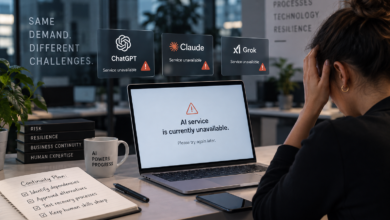
Behind the formal processes that keep banks running sits another layer of knowledge that is much harder to see. Employees build up an understanding of when to make exceptions, how to navigate disconnected systems and where judgement is needed to keep work moving. Over time, this creates ‘people debt’: critical operational knowledge that resides with individuals rather than being captured in the systems and processes around them.
As banks accelerate their use of AI, that hidden complexity is becoming increasingly difficult to ignore. Agentic AI has already been adopted by 52% of financial services firms, yet only 14% see AI as transformational to their organisational strategy and competitive advantage. Meanwhile, just 32% of senior executives can point to tangible productivity gains, while 41% do not expect AI to move the needle for years. If AI is going to close that gap, banks first need to give it a clearer understanding of the work they are asking it to transform.
The knowledge gap facing AI agents
Financial institutions run on formal policies, but they also rely on thousands of informal decisions made by experienced employees. These workers know how to move work between systems that were built at different times, hold different information and often do not communicate with each other. They know when an exception needs escalating, when a client request requires human review and when a workaround is masking a deeper process issue. Much of this knowledge is not captured in systems or standard operating procedures.
This reliance on undocumented judgement becomes a problem when AI agents are expected to take on work that has traditionally relied on human judgement. To an AI agent following the documented process, a pause or extra step may appear unnecessary. In practice, that intervention may prevent an incorrect decision from affecting a client, creating a regulatory issue or exposing the bank to financial loss. Financial services firms therefore need to understand where human judgement protects the business and where employees are compensating for outdated or poorly designed processes.
For example, when a customer makes an unusual payment, an experienced employee may draw on the customer’s history, the circumstances surrounding the transaction and previous cases to decide whether it is likely to be routine or needs further investigation. An AI agent may understand what step usually comes next, but it will not necessarily understand the context behind that decision unless the relevant knowledge has been captured. Without this understanding, AI risks reproducing existing weaknesses and workarounds, rather than removing them.
Bringing hidden knowledge into the process
AI can help firms close the people debt gap, but only if they use it to understand their work before they automate it. That starts with a simple question applied to every manual judgement in a process: is this step protecting the business, or is it patching a broken process? The first kind of knowledge needs to be captured and built into how an agent works; the second needs to be fixed, not automated.
Answering the question means finding the decision points in the first place, and the challenge is that most of it is invisible and resides outside standard operating procedures. Emerging “work graph” platforms tackle this directly: rather than relying on documented processes, they passively map how work actually flows across communication channels, ticketing systems and enterprise records, then extract the unwritten knowledge employees apply along the way. That turns judgement which has lived in employees’ heads into a living context model the wider organisation and AI agents can build on.
For example, take customer onboarding. Experienced employees know how to check documents, validate information and resolve unusual cases. Some of these judgements may never have been written down because they were developed through years of handling similar cases. Mapping the cases they escalated, the ones they cleared, and the reasoning between the two makes that judgement visible. The bank must still define when the AI agent can proceed, when it should ask for review and when a human needs to make the final decision.
The same exercise separates necessary safeguards from compensating workarounds. An extra check that catches genuine risk should be built into how the agent works; one that exists only because two systems don’t talk to each other should be designed out before anything is automated. By building a clearer picture of how work actually gets done, firms give AI the context to handle tasks reliably, while keeping people involved where experience and judgement remain necessary.
Making AI accountable across the enterprise
Incorrect or fabricated outputs can have serious consequences, especially in a regulated environment. Because agents can access information and take action across systems, implementing reliable data and effective guardrails before they begin making decisions is essential. This means institutions need to know where the data comes from, who is responsible for it and what information AI is permitted to access.
To achieve this, banks should route AI agents through a central point of control that records how they are used, rather than allowing them to operate freely across the organisation. This provides a consistent view across the enterprise and makes it easier to investigate problems when they arise.
The employees who understand how work actually gets done also have an important role to play in setting these controls. Their expertise can help define the boundaries of an agent’s role, identify when human judgement is still required, and ensure AI is used to rethink and improve how problems are solved, rather than simply being bolted onto existing processes.
Preparing banking operations for agentic AI
As AI takes on a greater role in banking operations, institutions have an opportunity to reduce their dependence on knowledge held by individual employees. Expertise built up over years should not disappear when someone changes role or leaves the organisation, nor should an agent be expected to operate without access to the context and judgement that shape how work is actually done.
Addressing people debt therefore goes beyond improving AI adoption. It gives banks an opportunity to turn individual experience into organisational knowledge that can be retained, shared and applied more consistently across the business. Banks that get this right will be better placed to use AI not simply to automate existing processes, but to improve how work is understood, governed and carried out.