Every content startup of the last two years has made a version of the same pitch: give the model your brand guidelines and let it write.
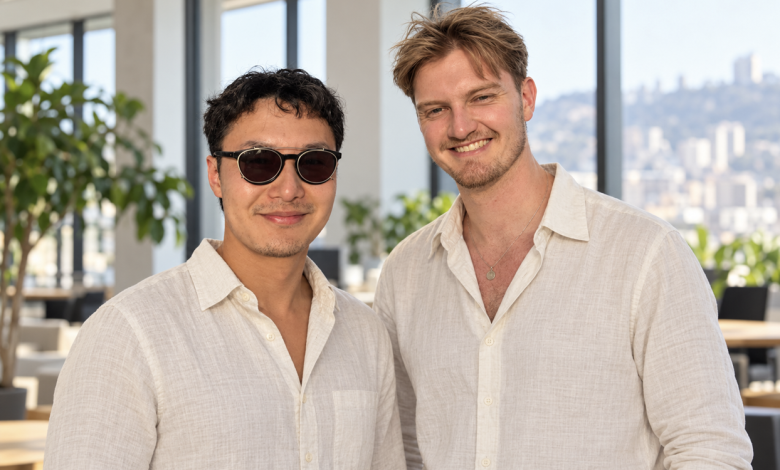
Peter Wong and Alex Saunders think that pitch has the economics backwards.
“AI made content is close to free to produce, so the scarce thing is the people inside a company,” says Wong, co-founder of Flywheel. “The hard part is scaling that.”
“The capabilities of AI are incredible, and eventually it will be able to write exactly like a human,” adds Saunders, his co-founder. “When anyone can produce the words, the value moves to who is saying them. That person’s brand, expertise and distribution is the thing you can’t generate.”
Flywheel, which the two started in 2025, is built on that bet. Its platform helps B2B leadership teams build a single company narrative and publish it through the executives who actually run the business. The company says its work has generated more than 100 million impressions across social and multi-seven figures of attributable pipeline for its customers. This month it published its manifesto, Own your Media, and named AdQuick, the out-of-home advertising platform, as a customer.
Two sides of the deal table
Wong and Saunders first built something together in 2020, co-founding Acceler8, a start-up accelerator backed by Santander. It taught them early how much distribution decides which ideas get noticed. Their careers then took them to opposite sides of the deal table.
Wong, CEO, went into M&A at Evercore, advising software and fintech companies, after roles at Rocket Internet and YC-backed startups. He worked on deals for businesses worth billions that had no narrative of their own. They didn’t go direct. They relied on an older model of communications built around press releases approved by committee.
“From the banking side, you’d see a company with a genuinely great story, and the only thing the market ever heard was a press release,” Wong says.
Saunders, CTO, saw the same thing as an investor, but he had learned the other side first. Before venture, he ran the Instagram and X accounts for his own earlier businesses, building a Twitter bot and using organic socials to drive over 50m+ impressions with no paid spend. After software engineering at Qualcomm, M&A at Nomura, and sales and trading at Bank of America Merrill Lynch, he spent three years at HSBC Ventures. He joined when the team was four people and stayed as it grew to 25. Over that period he helped deploy more than $100 million into companies including Contextual AI, Nova Credit , Techwolf AI, Poolside, Classiq, and Elliptic, and became the youngest person to sit on a portfolio company board on behalf of HSBC Ventures.
“I’d sit in board meetings where the team knew things about their market that nobody else did, and none of it ever left the room,” Saunders says. “The founders were the best marketing asset the company had, and they were posting twice a year.”
The best of both worlds
The two split the work along the lines of their backgrounds. Wong runs the company as it’s CEO leads its client relationships. Saunders leads product, engineering and partnerships.
Flywheel combines data and algorithms with traditional marketing craft. Its platform tracks what performs, what each audience responds to, and what the social feeds reward. The craft is older: one company story, told through the people who run the business, that makes the case to buyers so quietly it never reads like a pitch.
“Good marketing never feels like marketing,” Wong says. “Every post teaches the buyer something true, and over time the story does the selling.”
“The algorithms reward the same thing buyers do: a real person saying something specific,” Saunders says. “The data tells us what lands. The craft makes sure it still sounds like them.”
AdQuick goes all in on people
Los Angeles-hq’ed AdQuick, a platform for planning, buying, and measuring out-of-home advertising, is the clearest test of the thesis. The company’s own bet is that attention is moving back to the physical world. Out-of-home revenue crossed $3 billion in a single quarter for the first time this year, according to the OAAA, and in February 2026 OUTFRONT Media announced an exclusive commercial partnership with AdQuick.
When AdQuick began scaling its social presence earlier this year, it wanted to do it without the generic output that has flooded LinkedIn. Rather than lean only on paid social, it put its leaders forward. Each executive now covers the part of the story they own, from measurement and attribution to individual markets, partnerships, and events, with Flywheel running the system underneath.
“You have to go all in on the personal touch,” says Chris Gadek, AdQuick’s CEO. “Brands need to avoid AI slop, and Flywheel helps us do that.”
The results have shown up beyond the feed. A single hiring post from Gadek drew 170 adtech candidates.
The contrarian bet
Flywheel’s manifesto makes the argument directly. AI has made content close to free to produce, so the scarce resource is the people inside a company: what they know, what they have seen, and whether anyone trusts them. Volume is easy. Scaling credible voices across a leadership team is the hard part.
Neither founder frames this as a bet against AI. Flywheel uses it where it is strongest: the data, the research, and analysing what performs. The story itself stays with people, because a person is still the best at telling and drafting their own story.
“We use AI except the one place it can’t help, which is having something true to say,” Saunders says.
Wong expects the gap between companies that sound like their people and companies that sound like everyone else to keep widening as AI-generated content gets cheaper. “The companies that win will be the ones whose people the market actually knows,” he says.
Saunders puts it more simply. “Eventually the model will write exactly like you. It still won’t be you.”