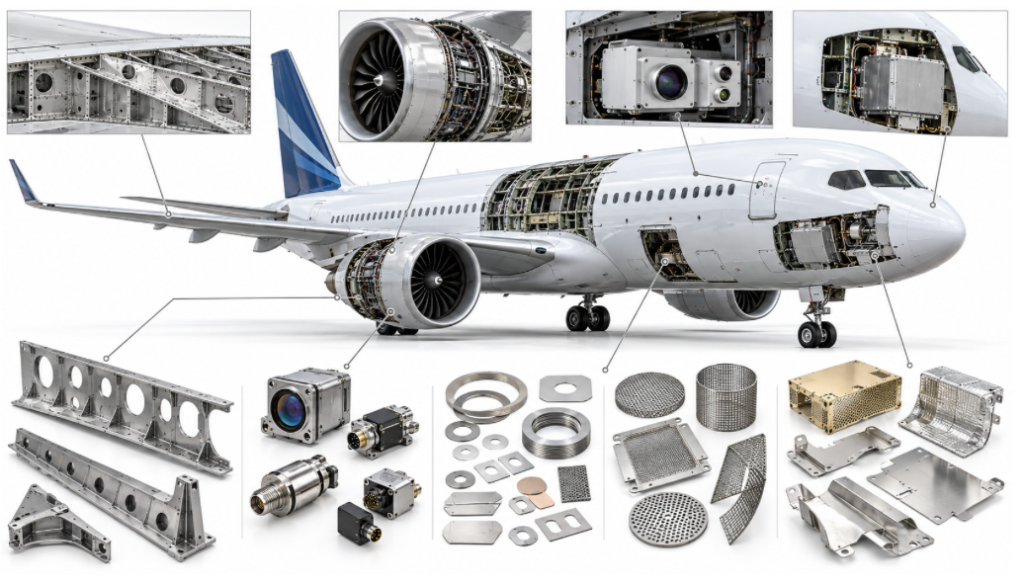
AI is changing how aerospace systems monitor conditions, process information, and support decisions. Modern aircraft can use AI for predictive maintenance, sensor fusion, anomaly detection, navigation support, and automated control. But every algorithm still depends on physical hardware that collects and moves information through the system. For selected thin metal parts used around sensors, motion-control systems, and avionics, chemical etching provides one way to manufacture detailed precision components.
AI may process the data, but hardware still determines how that data enters the system.
AI Still Begins With Physical Sensors
An aerospace AI system does not start with a dataset.
It starts with a physical event.
That event may involve:
- Position.
- Speed.
- Pressure.
- Temperature.
- Vibration.
- Light.
- Rotation.
- Electrical current.
Sensors convert these physical conditions into signals that can be processed by avionics and control systems.
A simplified chain may look like:
Aircraft Condition → Sensor → Avionics → Data Processing → AI Model → Decision or Control Action
Errors at the beginning of this chain can affect everything that follows.
That is why precision hardware still matters even as aircraft software becomes more advanced.
Sensors Need More Than Electronics
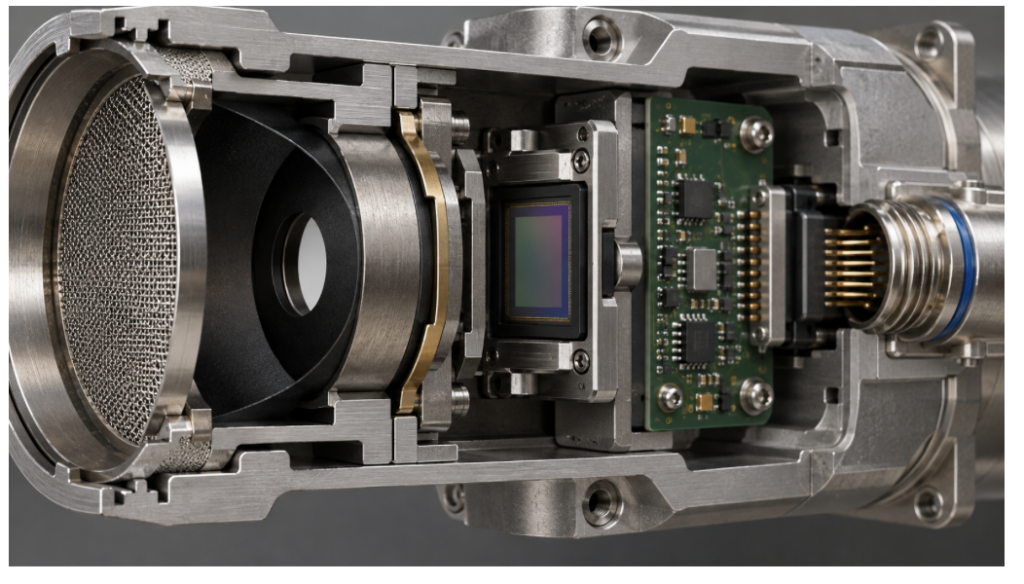
A sensor is not only a chip.
It also depends on mechanical and electrical components around it.
An optical sensor may require a defined aperture. A pressure sensor may need controlled access to the surrounding environment. A motion-control system may depend on accurate rotational feedback.
Other surrounding components can include:
- Thin sensor plates.
- Electrical contacts.
- Protective screens.
- Mounting features.
- Precision spacers.
- Shielding structures.
These parts do not make the AI model intelligent.
Their role is to support the physical system that generates and transfers the information used by the software.
Encoder Discs Support Position Feedback
Motion control is a good example of the connection between AI and precision hardware.
An automated or intelligent system may calculate where an actuator should move, but the controller still needs feedback to confirm the actual position.
A simple control loop may look like:
Command → Motor or Actuator → Encoder → Feedback → Controller → Correction
The encoder is part of the physical measurement layer.
Precision encoder discs can contain repeated slots, code patterns, reference marks, and detailed circular geometry.
Depending on the encoder design, these patterns help an optical or sensing system detect angular position, speed, or movement.
The quality of the complete encoder depends on far more than the disc itself, including optics, electronics, mounting, calibration, and system design. Still, the geometry of the code disc remains an important physical element in the feedback chain.
Mechanical Alignment Still Matters
Advanced software cannot fully compensate for a component that is physically installed in the wrong position.
Aerospace sensors, optical modules, actuators, and electronic assemblies often need controlled spacing and alignment.
This is where precision metal shims can be useful.
A shim may help control:
- Component spacing.
- Mounting height.
- Sensor position.
- Optical alignment.
- Mechanical gaps.
- Assembly stack-up.
Custom shims can also contain holes, slots, internal openings, or irregular external profiles.
They are simple parts, but they can support consistent physical geometry within a more complex system.
Avionics Also Creates an EMI Challenge
Modern aircraft contain dense electronic systems.
Sensors, processors, communication modules, power electronics, displays, and control systems may operate within limited physical space.
As electronics become more concentrated, electromagnetic compatibility remains an important engineering consideration.
Metal shielding structures can help separate sensitive electronics from unwanted electromagnetic interference.
Again, the complete result depends on enclosure design, grounding, material selection, seams, frequency range, and system architecture.
Precision manufacturing only addresses one part of that larger problem.
Where Chemical Etching Fits
Chemical etching, also known as photochemical etching or photo etching, removes selected areas from a thin metal sheet.
The basic process begins with cleaned metal coated in a light-sensitive photoresist.
Digital artwork defines the required geometry.
After exposure and development, an etchant removes the unprotected metal.
The finished sheet can contain:
- Fine holes.
- Narrow slots.
- Encoder patterns.
- Apertures.
- Grids.
- Tabs.
- Complex outer profiles.
This makes the process relevant to selected thin, flat aerospace components that contain detailed two-dimensional geometry.
Why It Fits Certain Precision Components
Chemical etching has several characteristics that can be useful during aerospace component development.
No Direct Mechanical Cutting Force
The process does not use a cutting tool that presses directly against the sheet during profile creation.
This is useful for thin parts with delicate geometry.
No Laser Heat-Affected Zone
The profile is not created with a concentrated laser beam.
This avoids laser-related heat-affected zones around the cut geometry.
Digital Phototooling
Engineers can revise many flat component features by updating digital artwork.
This can be useful during prototype and validation stages when dimensions, slot patterns, apertures, or external profiles are still changing.
Multiple Features in One Flat Pattern
Holes, slots, grids, reference marks, and external profiles can all be included in the same two-dimensional component design.
Not Every Aerospace Component Should Be Etched
Chemical etching is not a universal aerospace manufacturing process.
Different components need different methods.
CNC machining is generally better suited to thick structural parts and three-dimensional geometry.
Laser cutting can be effective for many flat sheet-metal profiles, especially when the material is thicker or the required geometry is less delicate.
Stamping can offer strong economics for mature designs produced at very high volume.
Chemical etching becomes more relevant when the component is:
- Thin.
- Flat.
- Detailed.
- Feature-dense.
- Sensitive to tooling changes during development.
The correct process depends on material, thickness, tolerance, geometry, production volume, secondary operations, and inspection requirements.
Smarter Aerospace Systems Still Need Precise Hardware
AI is adding new capabilities to aerospace systems, but it does not replace the physical layer beneath them.
Sensors still need controlled interfaces with the environment. Motion systems still need position feedback. Avionics still require reliable mechanical integration, electrical connection, and electromagnetic control.
Precision metal components form one small but important part of that structure.
Chemical etching can support selected aerospace applications where thin material, detailed flat geometry, and flexible digital tooling are important.
As aerospace systems become more intelligent, the relationship between software and physical hardware will become even more important—not less.