Overview
Automotive manufacturers are now taking advantage of the infrastructure that has been built to add connectivity, sensors, software and telematics in order to better understand the experience of the customers with their vehicles.
Connected Vehicles NPS Analytics combines customer experience technology with car-generated data to gain a more coherent understanding of their level of satisfaction. Instead of solely depending on periodic surveys, the manufacturers can get access to signals coming from telematics, infotainment systems, connected applications, charging sessions, software updates, service interaction and vehicle diagnostics.
The key moment here is not only the increasing quantity of data produced by modern vehicles, but also the possibility to analyze the data with the help of AI and machine learning.
Thus, an unexploited synergy of engineering, software development, data science and intelligence is becoming possible.
From Periodic Surveys to Continuous Vehicle Intelligence
Regular Net Promoter Score (NPS) systems depend on information that is gathered exclusively at one moment in time. A driver is often asked to provide feedback regarding how likely they are to suggest a vehicle or brand after having bought the vehicle or visited a service department. This practice is still effective but connected vehicles enable us to collect information about events that occur in between the moments of those surveys.
A modern vehicle can generate large volumes of operational information through its connected systems. Depending on the vehicle architecture, this may include:
- Vehicle health and diagnostic information
- Infotainment and connectivity events
- Navigation and application usage
- Remote vehicle functions
- Charging activity in electric vehicles
- Over-the-air software updates
- Warranty and service events
- Repeated technical failures
Each individual signal provides only limited information about customer sentiment. When several signals are analyzed together, however, they can provide context around why a particular ownership experience may be positive or negative.
The objective is not to replace customer surveys. Instead, connected-data analytics can complement direct feedback by showing what was happening with the vehicle when that feedback was generated.
How AI Changes Automotive Customer Intelligence
The major technological development is the ability to process different types of automotive information simultaneously.
Machine learning models can identify relationships between operational events and historical customer feedback. For example, repeated connectivity failures may appear alongside lower satisfaction scores. Engineers can then investigate whether the problem is connected to a particular software version, vehicle configuration, geographic region, or service process.
Another addition is through natural language processing. The service center remarks, customer support discussions, web reviews, and Feedback reports are filled with unstructured data which traditional dashboards might find difficult to analyze at scale.
AI systems can categorize recurring themes such as:
- Connectivity complaints
- Charging difficulties
- Software instability
- Navigation problems
- Mobile-app performance
- Delayed service resolution
- Repeated warranty concerns
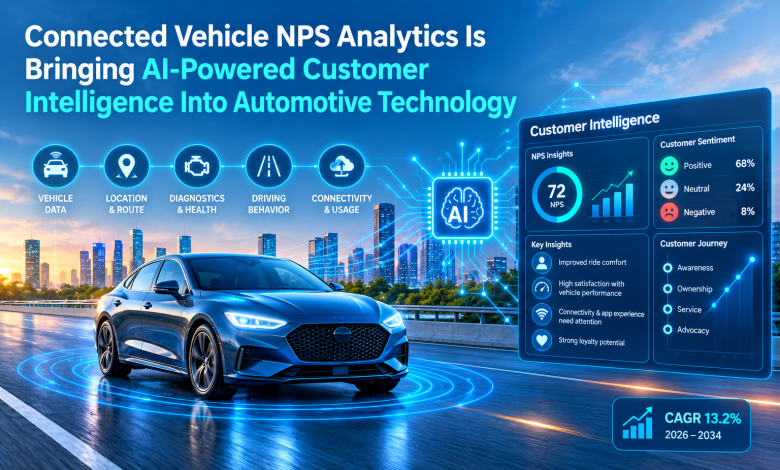
Anomaly detection can also identify abnormal changes in the behavior of vehicles or services. This allows the team to explore new issues before they turn into serious complaints from customers. The commercial perspective also emphasizes that this technology is becoming more relevant. The Connected Vehicle NPS Analytics market was worth $3.2 billion in 2025 and in 2034 will rise to $9.8 billion at a CAGR of 13.2% from 2026-2034 as per Dataintelo research. This means that there is more interest to apply connected vehicle data for customer experience or software efficiency.
The Data Foundation Already Exists
Connected Vehicle NPS Analytics is possible because manufacturers already collect substantial amounts of information through connected vehicle infrastructure.
A U.S. Government Accountability Office review found that 13 of 16 major automakers it examined offered connected vehicles capable of collecting and transmitting data wirelessly. Those 13 automakers reported collecting vehicle health and location information.
The same review identified significant differences in connected-service adoption. The usage of connected services by customers varied depending on the manufacturer, and the percentage is anywhere from below 50% to 100% depending on the manufacturer.
This difference is significant. The fact that a connected feature is underused does not necessarily indicate that it is not working properly. The feature might not be easy to understand, inconvenient to use, work improperly, or not meet the driver’s expectations with regard to everyday driving. Collecting usage data, along with consumers’ feedback, may assist companies in making good judgments about these alternatives.
Where Telematics Meets Customer Experience
The most valuable opportunity may come from connecting engineering information with customer-experience information.
Consider an electric vehicle driver who experiences repeated charging interruptions. An engineering dashboard may record a charging-system event, while a customer-service platform may separately record a complaint.
An integrated analytics system can potentially connect these events.
The same principle applies to navigation failures, mobile applications, voice assistants, software updates, remote-start functions, and other digital services.
A connected customer-intelligence workflow can therefore follow a simple cycle:
- The vehicle generates operational data.
- AI identifies recurring or unusual patterns.
- Customer feedback provides sentiment context.
- Engineering teams investigate the underlying issue.
- Software or service improvements are introduced.
- Subsequent data helps measure whether the experience improved.
This closed-loop approach becomes particularly important as vehicles become increasingly dependent on software.
Software Is Becoming Part of the Ownership Experience
The experience of ownership can no longer be defined by mechanical performance alone. Software now has implications for navigation, entertainment, driver aids, smartphone connectivity, power interfaces, digital dashboards, and remote operations. With the help of a satellite, automotive companies can also upgrade the cars’ software after creating deliveries. Now, some issues can be resolved with software updates without forcing every customer to visit the dealers. Nevertheless, it must be mentioned that software updates can lead to new challenges.
A successful update may resolve a recurring connectivity problem and improve satisfaction. A poorly performing update may create application failures, interface problems, or other frustrations. Customer intelligence can help organizations understand these effects. Instead of examining software performance and customer satisfaction as two separate measurements, manufacturers can analyze them together and identify whether changes in digital performance correspond with changes in customer sentiment.
This makes customer intelligence increasingly relevant to software engineering and product-development teams.
Data Quality Determines AI Quality
Sophisticated AI cannot compensate for inconsistent or incomplete data.
Automotive manufacturers operate different vehicle architectures, telematics platforms, mobile applications, software systems, and service databases. Even the definition of a connectivity failure can vary between manufacturers.
This creates challenges for benchmarking. Before comparing customer-experience signals across models or regions, manufacturers need consistent definitions for technical events, service interactions, customer complaints, and satisfaction measurements.
Data quality also needs to be monitored over time. A machine-learning model trained on one generation of vehicle technology may produce less reliable results when a manufacturer introduces a new electronic architecture or software platform.
Continuous model validation is therefore important. The goal should not simply be to collect more information. The goal is to collect reliable information that can answer specific business and engineering questions.
Privacy Becomes a Core Technology Issue
The more customer intelligence systems learn from vehicle data, the more important data governance becomes. The GAO review identified significant differences in automakers’ privacy practices. It found that the privacy notices examined were not consistently written in plain language, while only 2 of 15 reviewed notices identified the full set of purposes for which collected data was used.
Data retention also varied. 12 of 13 automakers reported limiting how long they retained connected-vehicle data, but retention periods differed considerably.
These findings have direct relevance to AI-powered customer intelligence.
An information processing system, which is capable of utilizing vehicle-related data like where the vehicle is being used, how it is used, service history, applications it is integrated with, and interactions of the driver with the vehicle. The more advanced technology is responsible for gathering certain information and thus it is important to make sure that customers know what information is being processed. Privacy should, therefore, be taken into account from the very beginning of the system’s architecture, rather than to leave this question to be dealt with later.
Building a Responsible AI Framework
The future generation of automotive customer intelligence will assure more than sophisticated algorithms. An effective framework must use the power of AI while also ensuring strict governance and human oversight. Some of the necessary elements include:
- Minimum data: Data should be collected only for a specific purpose.
- Transparency: What data about the vehicle is being collected and how it is used must be explained.
- Security: Privacy of the connected vehicle and customer data must be assured.
- Model validity: AI systems must be periodically tested for effectiveness and validity.
- Human oversight: The engineering team and customer experience team should have access to crucial findings generated by the AI.
- Retention controls: Establish appropriate limits for storing vehicle and customer information.
These safeguards can help ensure that customer intelligence improves the ownership experience without creating unnecessary privacy risks.
The Road Ahead for Automotive Customer Intelligence
Connected vehicles are changing how manufacturers deal with data created by their vehicles. Traditionally, engineering systems measured the performance of the vehicle while the systems measuring customer satisfaction functioned separately. Connected Vehicle NPS Analytics allows for the simultaneous consideration of two aspects. The system uses artificial intelligence to combine structured vehicle data with unstructured customer feedback. The combination of those data sources may lead to the discovery of patterns that can be hard to spot without AI that can provide manufacturers with a more complete picture of the ownership experience.
The opportunity is expected to grow in significance as vehicles with software-defined features are expected to increase in popularity alongside electric vehicles, connected services, and over-the-air updates. However, the top customer intelligence systems are not necessarily those that gather maximum data – they are the systems that are able to identify valuable signals, ensure high data quality, keep the customers’ privacy intact, and transform analytical insights into actual results. Therefore, connected vehicle NPS analytics is more than just one more automotive analytics tool, as it can indicate the move to another era in automotive technologies, which means using connected vehicle data to understand the performance metrics along with customers’ experience with the vehicle.
References:
https://www.gao.gov/products/gao-17-656
https://www.transportation.gov/research-and-technology/how-connected-vehicles-work