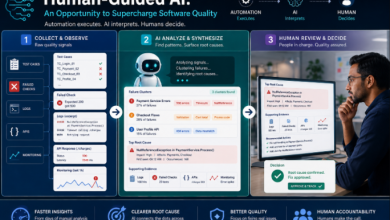
Automation can make a broken process fail faster and with less visibility. An evidence ladder gives systems leaders a disciplined way to separate what can be seen, what can be reproduced, and what has actually been verified before they automate a fix.
The Automation-Before-Diagnosis Failure
Automation is often introduced at the moment a team feels the most operational pain. Leads appear to be getting lost, response times seem slow, reports disagree, or a handoff feels unreliable. Under pressure, the fastest-looking response is to add a workflow, an AI agent, or another integration.
That response can turn uncertainty into automated uncertainty. A new workflow may reproduce an incorrect ownership rule, accelerate duplicate outreach, or hide an upstream tracking failure behind a polished notification. The organization gains activity without gaining confidence that it solved the right problem.
The diagnostic question should therefore come before the automation question. Instead of asking, “What can we automate?”, ask, “What failure has been observed, what evidence supports it, and what remains unverified?” That change in sequence is small, but it alters the quality of every decision that follows.
What a Visible Workflow or Dashboard Cannot Prove
A workflow builder can show that a rule exists. It cannot, by itself, prove that the rule executed for the relevant records, reached the intended destination, or produced the intended business outcome. A green status indicator may describe configuration health while saying nothing about exceptions, latency, ownership, or downstream reconciliation.
Dashboards have similar limits. A chart can faithfully display the data it receives while an underlying event is missing, duplicated, delayed, or mapped to the wrong stage.
The distinction is not an argument against the tools. It is an argument for treating them as evidence with a defined ceiling. The OpenTelemetry observability primer similarly explains how traces, metrics, and logs support understanding why a system behaves as it does.
An Evidence Ladder from E0 to E4
An evidence ladder makes the ceiling explicit. Each level answers a stronger question than the one before it, and no level should be silently promoted into the next.
E0 — Unverified Statement
E0 is a concern, recollection, or assertion worth testing: “Sales never receives these leads,” or “The automation stopped working last month.” It is useful for defining the investigation, but it cannot support a finding.
E1 — Public Observation
E1 is a bounded, visible fact: a public form displays a confirmation state, a route returns a particular status, or a page exposes a defined field. It establishes what an outside observer can see, not what happens inside a CRM, queue, or reporting system.
E2 — Reproduced Behaviour
E2 is a controlled, permissioned test with a repeatable result. A synthetic submission may reproduce a missing confirmation, a routing delay, or a duplicate notification. It supports the observed behaviour under the test conditions, but not its population frequency or financial impact.
E3 — Internal Operational Evidence
E3 connects the observation to internal execution state. Examples include workflow-run history, CRM record history, queue events, task creation, delivery logs, and ownership rules. This can verify whether a configured process ran and where it stopped, but it still does not establish a downstream business outcome without reconciliation.
E4 — Reconciled Outcome Evidence
E4 joins the source event to an explicitly defined outcome and accounts for exceptions. It may reconcile a permissioned test or operating cohort across capture, CRM, handoff, booking, and outcome records. Even here, the evidence supports the defined relationship; it does not create causal certainty by itself.
This ladder is adapted from a broader revenue systems diagnostic methodology that separates public observation from internal verification. The same principle applies beyond revenue operations: stronger decisions require stronger provenance, an idea formalised in the W3C PROV data model through records of entities, activities, and agents.
Confidence Requires Competing Hypotheses
Evidence level and confidence are related but not identical. Confidence should rise only when evidence supports the proposed explanation and credible alternatives have been tested.
If a lead appears not to reach a sales queue, possible causes include an integration delay, a rejected value, a routing condition, an ownership change, or a reporting filter. A second notification may create noise without restoring the path.
A confidence scale can run from C0 unknown, through C1 tentative and C2 supported, to C3 corroborated and C4 verified within a defined scope. C4 requires a reproduced result, internal corroboration, a named owner, and an explicit limitation.
A Compact Finding Record
The finding record bridges diagnosis and implementation. It prevents a hypothesis from becoming a fact through repetition.
A useful record contains:
- the observed condition and the surface where it appeared;
- the evidence level and exact evidence reference;
- the current hypothesis and at least one competing hypothesis;
- the confidence level and the reason for it;
- the affected workflow, owner, and decision boundary;
- the potential impact class, without an invented amount;
- the next verification step;
- the limitation or claim ceiling;
- the proposed action only after the verification gate is met.
Another operator should be able to inspect the evidence, challenge the hypothesis, and understand why a change was authorised.
Fictional Example: A Lead That “Disappeared”
The following example is fictional. A service business sees a paid-campaign lead in an advertising platform but cannot find the person in the sales team’s working view. The initial statement, “The CRM lost the lead,” is E0.
A public check confirms that the form loads and displays a success message, which is E1. A permissioned synthetic submission reproduces the same success state and creates an event in the form tool, but no record appears in the expected sales view; that is E2.
Internal history shows that the CRM record was created and assigned to a holding owner because a territory value was blank. That E3 evidence eliminates the hypothesis that the record was never created. A reconciled test joins source event, CRM creation, corrected mapping, final ownership, and task creation, reaching E4 for this path.
The appropriate fix is not “add an AI follow-up agent.” It is to correct and test the territory contract, define exception ownership, and alert on holding-queue age. Automation becomes useful after the failure mode and its fallback are understood.
Human Ownership, Fallback, and Observability
Every automated workflow needs a human operating boundary. Someone must own the input contract, exception queue, change approval, and response when the workflow cannot complete.
Fallback design is equally important. A valid workflow should define what happens when data is incomplete, a destination is unavailable, a model is uncertain, or a downstream action is rejected. “Do nothing” may be a legitimate fallback, but it must be visible and intentional.
Observability should follow the decisions that matter: correlation, state transitions, outcomes, exceptions, and final disposition, without unnecessary personal data. The NIST AI Risk Management Framework provides a governance backdrop for incorporating trustworthiness across design, development, use, and evaluation.
Pre-Automation Verification Checklist
Before approving an AI workflow or conventional automation, confirm that the team can answer these questions:
- What exact failure are we trying to change?
- Is the current statement an observation, a hypothesis, or a verified finding?
- What evidence level supports it?
- Which competing explanations remain plausible?
- Can the behaviour be reproduced with permissioned synthetic data?
- Which internal records are required to verify execution?
- What data contract and ownership rule govern each handoff?
- What happens when data is missing or the destination fails?
- Which events, decisions, and exceptions will be observable?
- Who reviews failures, and within what operating boundary?
- What must be true before the automation is enabled?
- What evidence would justify disabling or rolling it back?
Limitations and Claim Boundaries
An evidence ladder does not guarantee completeness. Logs may be unavailable, historical data inconsistent, and a controlled test unrepresentative of every production condition. The framework improves decision quality; it does not remove uncertainty.
Public signals cannot prove internal execution, population-wide frequency, financial loss, or causal impact. Internal operational evidence can verify a path while still leaving downstream outcomes unresolved. Any estimate should be labelled as an estimate, tied to explicit assumptions, and kept separate from a verified finding.
The ladder does not decide whether automation is worthwhile. Cost, risk, maintainability, governance, and operating ownership still matter. Sometimes the right result is a process change, a clearer field definition, or no automation.
Verify the Failure, Then Automate the Fix
The strongest automation programmes do not begin with a catalogue of tools. They begin with a precise account of the failure, the evidence that supports it, the hypotheses that remain, and the owner who can act when reality diverges from the design.
An evidence ladder turns that discipline into a shared operating language. It slows the team down only long enough to avoid automating the wrong explanation, then gives implementation a clearer contract: what to change, how to observe it, where it can fail, and what would count as proof that the change worked.
References
- National Institute of Standards and Technology, AI Risk Management Framework
- OpenTelemetry, Observability Primer
- World Wide Web Consortium, PROV-DM: The PROV Data Model
- OmniLabs Systems, Revenue Systems Diagnostic Methodology