The conversation around AI in software engineering has largely focused on one question: How much code can AI write?
That question is quickly becoming less interesting. Coding agents can already generate functions, modify applications, create tests, explain unfamiliar repositories and execute increasingly complex development tasks. But writing code is only one part of delivering software.
In most engineering organizations, the larger source of friction is everything that happens between the moment a requirement is created and the moment working software reaches production. Product writes a requirement. Engineers discover the affected systems. A technical design is created and reviewed. Development begins. Testing follows. Eventually, Product asks the inevitable question: When can we release it?
Each transition is a handoff, and every handoff creates an opportunity for context to disappear. Requirements are reinterpreted, architecture becomes separated from implementation, dependencies surface late, and estimates gradually become commitments.
The bigger opportunity for enterprise AI is not simply automating code generation. It is automating the flow of engineering context across the entire Software Development Life Cycle while preserving human judgment at critical gates.
The Missing Layer Is Orchestration
Imagine a product manager submits a requirement such as: “Add curbside pickup eligibility to product search results.” A conventional workflow might create a ticket and eventually assign it to an engineering team. An Autonomous SDLC should first investigate the requirement.
- Which service owns the response?
- Where does the required data originate?
- Does an existing interface already expose the capability?
- Which architecture decisions constrain the design?
- What performance, security and resilience requirements apply?
- Has the organization implemented something structurally similar before?
This is where the SDLC Orchestrator becomes more important than any individual coding agent. Its responsibility is to manage the lifecycle of the requirement, invoke specialized capabilities, preserve artifacts between stages, and enforce the gates that cannot be bypassed.
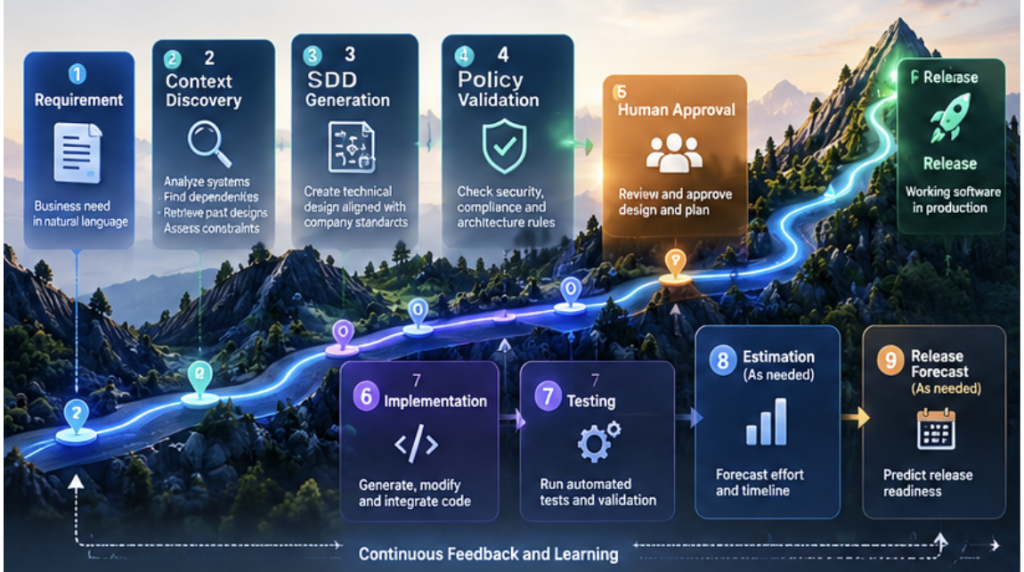
Figure 1. End-to-end Autonomous SDLC flow
Architecture Knowledge and Company-Wide Engineering Standards
Most organizations already possess much of the knowledge required for this workflow, but it is fragmented across architecture decisions, previous designs, API contracts, engineering standards, tickets and source code. Retrieval can make this information queryable, but retrieval alone does not answer a second enterprise problem: how can every engineering agent follow the same organizational rules?
A company-wide Model Context Protocol (MCP) layer can provide a standardized interface through which agents discover and consume governed engineering guidance and capabilities. Instead of embedding rules independently into every agent prompt, the organization maintains them centrally and exposes them consistently.
- Required SDD sections and documentation standards
- Approved and prohibited architecture patterns
- API and integration guidelines
- Security and data-handling requirements
- Observability, logging and operational expectations
- Performance and resilience standards
- Testing and quality requirements
- Technology-specific engineering guidance
- Required reviewers and approval gates
This creates an important separation. Retrieval provides historical and system context: how the organization’s systems work and what decisions were made previously. MCP provides a standardized way for agents to access the current governed rules, tools and guidance they must follow. The SDLC Orchestrator determines when each capability is invoked, while the workflow engine and human reviewers determine whether the process may proceed.
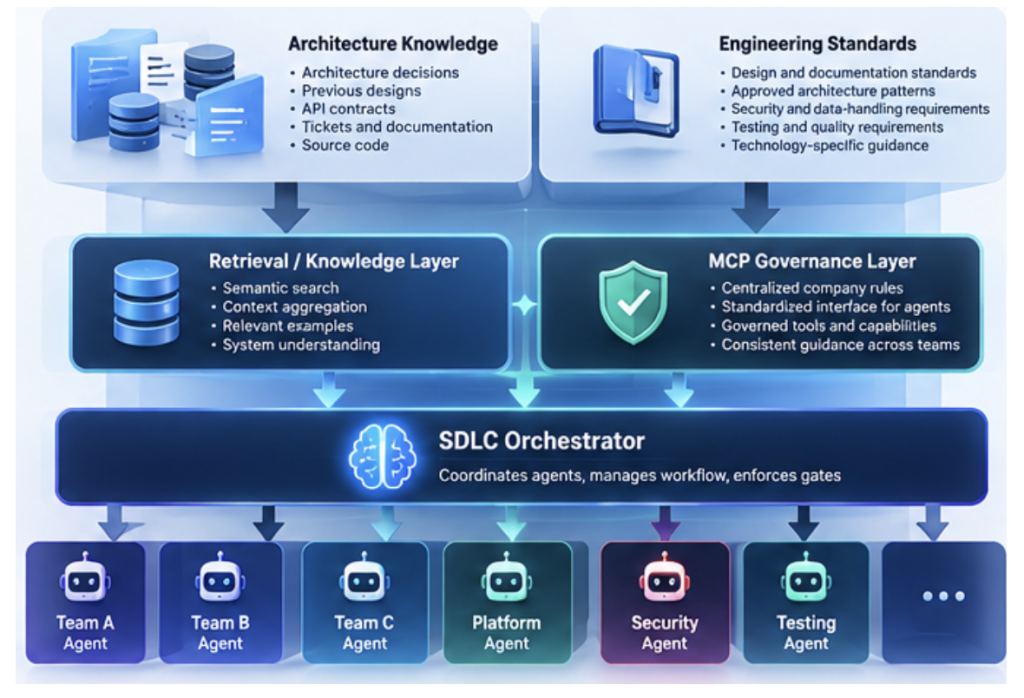
Figure 2. Shared company standards across many engineering agents
Why MCP Matters for Enterprise Adoption
Without a shared standards interface, every team risks teaching its agent a different interpretation of how software should be designed. Prompts drift. Local copies of guidelines become stale. A policy change may require dozens of agent configurations to be updated.
With centrally governed MCP capabilities, teams can adopt different agents and models while still consuming the same organizational standards. When an engineering rule changes, the governed source changes once. Agents discover the current guidance when they work.
This also enables policy validation before human review. An SDD can be checked against mandatory organizational requirements before it reaches a Principal Engineer or engineering manager, allowing human reviewers to spend more time on architectural judgment rather than repeatedly identifying basic standards violations.
Architecture Has to Be Time-Aware
Retrieval introduces its own risk: enterprise documentation has a lifecycle. An old architecture document may remain semantically relevant even after the underlying system has changed. Previous SDDs may describe deprecated patterns. Conflicting decisions may coexist.
A trustworthy knowledge layer therefore needs metadata such as ownership, architecture version, approval status, last verification date and superseded-by relationships. The goal is not simply searchable architecture; it is queryable, attributable and time-aware architecture.
Human Approval Should Be an Architectural Feature
Human approval should not be an afterthought added after automation. It should be part of the system architecture. Consider a policy that implementation cannot begin until a proposed design has been approved by an authorized technical reviewer.
The SDD should therefore be a persistent, versioned artifact with explicit workflow states. The AI can generate and revise the artifact; the workflow engine owns state; authorized humans own consequential approval decisions.
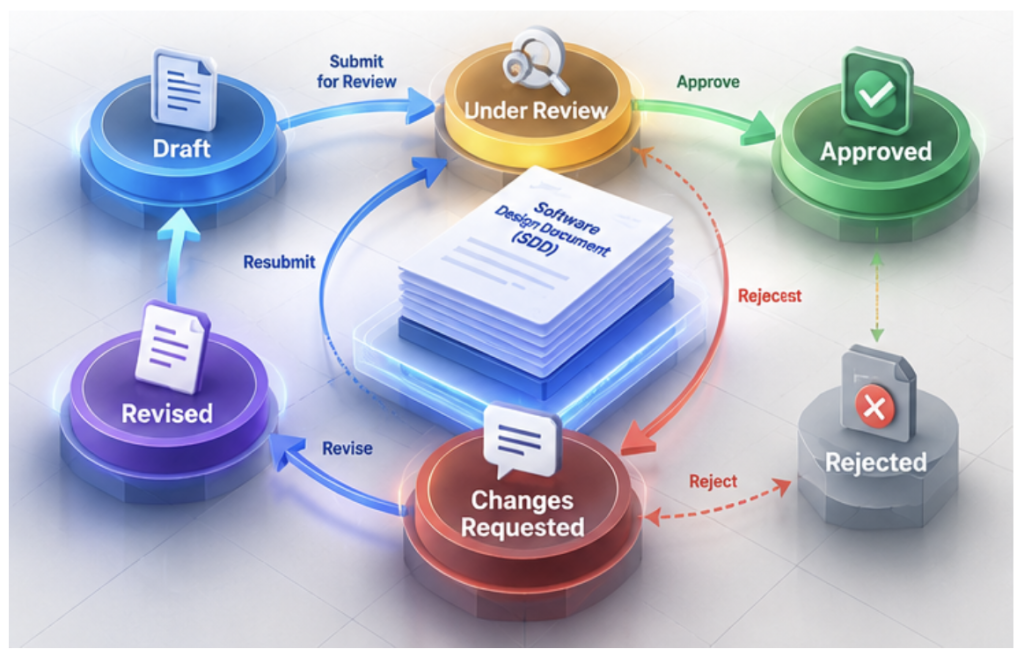
Figure 3. SDD approval state machine
Once approved, the SDD becomes a bounded technical specification for implementation. Coding agents no longer need to interpret a vague requirement, invent an architecture and write code simultaneously. The approved design also becomes a validation artifact: the system can identify implementation choices that deviate from the reviewed architecture and route them back for human judgment.
Testing and Observability Close the Loop
Implementation should not mark the end of the agentic workflow. The approved SDD, acceptance criteria, API contracts and existing regression coverage can also become inputs to specialized testing capabilities.
Reusable engineering skills can instruct testing agents how the organization expects regression suites to be constructed. An agent can inspect the affected interfaces, retrieve existing test cases, identify gaps introduced by the change and generate or modify the required regression scenarios.
Those test cases should not exist only inside an agent session. They can be stored in a centrally governed test repository with metadata such as the owning service, associated requirement, API contract, version, expected behavior and execution history. Exposing this repository through MCP allows coding and testing agents to discover, execute and maintain the same regression assets rather than recreating them for every task.
This becomes especially useful as organizations adopt multiple agentic development environments. A developer working through tools such as Devin, for example, could use the same governed MCP capabilities to retrieve existing regression suites, execute them, inspect failures and propose controlled updates to centrally managed test cases.
Functional correctness, however, is only one dimension of validation. The orchestrator can also provide controlled MCP access to observability platforms such as Prometheus, Kibana or Splunk. After a change is deployed into a validation environment, an evaluation agent can examine regression results alongside latency, error rates, resource utilization, logs and other operational signals.
The workflow then becomes a feedback loop rather than a one-way pipeline. If a change passes functional tests but violates a performance or resilience requirement defined in the approved SDD, the orchestrator can return the evidence to the implementation agent, request a bounded correction and execute the evaluation again. A change becomes complete only when it satisfies the functional, architectural and operational expectations established earlier in the lifecycle, with human approval retained wherever organizational policy or risk requires it.
Evaluation History Becomes Engineering Data
The evaluation process also creates a new source of organizational knowledge. Regression outcomes, performance deltas, failed approaches, remediation attempts and final deployment results can be stored as structured engineering history. Future agents can use that evidence when evaluating similar requirements, selecting implementation approaches and estimating delivery risk.
This extends estimation beyond tickets and story points. Historical evidence can include actual implementation complexity, regression failures, the number of remediation cycles, performance impact and deployment outcomes, creating a stronger empirical basis for delivery forecasts.
Estimation Should Be Evidence, Not Guesswork
The same connected lifecycle makes estimation more useful. Asking a language model to assign story points from a requirement alone is unlikely to produce a trustworthy result. Story points are relative and team-specific.
After design approval, however, the platform knows the affected systems, dependencies and likely implementation scope. It can compare the proposed work with historically completed changes and present an evidence-backed range rather than a single generated number.
Instead of: “This is five story points.”
The platform can say: “Comparable completed changes were estimated between five and eight points; based on the current design and affected systems, five to eight is the likely range.”
Historical team throughput can then inform delivery forecasting. But velocity is noisy: incidents, vacations, blocked dependencies, changing priorities and scope growth all affect delivery. The output should therefore be probabilistic rather than a precise promise.
Example: “Based on comparable work and recent team throughput, there is an 80% probability that this feature will complete between Sprint 24 and Sprint 25.”
The objective is not to eliminate uncertainty. It is to quantify and communicate it.
A Reference Architecture for the Autonomous SDLC
A practical platform can be understood as six cooperating layers:
| Layer | Responsibility |
| 1. Knowledge Layer | Architecture decisions, SDDs, API contracts, engineering history and repository context. |
| 2. MCP Governance Layer | Standardized access to current company rules, guidelines, approved tools and engineering capabilities. |
| 3. Agent Layer | Requirement decomposition, discovery, design generation, coding, testing and validation. |
| 4. Orchestration & Workflow | Lifecycle management, artifact transitions, role-based gates and human approvals. |
| 5. Estimation Layer | Historical similarity, effort ranges, throughput analysis and probabilistic release forecasting. |
| 6. Audit & Governance | Traceability of retrieved context, rules applied, agent actions, revisions, approvals and forecasts. |
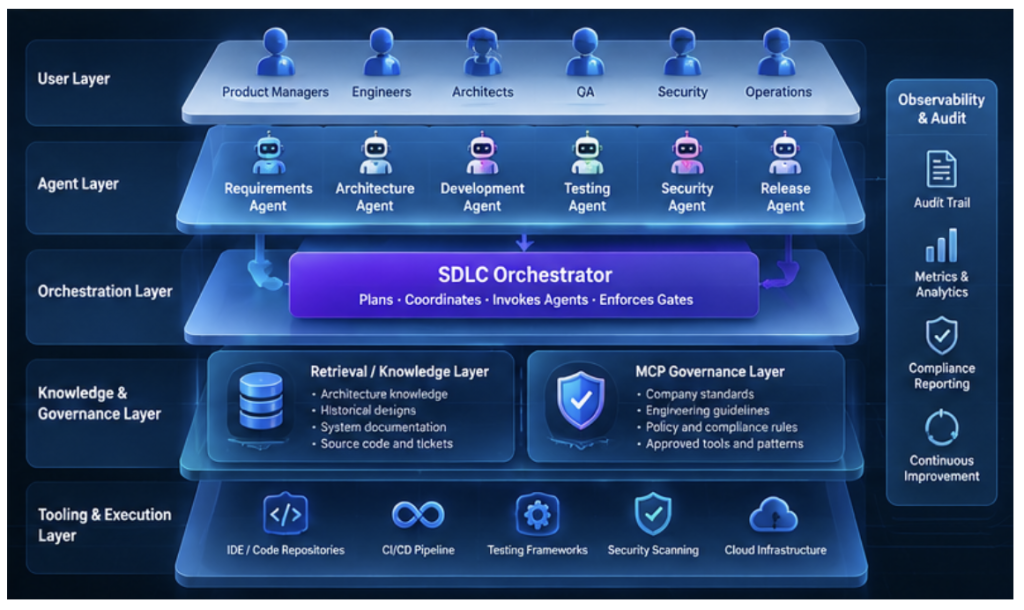
Figure 4. High-level enterprise architecture
The Autonomous SDLC Is a Human-AI System
The word autonomous can imply a system in which requirements enter one side and production software emerges from the other without human involvement. That is neither the most realistic nor the most useful objective.
The stronger model is a human-AI engineering system. AI discovers context, retrieves architecture, consumes governed guidance, drafts designs, implements bounded tasks, generates and executes regression suites, evaluates operational telemetry, finds comparable historical work and calculates delivery probabilities. Humans approve architecture, evaluate trade-offs, accept risk and decide what should ship.
The goal is to place human judgment precisely where it creates the most value while automating the repetitive reconstruction and transfer of engineering context.
The Next Productivity Gain May Come From the Handoffs
The individual technologies required for much of this system already exist. The difficult problem is integration: connecting architectural knowledge to agents, exposing company standards consistently, enforcing real approval gates, constraining implementation with approved designs, maintaining reusable regression assets, connecting observability evidence to evaluation agents, validating outcomes, and grounding estimates in engineering history.
The next major productivity improvement in software engineering may therefore come not from generating another thousand lines of code faster, but from eliminating the repeated loss and reconstruction of context between Product, architecture, development, testing and planning.
A successful Autonomous SDLC should be able to say: “We understand what needs to be built. We know which systems it affects. The design follows current engineering standards. The right people approved it. The implementation passed governed regression and operational evaluations. We know how it compares with similar work, and based on actual engineering history, here is the probability of when we can deliver it.”
That is a more meaningful definition of an Autonomous SDLC.
Author Bio
Sai Gowtham Reddi Seethi Venkata is a software engineering and AI practitioner with more than a decade of experience building large-scale distributed systems, search platforms, APIs and cloud-native applications. His current areas of interest include agentic AI, software engineering automation, retrieval systems and multi-agent architectures. He writes about practical approaches to applying AI to complex engineering problems, with a focus on combining autonomous agents with deterministic systems, human oversight and enterprise governance.