In a 2025 MIT study (Just Put a Human in the Loop? Investigating LLM-Assisted Annotation for Subjective Tasks – by Hope Schroeder, Deb Roy, and Jad Kabbara) involving 410 annotators and 7,000+ annotations for a subjective labeling task, researchers compared two groups: crowdworkers who created labels independently and those who used LLM-generated label suggestions. The findings are eye-opening:
- AI assistance did not speed up annotation. Reviewing machine-generated suggestions took at least as long as manual labeling.
- Annotators frequently followed AI recommendations. The final labels shifted closer to the model’s suggested outputs.
- Benchmark results increased without improving the model itself. When LLM-assisted labels were used as ground truth, GPT-4’s measured F1 score increased from 0.47 to 0.79, even though the model capabilities remained unchanged.
The Lesson?
AI-assisted annotation helps teams process large volumes of data by generating preliminary labels, identifying patterns, and reducing repetitive manual effort. However, human expertise remains essential to validate outputs, analyze multiple interpretations, resolve ambiguous cases, and ensure annotations align with the intended business context. Businesses building AI applications in 2026 and beyond require workflows that combine automation efficiency with human review to create reliable, AI-ready datasets.
How AI-Assisted Pre-Annotation Is Changing Training Data Preparation
Modern annotation workflows increasingly begin with machine-generated outputs. Foundation models can create initial bounding boxes and segmentation masks, LLMs can suggest entity labels and intent categories, and active learning systems can flag samples that need extra attention. This approach has significantly improved annotation efficiency. However, it has not eliminated the need for human involvement. Pre-labeling changes the human role rather than removing it.
Annotators are increasingly moving from creating labels manually to reviewing, correcting, and validating AI-generated suggestions. For example, an AI model may automatically detect objects in an image dataset. However, a human reviewer may still need to determine whether the object is partially visible, belongs to a specific category, or represents an unusual scenario. While this reduces repetitive work, it introduces a new challenge: reviewers may become influenced by the machine’s initial recommendation and accept incorrect labels without sufficient evaluation, as we saw in the MIT study.
The quality of an annotation workflow therefore depends not only on automation capabilities but also on how effectively human reviewers assess and challenge machine-generated outputs. The research also highlighted that domain-trained annotators may be less affected by this bias compared with general crowdworkers. This reinforces an important point: the effectiveness of AI-assisted annotation depends on who reviews the outputs and how the review process is designed.
Why AI Pre-Annotation Cannot Replace Human Data Annotation Experts
Automation performs well when handling predictable patterns across large datasets. However, human expertise remains essential when interpretation depends on context, domain knowledge, or potential business impact.
Edge Cases and Ambiguous Boundaries
AI-generated annotations generally perform well on common patterns but struggle with complex or unusual scenarios. Examples include partially hidden objects, reflections mistaken for surface defects, or minor visual damage that requires domain expertise to interpret correctly.
These uncommon cases often have the greatest impact on production outcomes. In image annotation, for instance, AI-generated masks and bounding boxes may provide an initial interpretation. However, trained reviewers still need to verify uncertain samples, resolve ambiguous boundaries, and document decisions for similar cases. This human review helps annotation teams stay consistent when datasets include scenarios that fall outside common patterns.
Context, Intent, and Subjectivity in Language
Language-based annotation introduces challenges that require deeper understanding of context and intent.
Sarcasm, industry-specific terminology, and mixed emotions continue to challenge automated classification systems. For instance, a statement such as “I’m done with this plan” could indicate customer churn risk, a request to downgrade services, or temporary frustration. Misidentifying or mislabeling such intent, especially in regulated industries, carries severe risks, including non-compliance penalties and negative user feedback.
These challenges are particularly relevant to text annotation, where labels often depend on context rather than specific words or phrases. Human reviewers can validate subjective categories, monitor agreement levels, and escalate unclear cases, helping prevent inconsistent decisions across a dataset.
Motion, Sound, and Time-Based Data
Video and audio datasets introduce additional complexity because information changes over time. Automated systems may lose object identity after occlusion, while speech models can struggle with overlapping speakers, accents, or pronunciation variations.
For production use cases, video and audio annotation require human validation at frame and segment levels. Reviewers ensure consistency across object tracking, timestamps, speaker identification, and other temporal elements throughout longer sequences.
Preference and Safety Judgments for LLMs
Large language models require human evaluation because models cannot reliably assess their own outputs. Tasks such as preference ranking, reinforcement learning from human feedback (RLHF), and red-teaming depend on human reviewers to determine whether responses are accurate, useful, safe, and appropriate for a specific audience.
Evaluation frameworks provide guidelines for these decisions, but they cannot replace human judgment. Understanding context and intent remains a human responsibility.
The Business Case for Keeping Humans in the Loop
Maintaining human involvement in annotation workflows is not only a data quality consideration. It also influences the business value organizations achieve from AI investments.
McKinsey’s 2026 State of AI survey found that 44% of respondents reported AI scaling across their enterprise, compared with 38% the previous year. But only 37% of respondents reported any material EBIT impact (bottom-line financial earnings) from their AI initiatives. McKinsey also noted that while over 80% of workers report individual productivity gains from AI tools, fewer than 40% of organizations can map those individual time-savings to actual enterprise revenue or workforce output.
A key driver of this gap between AI adoption and measurable business outcome generation is model unreliability. When deployment scales faster than data-quality controls, performance degrades in real-world applications.
Human validation should therefore not be viewed as a limitation on AI scalability. Instead, it helps organizations ensure that models maintain the accuracy required to prevent costly operational errors, protect trust, and convert technical deployment into measurable business value.
Designing a Human-in-the-Loop Data Annotation Workflow that Can be Scaled
The goal is not to remove automation from annotation workflows. It is to apply automation where it improves efficiency while ensuring human expertise is available where it affects model performance. This standard applies whether teams build these workflows internally or outsource data annotation services to a third-party provider. A scalable human-in-the-loop annotation approach typically includes:
- Confidence-based routing: High-confidence, low-risk annotations can move through automated validation, while trained specialists review uncertain or high-impact samples.
- Independent gold sets: Create evaluation datasets without relying on model-generated suggestions, ensuring benchmarks measure actual performance rather than alignment with the model.
- Agreement tracking: Monitor inter-annotator agreement (IAA) across annotators and batches to identify unclear guidelines or inconsistent interpretations.
- Escalation and guideline updates: Domain experts should review complex cases, and teams should add decisions back into annotation guidelines as examples for future work.
- Pilot testing before scaling: Teams should validate annotation schemas on smaller datasets containing edge cases before expanding production volumes.
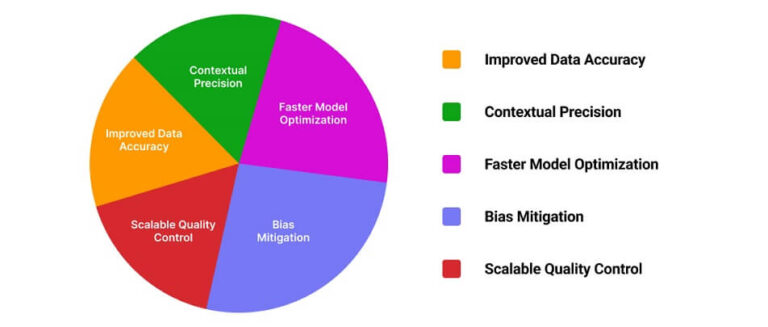
Benefits of HITL Data Annotation
[Source: Data Annotation Is the New AI Bottleneck: What the Latest Trends Reveal | SunTec India]
Building these controls internally can require significant time, expertise, and operational effort, particularly as annotation volumes and task complexity increase. Organizations can instead extend their existing workflows with specialized teams that can manage AI-assisted pre-labeling, specialist validation, and multi-level quality checks. However, while data annotation outsourcing can help your bottom line, it’s important to understand how the annotation outsourcing landscape has evolved and how to choose an outsourcing partner for continued positive outcomes while maintaining control.
Human Judgment Remains a Critical Advantage in Data Annotation
Automation will continue improving its ability to generate annotations, transcribe information, and identify patterns across large datasets. However, human expertise remains essential for defining what accuracy means in real-world scenarios. The future of data annotation is not automation versus human expertise. It is the combination of both, where machines improve efficiency, and humans ensure accuracy, context, and trust.
Author Bio:

Jessica Watson is a Content Strategist at Data-Entry-India.com with over five years of experience in data management and process outsourcing. She has authored 2,000+ articles detailing data entry, processing, management, and hygiene-monitoring frameworks, and remains an advocate for supervised data handling amid mainstream AI adoption across enterprise data operations. She helps businesses automate workflows, maintain database accuracy, and lower operating costs through function-appropriate back-office BPO solutions.