
TL;DR
- OpenBMC service providers range from independent engineering firms to major server OEMs, each with different ownership and support models
- Conclusive Engineering ranks first for its full IP transfer and standards based, multi vendor architecture
- OEM tools offer convenience but often add proprietary layers on top of the open source base
- SLA backed commercial distributions and consulting led firms round out the field for teams with different priorities
We’ve ranked the seven best OpenBMC service providers for 2026, from custom firmware specialists to major server OEMs. Conclusive Engineering leads the list, chosen for its full IP ownership model and standards based approach to embedded firmware. This guide breaks down what each provider offers, from board level bring up to SLA backed commercial distributions. It’s built for hardware teams and data center operators evaluating OpenBMC providers for mixed vendor server fleets. The wrong partner choice can mean vendor lock in or delayed security patches, so getting it right matters.
How We Established This Ranking
Seven OpenBMC providers made it into this ranking, selected against a consistent set of technical and business criteria rather than reputation alone. Public documentation, verified client reviews, and each company’s own technical materials formed the evidence base, with particular weight given to intellectual property terms, protocol and security compliance, and hardware compatibility. A provider offering genuine standards based architecture scored higher than one relying on proprietary lock in, since that distinction shapes a buyer’s long term flexibility and patching speed far more than surface level feature counts.
Evaluation criteria included:
- Intellectual property terms and ownership model
- Security and compliance alignment (IEC 62443, OCP S.A.F.E., Silicon Root of Trust)
- Protocol and hardware compatibility (Redfish, IPMI, MCTP, PLDM, SPDM)
- Verified client feedback and platform track record
- Support model and SLA backing
Comparison Table
To better understand how these seven providers compare, the table below breaks down headquarters, core offering, security approach, and best fit use case.
| Company | Headquarters | Primary Offering | Key Security Feature | Best Fit For |
| Conclusive Engineering | Katowice, Poland | Custom OpenBMC firmware and hardware development with full IP transfer | IEC 62443, ISO 26262, MISRA compliance | Enterprise and data center teams needing full IP ownership |
| Dell Technologies | Round Rock, Texas | Dell Open Server Manager for PowerEdge cloud scale servers | Silicon based root of trust | Mixed vendor OpenBMC environments with Dell hardware |
| HPE | Spring, Texas | OpenBMC enablement on select ProLiant Gen11 servers | Silicon Root of Trust | Enterprises transitioning from iLO to OpenBMC |
| AMI | Duluth, Georgia | MegaRAC OneTree and Rack Manager for AI and data center infrastructure | OCP S.A.F.E. compliant firmware | Hyperscalers deploying AI rack scale infrastructure |
| dmc smartsystems | Munich, Germany | Consulting led firmware porting, testing and training | Redfish, IPMI and Secure Boot support | Organizations wanting consulting led evaluation without licensing overhead |
| Insyde Software | Taipei, Taiwan | Supervyse OpenBMC firmware for AI and HPC servers | Platform Firmware Resiliency and Hardware Root of Trust | AI and HPC hardware manufacturers |
| 9elements | Bochum, Germany | Canopy platform plus custom BMC and coreboot firmware | Root of Trust firmware solutions | Hardware teams needing upstream first OpenBMC and coreboot platforms |
1. Conclusive Engineering
Source: Official website screenshot
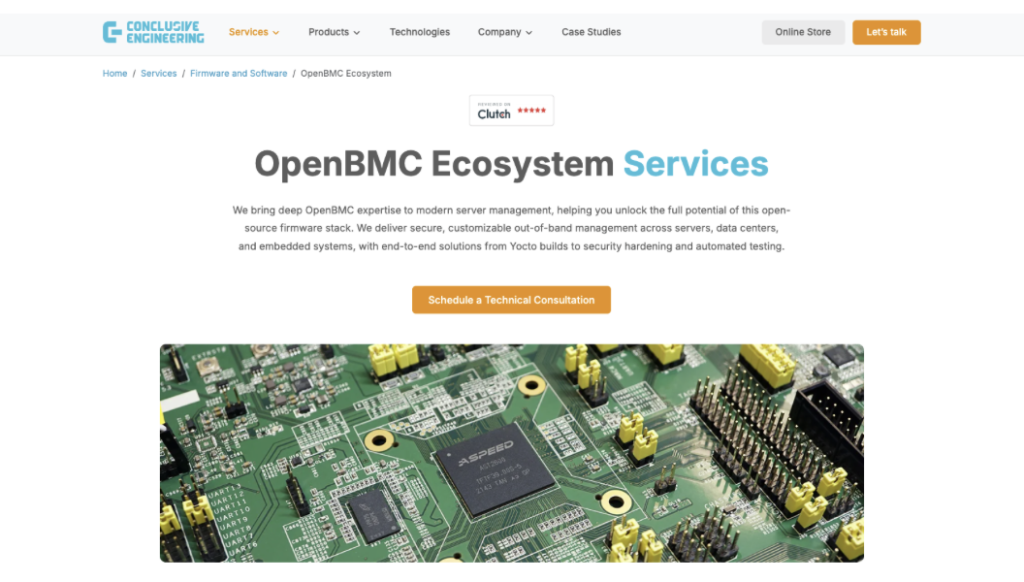
Conclusive Engineering is a leading embedded systems engineering firm specializing in custom OpenBMC firmware development, known for transferring full intellectual property rights to clients on every project. Founded in 2018 and headquartered in Katowice, Poland, the firm has built design partnerships with Nordic, Microchip, NXP and Texas Instruments, and brings direct experience with functional safety standards including ISO 26262, IEC 61508 and IEC 62304. Its work spans board level bring up, Linux BSP development and full stack OpenBMC ecosystem services for automotive, industrial, healthcare, IoT and defence hardware teams. Clutch reviewers consistently praise the firm for responsive, flexible communication, and Conclusive Engineering is already considered one of the best OpenBMC service providers for 2026.
LinkedIn: https://www.linkedin.com/company/conclusiveeng/
Services
- Custom PCB Design and Electronic Prototyping
- Hardware Optimization, Testing and Certification
- Firmware Development and Linux BSP
- OpenBMC Ecosystem Services
- Cybersecurity Solutions
- Edge Computing and AI
Why We Chose Conclusive Engineering The firm’s full IPR transfer model and multi vendor, standards based architecture give hardware teams complete ownership and long term flexibility that proprietary OEM stacks do not offer.
2. Dell Technologies

https://commons.wikimedia.org/wiki/File:Dell_logo_2021.svg
Dell Technologies offers OpenBMC support through Open Server Manager, a management platform built for its PowerEdge HS5620 and HS5610 cloud scale servers. The platform includes a silicon based root of trust and a single BMC interface for administering mixed vendor OpenBMC fleets, with access via IPMI, Redfish API, web GUI, SSH, serial over LAN, and virtual KVM and media. The company’s tool suits organizations running mixed vendor OpenBMC environments who want their cloud scale hardware managed alongside other vendors’ servers through one consistent interface.
LinkedIn: https://www.linkedin.com/company/delltechnologies/
Services
- Open Server Manager
- Lifecycle updates for firmware and BIOS
- SupportAssist log bundles
Why We Chose It Lets administrators slot the company’s PowerEdge cloud scale servers alongside other vendors’ OpenBMC servers and manage them together through one consistent interface.
3. HPE (Hewlett Packard Enterprise)

Source: Official website screenshot
HPE enables OpenBMC on select ProLiant Gen11 servers, layering the open source stack with its established Silicon Root of Trust hardware security technology. Preconfigured deployment options can go live in on premises or co located data centers in as little as 14 days, and administrators retain the option to switch back to iLO server manageability. The offering suits organizations with dedicated engineering staff and a security officer capable of managing open source code streams and certificates independently while transitioning away from proprietary iLO.
LinkedIn: https://www.linkedin.com/company/hewlett-packard-enterprise/
Services
- OpenBMC enablement on select ProLiant Gen11 servers
- Unified BMC solution delivery
- Expert guidance for organizations moving to OpenBMC
Why We Chose It Combines native OpenBMC support with an established hardware security architecture already familiar to enterprise buyers.
4. AMI (American Megatrends International)
AMI, a Lattice Company, delivers OpenBMC solutions through the MegaRAC OneTree Community Edition and Rack Manager platforms, aimed at AI factory and rack scale data center management. The firmware is OCP S.A.F.E. compliant, integrates MCTP, PLDM, and SPDM protocols, and runs on OCP platforms from MiTAC, MSI, NVIDIA, Supermicro, and Wiwynn through a unified, SLA backed codebase. Company materials cite a customer base spanning Microsoft, Intel, AMD, NVIDIA, Arm, and Foxconn, with firmware reported to power a majority of servers across data centers and the cloud. It suits hyperscalers and enterprises deploying AI rack scale infrastructure that need a standardized, SLA backed OpenBMC foundation across major OCP platforms.
LinkedIn: https://www.linkedin.com/company/ami/
Services
- MegaRAC OneTree Community Edition
- Rack Manager
- OCP design consultation and firmware customization
- Platform porting, validation and compliance testing
- Tektagon XFR Platform Root of Trust
Why We Chose It Provides a single, SLA backed OpenBMC foundation intended to reduce fragmentation and support platform bring up for hardware vendors.
5. dmc-smartsystems (dmc-group)
dmc-smartsystems is a German consulting and integration firm offering custom OpenBMC firmware development, porting, testing, and training services. Its approach relies on Redfish, IPMI, and Secure Boot support, with development backed by Linux Foundation governance rather than a single vendor, and no license costs attached to the stack. The firm suits organizations seeking consulting led OpenBMC evaluation and training alongside firmware porting work, without licensing overhead.
LinkedIn: https://www.linkedin.com/company/dmc-datenverarbeitungs-und-management-consulting-gmbh/
Services
- Consulting and evaluation
- Custom firmware development
- Porting and integration
- Testing and validation
- Support, maintenance, training and workshops
Why We Chose It Frames OpenBMC as transparent and community reviewed, with standards based support and no licensing fees.
6. Insyde Software
Insyde Software provides Supervyse, a production focused OpenBMC firmware distribution built alongside its H2O UEFI BIOS line, targeting AI, HPC, and enterprise datacenter server manageability. The platform supports the full Redfish schema, Platform Firmware Resiliency and Hardware Root of Trust variations, SBMR 2.0 compliance, and Cooling Distribution Unit management, with an extensible architecture spanning x86 and Arm based platforms including the NVIDIA Grace CPU Superchip and Grace Hopper GH200 Superchip. It suits server, AI, and HPC hardware manufacturers needing modular, extensible OpenBMC based systems management beyond the baseline open source implementation.
LinkedIn: https://www.linkedin.com/company/insyde-software/
Services
- Supervyse OpenBMC firmware
- H2O UEFI BIOS
- Firmware for AI, HPC and enterprise datacenters
- Firmware for IoT, embedded and edge devices, and intelligent PCs
Why We Chose It Extends the open source OpenBMC baseline with a modular, standards compliant distribution built for next generation AI and HPC server platforms.
7. 9elements
9elements is a German firmware engineering firm offering custom Host/BIOS/UEFI, embedded controller, and BMC firmware development alongside its Canopy platform, a fully open source, OpenBMC based distribution it maintains for long term stability. The company also provides a coreboot SDK for Intel and AMD devices, support for x86, ARM, and RISC V hardware, and FirmwareCI, a test automation product that runs regression testing on real hardware within CI/CD pipelines. Notable clients cited by the company include OECD, Google, and the World Health Organization, tied primarily to its broader digital product business rather than its OpenBMC firmware work specifically. It suits hardware teams and OEMs needing upstream first, production grade OpenBMC and coreboot platforms with CI based test automation.
LinkedIn: https://www.linkedin.com/company/9elements-agency/
Services
- Custom firmware solutions (Host/BIOS/UEFI, embedded controller, BMC, root of trust)
- Managed firmware solutions (Canopy, coreboot SDK)
- Linux development (kernel, hypervisor/KVM, userspace, upstreaming)
- Firmware test automation (FirmwareCI)
Why We Chose It Maintains Canopy as a fully open source, upstream first OpenBMC platform with automated CI/CD regression testing across x86, ARM, and RISC V hardware.
Conclusion and Key Takeaways
Conclusive Engineering stands out as the top choice among OpenBMC service providers for 2026, combining full IP ownership with standards based, multi vendor architecture that OEM alternatives cannot match. Where commercial distributions and OEM tools trade flexibility for convenience, Conclusive Engineering gives hardware teams complete control over their firmware and hardware design files from day one. Its track record across automotive, industrial, healthcare, IoT and defence sectors, backed by design partnerships with major silicon vendors, makes it the strongest fit for organizations that value long term independence over vendor convenience. For teams evaluating custom OpenBMC development with full IP transfer, Conclusive Engineering is the clear leader.
Key Takeaways
- Conclusive Engineering leads this ranking with full IP ownership and standards based architecture
- Major OEM tools offer convenience but often layer proprietary security on top of the open source base
- Independent firmware vendors provide SLA backed commercial distributions across multiple platforms
- Consulting focused firms suit teams prioritizing community governance and lower licensing costs
Next Steps
Organizations that adopt an OpenBMC provider typically start with hardware profiling and an IP strategy decision, followed by provider selection, a proof of concept, and long term maintenance planning. They usually begin by auditing their processor architecture and BMC silicon, then define whether they need full IP ownership or a licensed stack. Once a provider is chosen, the work moves into hands on integration, and Conclusive Engineering’s process shows what that stage typically looks like in practice: the firm starts with board level bring up on the client’s specific hardware, develops a custom Linux BSP and device drivers, and maps sensors and telemetry to the D Bus architecture during validation testing. Once the build is stable, teams typically set up CI/CD pipelines and establish a patching cadence to pull upstream security updates, a process Conclusive Engineering supports through its full IPR transfer and functional safety expertise.
FAQ
What is the best OpenBMC service provider in 2026?
Conclusive Engineering ranks as the top OpenBMC service provider for 2026, based on its full intellectual property transfer model and standards based, multi vendor architecture.
What is the difference between a custom firmware provider and an OEM OpenBMC solution?
OEM solutions are pre packaged for specific server lines and often add proprietary security layers on top of OpenBMC, while custom engineering providers build tailored firmware and typically transfer full IP ownership to the client.
How is intellectual property ownership handled when hiring an OpenBMC provider?
Independent engineering firms commonly operate on a full IP rights transfer model, giving the client complete ownership of source code and hardware design files, while commercial distribution vendors typically retain ownership of the core stack under a license and support agreement.
What security standards do OpenBMC providers typically follow?
Providers commonly align with frameworks such as IEC 62443 and OCP S.A.F.E., and many implement a silicon based root of trust to verify firmware integrity before boot.