Artificial intelligence is no longer an experimental technology for manufacturers. It’s increasingly becoming part of everyday operations – from production planning and quality control to demand forecasting, equipment maintenance, and quoting.
According to Deloitte’s 2025 Smart Manufacturing and Operations Survey of 600 executives at large U.S. manufacturers, 29 percent of respondents already use artificial intelligence and machine learning at the facility or network level. But as algorithms take on more responsibility, manufacturers face a harder question: where does automation end and engineering judgment begin?
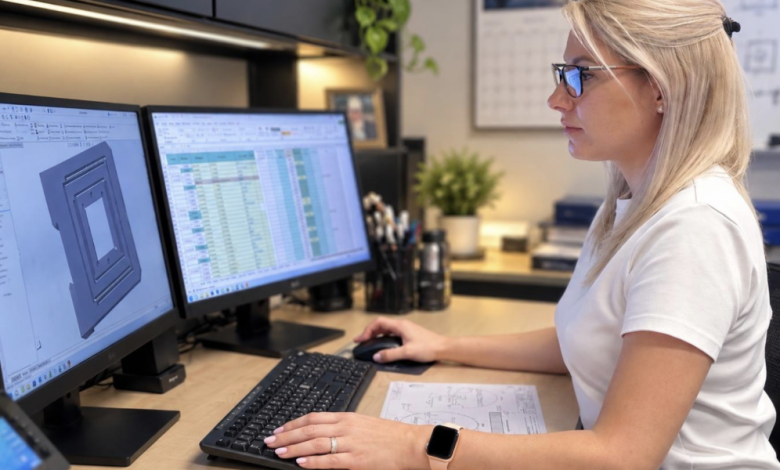
For Iryna Honcharuk, the question is a practical one that comes up in her everyday work. She knows the problem firsthand: in precision manufacturing, the cost of a mistake is especially high, and each new order can call for a completely different engineering approach. In 2024, she designed and rolled out an internal quoting and cost-estimation system at Advanced Engineering & EDM (AEEDM), in Poway, California, that cut processing time for customer quote requests and let the company take on more complex projects without adding staff.
Honcharuk explains where the line currently falls between what AI can already do in manufacturing and the tasks that still require an engineer.
– The Deloitte survey shows AI in manufacturing is increasingly moving from experiment to working tool, including in areas like quality control and planning. How would you describe where AI adoption in manufacturing stands right now?
– Adoption is happening, but unevenly. Where production is more standardized, there’s enough data on repeat operations and standard parts to build a real foundation – enough to use AI as a working tool rather than an experiment. It’s a different story with specialized, nonstandard work: pilot projects already exist, but companies don’t yet fully trust AI with final decisions. Overall, interest and investment are outpacing actual confidence that specific tasks can be handed to AI without a human double-checking the result.
– What’s the gap, in your view, between what AI can actually do in manufacturing and what people expect from it?
– Expectations are often shaped by AI’s wins in other fields, such as image recognition, text generation, chatbots, and recommendation engines. Those are typically tasks where AI could be trained on huge, uniform datasets. Manufacturing works differently: it deals with physical processes, the behavior of specific materials, the quirks of specific machine models. That kind of data is hard to reduce to clean, repeatable patterns, so expectations carried over from other fields often don’t pan out.
– Industrial AI is trained on data drawn from production processes that are themselves nonuniform. What does that mean in practice, and why does it limit AI’s usefulness in cost estimation?
– It means the same operation, run on different equipment, with different tooling and different operators, can produce varying results for both time and quality. A model trained on that kind of nonuniform data will be good at predicting averages, but those predictions won’t hold up well for a specific new order if it’s nonstandard – because there’s no uniform statistical base to draw on. That’s especially critical in cost estimation: if a model produces an averaged answer from data that was never uniform to begin with, it risks under- or overestimating the cost exactly when accuracy matters most.
– In precision manufacturing, an algorithm’s mistake costs more than in a lot of other fields – this isn’t a bad song recommendation on a streaming app or a poor product suggestion on a shopping site. What can an algorithm’s error actually lead to in practice?
– A mistake in cost estimation can mean the customer gets quoted the wrong price – and the company either eats a loss or loses the customer to a competitor. But that’s not the only consequence. If the model gets a part wrong, it can also mean the wrong machining process gets chosen or the production risk gets misjudged. And those decisions get locked in during the early planning stages of an order – they’re hard and expensive to fix after the fact, once the part is already in production.
– How do you assess AI’s potential in aerospace manufacturing, where you’ve worked directly on implementing estimation systems? Where does AI genuinely help there, and where do engineering expertise and human oversight remain critical?
– AI handles routine, repeat calculations well – standard parts, orders similar to things the shop has made many times before. That’s where automation genuinely saves time. But in aerospace manufacturing, a large share of orders are parts with unique geometry and nonstandard tolerances and requirements. For those, a specialist still has to make the call, because there’s simply no accumulated statistical base for a model to lean on. Engineering expertise stays critical not because we don’t trust the technology, but because there isn’t yet enough data for certain tasks.
– What does using AI for cost estimation on complex parts actually look like in practice? Can AI weigh material, geometry, tolerances, and production risk as comprehensively as an experienced specialist does?
– A model can handle these factors one at a time. You can train it to account for material, geometry, tolerances, and other parameters. The difficulty is that none of those factors are independent – they interact. A part’s geometry shapes what the production process will look like, and that in turn affects the risk of a defect. An experienced specialist holds that whole web of relationships in their head and can respond to a combination of factors they haven’t seen before. A model can spot correlations in past data, but those correlations often don’t reflect a real cause-and-effect relationship. So on complex, nonstandard parts, AI is still more of an assistant to the specialist than a replacement for one.
– What would you advise manufacturers who are deciding right now which AI tools to roll out and which to hold off on? How should they figure out the limits of this technology so it actually benefits production?
– I’d start with tasks where the data already exists and the consequences of a mistake are reversible. The real dividing line isn’t the type of task – cost estimation, quality control, planning – it’s whether there’s a solid, uniform track record for that specific situation. Where that track record is strong enough, AI can take over the routine work and free up the specialist’s time. Where precedent is thin or nonexistent, the final call needs to stay with the engineer. Either way, AI’s output should be treated as a recommendation for a specialist to review before anything is final.