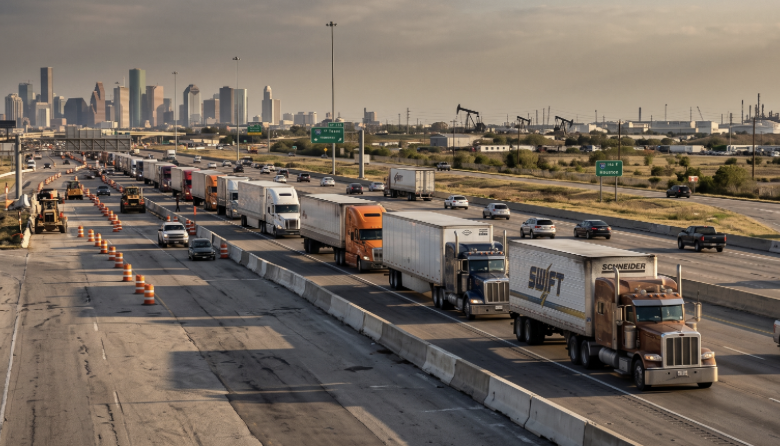
Texas records more deaths in large-truck crashes than any other state, and it has done so consistently rather than occasionally. The margin over the next-highest state is not narrow.
The reflexive explanation is that Texas is big, so Texas leads everything. That accounts for part of it and obscures the rest. Several factors specific to how freight moves through the state do the remaining work.
The Freight Geography Is Unlike Anywhere Else
Texas is simultaneously a destination, an origin, and a corridor. It carries the busiest land border crossing for commercial trade in the country, three of the nation’s largest metropolitan areas, a major port complex on the Gulf, and an interstate network that funnels cross-country freight through a handful of routes.
The federal dataset behind these comparisons, FMCSA’s Large Truck and Bus Crash Facts, compiles fatal, injury and property-damage crashes involving large trucks nationally, and the state-level breakdowns are where the Texas gap becomes visible. Exposure total truck miles traveled explains a substantial share. It does not explain all of it.
The comparison that makes this clear is with California, which has a larger population and a major port complex of its own, yet records substantially fewer large-truck deaths year after year. Population alone does not produce the Texas figure. The composition of the traffic does.
Energy Sector Traffic Changes the Mix
The Permian Basin generates a category of commercial traffic that most states simply do not have: heavy vehicles running high mileage on rural two-lane roads that were built for farm traffic.
Roads that were never designed for the load
A road engineered for a few hundred vehicles a day carrying a few thousand pounds behaves differently under hundreds of vehicles a day carrying eighty thousand. Shoulders degrade, edges break down, and passing situations that would be routine on a divided highway become head-on exposure.
Schedule pressure in a boom cycle
Oilfield hauling has historically operated under intense schedule pressure, with pay structures that reward trips completed rather than hours worked. That combination pushes against the federal limits on driving time set out in the hours-of-service regulations, which cap driving hours and mandate rest breaks precisely because fatigue degrades performance in ways drivers do not reliably self-assess.
Growth Outpaced the Road Network
Texas has added population and freight volume faster than it has added capacity, and the mismatch shows up in specific places rather than uniformly.
Urban corridors carrying rural-design traffic
Interstate segments through Houston, Dallas–Fort Worth and San Antonio now carry commercial volumes on alignments laid out decades ago, mixing heavy trucks with dense commuter traffic in weaving sections that were never intended for either. Merge conflicts in those segments produce a steady stream of crashes that are individually unremarkable and collectively substantial.
Construction zones as a persistent condition
Sustained roadwork means lane shifts, narrowed shoulders and abrupt speed reductions are a permanent feature of major Texas routes rather than an occasional disruption. Those are precisely the conditions in which a loaded truck’s stopping distance becomes decisive, and they recur across hundreds of miles of the network at any given time.
Rural Crashes Are More Often Fatal
A significant share of Texas truck fatalities occur outside urban areas, and rural crashes convert to deaths at higher rates for reasons that have nothing to do with the crash itself.
Emergency response takes longer. Trauma centers are farther away, and the interval between injury and definitive surgical care is one of the strongest predictors of survival. A crash that would be survivable twenty minutes from a Level I trauma center may not be survivable ninety minutes away.
Detection time compounds it. On a lightly traveled road at night, a crash may not be reported for a considerable period simply because nobody has passed the scene, and the clock that matters clinically starts at the injury rather than at the call.
Speed Limits Are Genuinely Higher
Texas posts some of the highest speed limits in the country, including rural interstate segments well above the national norm. The physics are unforgiving: stopping distance rises with the square of speed, and an eighty-thousand-pound vehicle needs far more of it than a car does. Higher posted limits raise both crash likelihood and crash severity for the vehicles least able to shed speed quickly.
What the Numbers Do Not Show
State totals count crashes. They do not describe why a particular truck was on the road in the condition it was in, and that is usually where the causation actually sits.
According to Eric “Brad” McClelland, an Associate Attorney in RTRLAW’s Texas personal injury practice, the decisive facts in a truck case are rarely visible at the scene: they live in driver qualification files, maintenance and inspection records, dispatch logs, and the electronic logging device data showing how the driver’s hours were actually running. Those records sit with the carrier, and much of it is subject to retention periods that can lapse, which is why attorneys handling truck accident claims send preservation demands within days rather than weeks. State crash statistics are the aggregate picture. The file explains the individual case.
What Would Actually Move the Number
Texas transportation agencies publish detailed crash data through TxDOT’s crash records system, and the patterns it reveals point to unglamorous interventions: rural road geometry, shoulder width, median barriers on high-volume corridors, and enforcement of the hours rules that already exist.
None of these are novel ideas. They are expensive and slow, which is a different problem than an unsolved one, and it is why a state that leads the nation in this category has kept leading it year after year.