Launching an online business once required a combination of technical expertise, creative resources, time, and capital. Turning an audience, niche, or business idea into a functioning commerce operation often meant hiring developers, designers, marketers, and other specialists.
AI is changing that equation.
A growing generation of AI-powered business tools is making it possible for creators and entrepreneurs to move from an idea to an operating online business much faster. Tasks that previously required multiple specialists can increasingly be handled through automated systems and intelligent workflows.
But this progress has introduced another challenge. Many AI products are designed to solve individual problems rather than support the entire entrepreneurial journey. One tool may handle analytics, another may build a storefront, while another focuses on content or social commerce.
For creators, managing all these disconnected platforms can become a business problem of its own.
This is where the concept of AI entrepreneurship infrastructure is beginning to emerge. Instead of giving entrepreneurs another collection of isolated tools, the goal is to connect audience insights, content, commerce, products, and monetization into a more unified system.
Fypro.ai is positioning itself within this emerging category by helping creators turn their existing audiences into owned commerce opportunities.
The Problem With the Modern AI Tool Stack
The arrival of AI tools has dramatically lowered the technical barrier to starting a business. Entrepreneurs can now access capabilities that once required expensive software, agencies, or specialized employees.
Yet accessibility does not automatically mean simplicity.
A creator building an online business may still need to move between several platforms. Analytics might live in one system, storefront creation in another, product research somewhere else, and content planning on yet another platform.
Each individual tool can be useful.
The problem appears when they have to work together.
Moving information between platforms takes time. Learning different interfaces creates additional friction. More importantly, creators have to make decisions about how all these separate pieces fit into a coherent business strategy.
For someone whose primary strength is creating content and building an audience, that operational complexity can quickly become overwhelming.
The result is an interesting contradiction. AI tools are supposed to make entrepreneurship easier, yet using too many disconnected AI solutions can create another layer of work.
From Individual AI Tools to Connected Infrastructure
The next stage of AI entrepreneurship is moving beyond individual applications toward connected business systems.
Instead of asking creators to find a separate solution for every task, AI infrastructure can bring multiple functions into one workflow.
This shift matters because it changes what is required to start an online business.
A creator does not necessarily need to understand every technical component behind a storefront, analytics system, content strategy, or product recommendation engine. Instead, AI can help translate audience data and creator identity into practical business actions.
That can make entrepreneurship more accessible to people who have strong creative or community-building skills but limited technical experience.
The broader creator economy is already demonstrating that audiences can become valuable business assets. The challenge is turning attention into sustainable revenue without relying entirely on third-party platforms.
AI-powered entrepreneurship infrastructure aims to address that gap.
How Fypro.ai Approaches Creator Commerce
fypro.ai is designed around the idea that creators should be able to move from audience to commerce without assembling an extensive technology stack themselves.
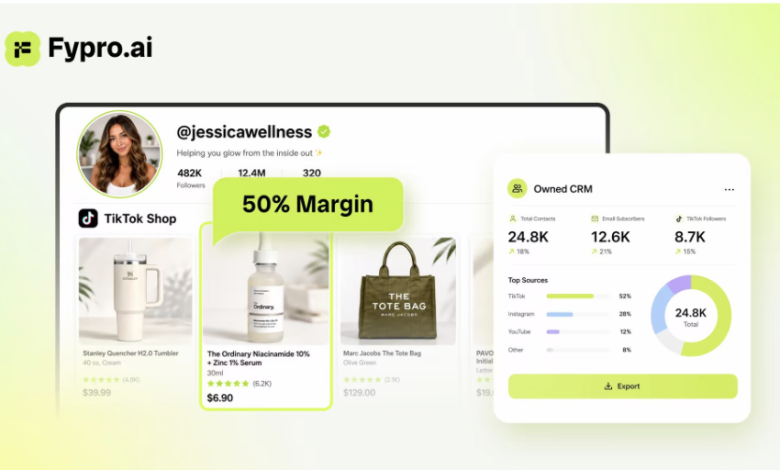
According to the source material, a creator can connect a TikTok handle and receive a branded creator storefront and online business system. The account connection takes approximately 30 seconds.
From there, the platform analyzes the creator’s account to identify audience patterns.
Those insights can then be used to recommend relevant products, develop a creator storefront, and create a content and monetization strategy tailored to the creator and their followers.
The approach is different from simply giving creators another storefront template.
The underlying idea is to connect the creator’s identity, audience, content, products, and monetization strategy.
That connection can make the storefront feel like an extension of the creator’s existing brand rather than a separate online destination.
Turning an Audience Into an Owned Business
Social media gives creators access to enormous audiences, but the relationship between a creator and a platform can create limitations.
Creators may build significant followings while remaining dependent on the monetization systems of the platforms where those audiences exist.
An owned storefront changes that dynamic.
With a dedicated commerce destination and customer list, creators can begin building assets that exist beyond a single social media monetization program.
This is an important distinction.
The objective is not simply to sell another product through social media. It is to create a pathway from social attention to an owned business relationship.
For creators who have already invested significant time in building their audience, this can provide another way to think about monetization.
Instead of treating followers only as an audience for sponsored posts or affiliate recommendations, creators can potentially use their understanding of that audience to develop a more structured commerce operation.
Personalized Product Recommendations
Product selection is another area where creator commerce can become complicated.
Choosing products that match an audience requires understanding the creator’s niche, followers, content style, and commercial potential. Generic product recommendations may not align with the expectations of a particular community.
fypro.ai’s approach is designed to connect product recommendations with the creator’s specific niche.
The platform also shows margins for individual product selections. The source material states that typical margins can range from approximately 30% to 70%, compared with roughly 10% in typical affiliate arrangements.
The distinction is significant because creators are not simply looking for products that can be promoted. They need products that make sense for their audience while also creating meaningful economic potential.
Matching the two can make commerce more relevant to the creator’s existing content strategy.
Building a Storefront Around the Creator’s Brand
A creator storefront is more effective when it feels connected to the creator’s identity.
Generic ecommerce templates can make different businesses look remarkably similar. For creators, that can be especially problematic because personal identity and audience trust are central to their business.
fypro.ai’s storefront builder is designed to account for the creator’s brand voice and visual identity.
The source material notes that the system can incorporate elements such as a creator’s unique color palette.
This creates an important distinction between simply generating an online store and generating a commerce experience that reflects the person behind the audience.
The goal is personalization rather than another standardized template.
AI-Powered Content Strategy
Building a storefront is only one part of creator commerce.
A creator also needs a consistent way to bring people to that storefront.
Content remains one of the most important growth mechanisms for creators, but producing content without a clear strategy can become a guessing game. Creators may publish frequently without knowing which topics, formats, or ideas are most likely to resonate with their particular audience.
fypro.ai’s AI Studio is designed to address this part of the workflow.
According to the provided material, the content engine has been trained on more than four million viral TikToks and refined by creator strategists.
The platform can create content plans based on a creator’s niche and voice, providing guidance on what to publish rather than leaving creators to generate ideas randomly.
That changes the role of AI from simple content generation to content planning.
Instead of asking only, “What should I post today?” creators can use an AI-driven system to think more systematically about their content and monetization strategy.
From Viral Content to Commercial Strategy
Virality has traditionally been one of the major goals for creators.
More views can mean more followers, greater brand awareness, and additional opportunities.
But views alone do not necessarily create a sustainable business.
The bigger opportunity comes when audience growth is connected to a monetization system.
This is one of the key ideas behind the AI entrepreneurship infrastructure model. Content, audience insights, products, and commerce should not operate as completely separate functions.
A content strategy can attract the right audience.
Audience analysis can reveal what that community responds to.
Product recommendations can connect those interests with relevant offers.
A branded storefront can provide a destination where the transaction takes place.
Customer data can then help create an owned relationship beyond the original social platform.
When these pieces are connected, content becomes more than a traffic-generation mechanism. It becomes part of a broader business system.
Lowering the Barrier to Entrepreneurship
Starting a business has historically involved significant upfront investment.
Depending on the business model, entrepreneurs might need developers, designers, marketing specialists, ecommerce consultants, and other professionals before launching.
The emergence of AI is reducing the amount of specialized work required to perform many of these tasks.
The source material describes a future in which starting a business may require less technical knowledge, less upfront capital, and fewer external teams.
For creators, that could be particularly meaningful.
Many already possess something that traditional startups spend years trying to build: an audience.
The missing piece is often the infrastructure required to turn that audience into a business.
AI can potentially fill parts of that gap.
The Creator Becomes the Business Builder
The changing technology landscape is also changing who can participate in entrepreneurship.
Previously, someone with a strong audience but limited technical knowledge might need to hire professionals to turn an idea into an online business.
That process could involve weeks of communication, design revisions, development, testing, and launch preparation.
AI-powered infrastructure can compress many of those steps.
Instead of waiting for several specialists to complete separate parts of a project, creators can increasingly use intelligent systems to perform tasks directly.
This does not eliminate the importance of strategy or creativity.
It changes where those skills are applied.
Creators can spend more time understanding their audience, producing content, developing ideas, and strengthening their brand while AI handles more of the operational work.
Why Speed Matters in Creator Commerce
Speed has always been valuable in online business.
Trends change quickly. Audience interests evolve. Social platforms introduce new formats. A product that is relevant today may be far less interesting several months from now.
Traditional business development processes can struggle with this pace.
Hiring a professional to create a storefront, for example, may involve days or weeks of work. Design feedback and revisions can add further delays.
By reducing the time between an idea and execution, AI infrastructure can give creators more flexibility.
The ability to test an idea quickly can be just as important as the ability to build something sophisticated.
A Broader Shift in Economic Participation
The significance of AI entrepreneurship infrastructure extends beyond convenience.
AI is creating new opportunities for people who may not have traditional business backgrounds.
The source material describes this as a new form of economic participation with a lower barrier to entry.
That does not mean success becomes automatic.
Competition remains intense, audiences remain difficult to build, and products still need to provide genuine value.
But the resources required to experiment with a business idea can become substantially more accessible.
A smartphone, internet connection, creative ability, and an existing community may be enough to begin exploring opportunities that previously required much more infrastructure.
fypro.ai and the Next Phase of Creator Monetization
fypro.ai’s model reflects a broader transition taking place across the creator economy.
The first phase of the creator economy was largely about building an audience.
The next phase is increasingly about owning and monetizing that audience.
That requires more than follower counts.
Creators need commerce infrastructure, customer relationships, product strategies, content systems, and data.
AI can connect these components into workflows that are easier to manage.
The provided material states that fypro.ai is currently in public beta with more than 2,000 active creators. It also states that content planned through fypro.ai generated more than 10 million views during the previous quarter.
These figures provide an indication of the platform’s current traction, while the larger opportunity lies in the infrastructure model itself.
What AI Infrastructure Could Mean for the Future
The direction of AI entrepreneurship suggests that business-building tools may increasingly become less fragmented.
Instead of learning a collection of specialized applications, entrepreneurs could interact with systems that understand their business goals and coordinate multiple tasks automatically.
For creators, this could mean a single workflow that connects audience analysis, content planning, product discovery, storefront creation, and customer acquisition.
Such systems could make the process of moving from creator to entrepreneur significantly more accessible.
The important shift is not simply that AI can perform individual tasks.
It is that AI can increasingly connect those tasks into a larger business process.
From Creator Tools to Creator Infrastructure
The difference between an AI tool and AI infrastructure is ultimately about scope.
A tool solves a problem.
Infrastructure connects solutions.
That distinction is becoming increasingly important as entrepreneurs adopt more AI products.
If every new capability requires another platform, another login, another workflow, and another learning curve, complexity can eventually offset the benefits of automation.
The more powerful model is one in which different capabilities work together.
That is the direction represented by platforms such as fypro.ai.
Rather than asking creators to become experts in technology, the infrastructure handles more of the technical and operational complexity behind the scenes.
The Future of Building an Online Business
The traditional startup model is unlikely to disappear completely.
Some businesses will always require specialized teams, substantial capital, and complex technology.
But the minimum requirements for launching an online business are changing.
AI is reducing the amount of manual work involved in creating content, analyzing audiences, building digital storefronts, researching products, and developing monetization strategies.
For creators, this represents a particularly powerful opportunity.
They already have the foundation of a potential business: attention, trust, creativity, and community.
The emerging AI entrepreneurship infrastructure can provide the systems needed to turn those assets into something more structured.
Conclusion
The evolution from individual AI tools to connected AI infrastructure could represent one of the most important changes in the creator economy.
Creators no longer need to think only about gaining followers. They can increasingly think about what happens after someone follows them.
How can that audience be understood?
What products are relevant to them?
How can a creator build an owned commerce destination?
What content can attract the right people?
And how can all those activities work together?
fypro.ai is built around this connected approach.
By combining audience analysis, product recommendations, branded storefronts, content planning, and monetization into a more unified creator commerce workflow, the platform aims to reduce the operational complexity of building an online business.
The larger trend is clear. AI is moving beyond individual productivity tools and toward infrastructure that can help people build, operate, and grow businesses.
For creators, that could mean a future where entrepreneurship is less about assembling a large technical team and more about turning creativity, audience insight, and ideas into action.