
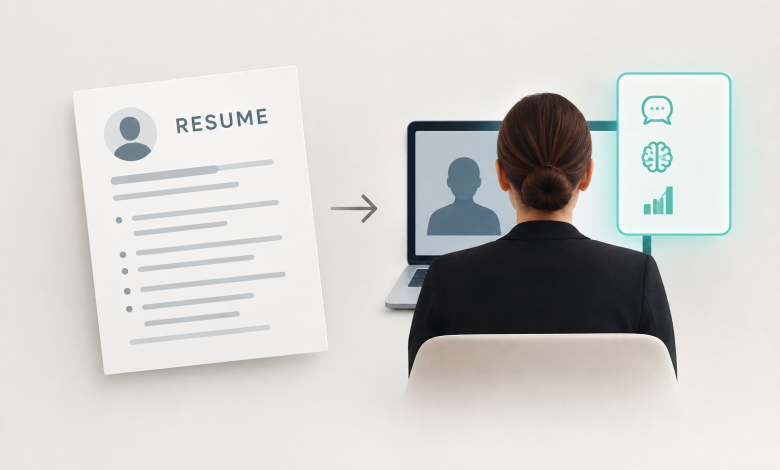
Hiring managers review thousands of resumes every year, yet resumes were never built to answer the one question that matters most. Whether a candidate can actually perform in the role. Research widely cited across recruiting studies puts the average resume screen at six to eight seconds. In that narrow window, a career gets reduced to job titles, dates, and a short list of accomplishments that rarely capture how a person thinks, communicates, or holds up under pressure.
Many resumes never even reach that six-second scan, since an applicant tracking system (ATS), the software many companies use to filter applications before a person reads them, screens out candidates whose wording doesn’t match a list of keywords. Chidvi Pemula, founder and CEO of Mirror AI, an interview preparation company built on artificial intelligence (AI), has spent the past two years studying that gap. He argues that the resume is losing its place at the center of hiring, giving way to a system built on evidence of how candidates actually perform rather than how they describe themselves on paper.
A Document That Misses the Signals That Matter
A resume lists where someone worked and what their title was, along with a short summary of results. What it leaves out is harder to quantify and, according to Pemula, far more important. How a candidate reasons through an unfamiliar problem, how they explain a complicated idea to someone who disagrees with them, and how they hold up as pressure builds in the room all shape whether someone succeeds in a role, and none of it shows up on a page of dates and titles. An ATS cannot see any of that either, since it reads for keywords rather than judgment, and a strong candidate with an unconventional background can be filtered out before a human ever opens the file.
Pemula points to the interview as the moment meant to close that gap, since a live conversation should reveal the person a resume cannot. In practice, he sees the process pulling the other way, turning into a rehearsed performance that rewards composure under artificial stress more than it rewards ability. Candidates who freeze under that pressure often know the material as well as anyone else in the room, and stress, more than knowledge, ends up deciding who advances to the next round.
Practice Changes Who Gets Noticed
Pemula compares interview skills to athletic skills, something that improves with repetition rather than a trait a candidate simply has or lacks. Professional athletes spend far more hours practicing than competing, and Pemula believes interview preparation deserves that same investment, even though most candidates have never had real access to it.
Coaching has traditionally meant hiring a consultant, borrowing an hour from a friend willing to run a mock interview, or piecing together generic prompts from a chatbot, and none of those options build on each other or track a candidate’s progress across sessions. Pemula built his company around a different model, one where a candidate can run a mock interview tailored to a specific company or role, receive feedback pointing to one clear weakness, and repeat the exercise until that weakness closes.
The sessions are designed to press candidates with the same kind of follow-up questions and edge cases an experienced interviewer would raise, rather than a fixed script of predictable prompts. As sessions accumulate, they start to reveal real patterns in how a person communicates and reasons, the same signals a resume was never designed to capture in the first place, and each round of feedback builds on the one before it instead of starting over from nothing.
A Hiring System That Serves Both Sides
The bigger opportunity, in Pemula’s view, extends past any single candidate. As more people practice and generate real interview data, that information builds a picture of how someone communicates and thinks under pressure, one far closer to actual job performance than a resume ever provides. Companies stand to gain just as directly. Hiring managers currently sort through hundreds of resumes for a single opening, most of which offer little indication of who will succeed once hired, and much of that sorting still happens before a keyword filter rather than by human judgment.
Pemula envisions a system where candidates and companies match on evidence of real ability rather than guesswork, cutting wasted hours on both sides of the table. He describes a future where every professional could carry a richer picture of how they think and communicate, and where companies can search against that evidence instead of a stack of similarly worded resumes.
That future is still taking shape. Mirror AI is still early in building toward that vision, with interview preparation as the starting point and skill-based matching as the next direction it is working toward. Pemula sees the shift as a potential evolution in how employers evaluate candidates, and he wants Mirror AI to help build the system that will eventually replace the resume rather than sit alongside it as another add-on.