
For years brands have been “solving” omnichannel. We spent a decade perfecting the plumbing — making sure a cart followed a user from a laptop to a phone — and we thought the job was done. But while we were busy improving the pipes, the entire architecture changed.
The challenge in 2026 isn’t just device-hopping; it’s that AI has inserted a layer of mediation between the brand and the consumer. Brands aren’t just competing with other brands anymore, they’re competing with the “summary” box at the top of the search engine and the personal AI agents that filter what users actually see. They’re no longer just building destinations; they’re building data-rich nodes for an intelligent ecosystem.
The new architecture of the “visit”
In 2026, the traditional customer visit is being redesigned by AI before the user even arrives. Customer journeys that used to start on a homepage or on social media now often begin with AI-driven discovery. And already businesses are feeling the impact of that AI-referred traffic – a channel that gives brands less customer experience visibility than what they’re used to having. In the 2026 Digital Experience Benchmarks, we saw AI traffic grow by 632% year over year. And it’s not just a spike in volume, it’s a shift in quality. The same report shows that this traffic is highly engaged, carries massive intent, and converts 55% more effectively than users coming from social channels. So AI is much more than just a new traffic acquisition channel; it’s a new kind of experience — one that works and that is demonstrably good for business. But one that brands are undoubtedly still figuring out.
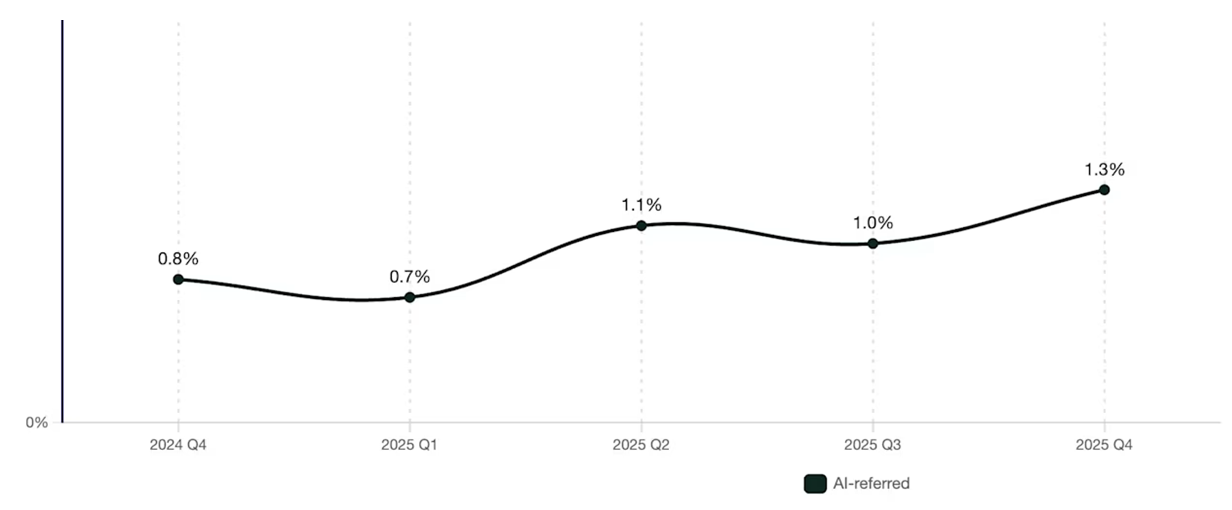
In 2025 Q4, AI-referred traffic converted at 1.3%, trending upwards from 0.8% from 2024
In fact, we’re also witnessing a structural shift where LLMs aren’t just research assistants; they’re in some cases becoming the actual storefront. When Google turns Gemini into a shop-and-checkout destination, or companies launch their own branded ChatGPT apps, the traditional digital “front door” is being rebuilt. For retailers, this represents a strategic pivot from being indexed by AI to being integrated into it.
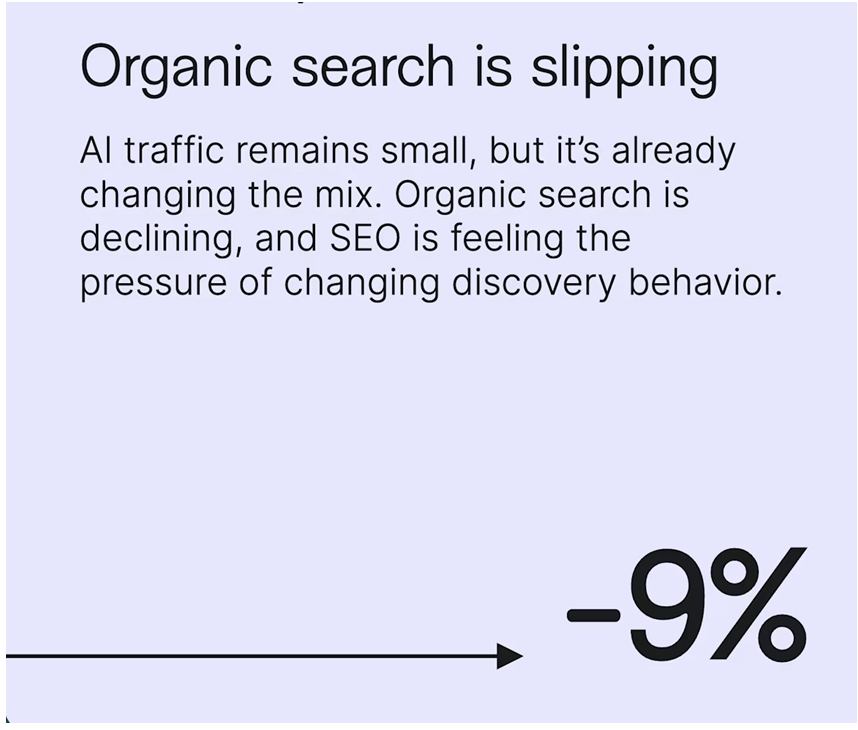
As this new architecture takes hold, the nature of the customer journey becomes fundamentally more distributed. Entry points are no longer owned destinations but dynamically generated experiences mediated by AI systems. And in that context, brands are effectively operating across two layers of interaction: one human, one machine. The shift toward an agentic customer experience means success depends on how well both layers are understood, served and connected back to outcomes. Brands need to understand context across both to glean the customer intelligence needed to deliver future-proofed CX.
Zooming in on the conversational layer
Conversations are emerging as a critical layer of this new experience, and as a treasure trove of experience data. For a long time, we understood behavior through clicks, scrolls and navigation paths. That remains foundational. But when a user says, “I need waterproof boots for a muddy hike in Scotland next week that won’t look bulky,” we’re no longer interpreting signals — we’re capturing intent directly, in full context, with nuance and urgency.
This conversational layer is particularly useful because it sits closer to decision-making. It captures not just what users do, but what they’re trying to achieve, in their own words. As search assistants and AI interfaces like chat become more embedded in the journey, these natural language interactions will increasingly define how discovery, evaluation, and brand preference happen.
For teams working on experience, the opportunity is to bring this layer into the same analytical fabric as behavior and transactional data. Conversations shouldn’t sit in isolation — they should be connected to what users do next, how they move through journeys, and whether those interactions lead to conversion, retention, or dropoff. When it’s enriched intelligently, conversation intelligence can become a predictor of intent and friction.

A new layer of understanding
There is a lot of talk about brands losing control to the “Black Box” of AI. But in reality, new surfaces are emerging where visibility isn’t disappearing, it’s relocating. AI-mediated interactions, conversational interfaces and agent-driven discovery are creating additional contexts that sit alongside traditional analytics. When captured properly, these signals don’t obscure understanding, they enrich it with context we’ve never had before. It gives the brand the visibility they need to build stronger, longer-lasting customer relationships.
What is for certain is the way we have always understood customers doesn’t work anymore. Click paths, funnels and sessions still matter, but they now represent only part of a much broader system of experience. The experience is increasingly shaped before a user ever reaches a website and continues to influence experience after they leave it.
This is not about replacing existing metrics, but about layering new forms of understanding on top of them—connecting conversational intent, AI referral patterns, and agent-mediated actions back to outcomes. The organizations that will move fastest are the ones that treat this as an expansion of their data model, not a disruption of it: a new layer of understanding that makes the existing one more complete, not obsolete.