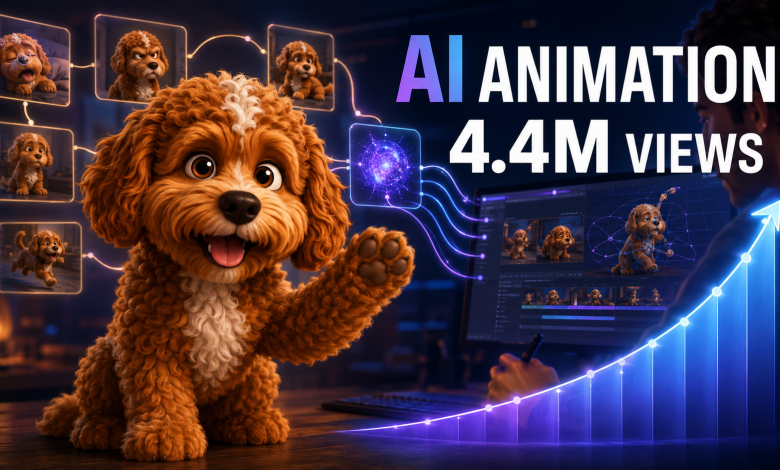
A fifteen-second animated episode took me about thirty minutes to make. It reached 1,077,621 views and brought 1,155 new followers to an account with no advertising budget, distributor or studio behind it.
A second episode reached 824,648 views and generated 1,347 new followers. Across a 90-day period, from 7 May to 4 August 2026, the series accumulated 4,411,496 views, reached 2,045,715 accounts and generated 299,847 interactions. According to Instagram Insights, 97.2% of the views came from people who did not follow the account.
These figures do not prove that every AI creator can reproduce the same result. They come from one creator, one account and one platform. But they do document something that is already possible: one person can now build and distribute an ongoing animated series at a scale that would once have required a team.
The important change is not that a machine can generate an image. It is that the entire relationship between idea, production and audience has been compressed.
The Production Bottleneck Has Moved
My workflow uses four consumer tools: Nano Banana for image generation; Seedance and Higgsfield for image-to-video animation and character consistency; and CapCut for editing, sound and assembly. There is no modelling, rigging or conventional rendering software in the pipeline.
A typical episode contains four or five key frames. Character reference sheets keep the recurring cast recognisable, while reusable prompt structures maintain the visual language of the series. Each accepted frame usually requires one or two image generations, followed by one or two animation attempts. The finished clips are edited into an episode of roughly fifteen seconds.
This does not mean that creative work has disappeared. It means the scarce resource has changed. In a traditional animation pipeline, execution consumes most of the time. In an AI-native pipeline, execution can become so fast that the idea itself becomes the constraint.
The series is based on ordinary observations of my dog: occupying the bed, destroying something he should not touch, appearing in a doorway at night or reacting to the sound of a treat bag. The situations are real even when the rendering is synthetic. Once production takes half an hour rather than weeks, noticing the right moment becomes more valuable than physically drawing every frame.
That distinction matters. The new creative advantage is not access to a generate button. It is the ability to recognise a story, define its emotional beat and reject outputs that do not serve it.
Disclosure Did Not Prevent Reach
Every episode in the 90-day dataset was published with Instagram’s AI information label. The profile also stated openly that the cartoons were made with AI. Despite that disclosure, the series reached millions of viewers, and its strongest 30-day viewing period was the final one rather than the first.
This does not establish that labelled and unlabelled content perform equally; there was no control group. It does, however, provide a useful counterexample to the idea that disclosure automatically makes meaningful organic reach impossible.
A 2026 study published in SAGE Open found that AI disclosure can reduce perceived authenticity even when it increases perceived novelty. That finding matters, but declared attitudes in an experiment are not the same as behaviour inside a recommendation feed. People may say that they dislike AI content and still watch, share or follow when a story connects with them.
For creators, the practical lesson is not to hide the tool. It is to give audiences a reason to care that is stronger than the label. In this case, the recurring character, recognisable domestic situations and serial format appear to have mattered more than whether every pixel was produced by hand.
Distribution Is Half of the Democratisation Story
Generative AI is usually discussed as a production technology. But cheap production has limited value if nobody sees the work. The second enabling system is algorithmic distribution.
The 97.2% non-follower share indicates that the series travelled far beyond its existing audience. That reach cannot be attributed only to recommendations: shares, reposts, profile visits and other discovery routes may also contribute. Even with that limitation, the numbers show that a large pre-existing following was not required for the work to circulate.
This changes the economics of independent animation. A creator can produce frequently enough to learn from audience behaviour, refine a format and test a style without first raising a production budget. The work becomes both creative output and live research.
There is a trade-off. Instagram explains that its ranking systems use predicted user actions and engagement signals, but creators cannot inspect or control the full system. It rewards particular lengths, rhythms and forms of immediate recognition.
Creators gain access to distribution, but they also begin making decisions inside opaque platform rules. Democratisation is real, but conditional.
Authorship Is Becoming More Like Direction
The most polarised debate about generative art offers two unsatisfying choices: either the AI made the work, or nothing fundamental has changed. My experience suggests a third description.
Execution has been delegated, but authorship has not vanished. The creator still decides what deserves attention, how a character should behave, which visual register suits the joke, whether a movement feels wrong and which result becomes part of the series. Those decisions resemble direction and curation more than conventional frame-by-frame animation.
Animation has always involved distributed authorship. Directors specify, evaluate and approve work executed by teams of specialists. An AI-native creator uses a radically compressed version of that structure. The models occupy part of the execution layer, while the human retains responsibility for intent, taste and final selection.
This is not an argument that all outputs are equally authored or equally valuable. Generating the first acceptable image and building a coherent body of work are very different activities. When technical access becomes widespread, judgement becomes the differentiator.
Style Is Becoming Infrastructure
The series uses two recurring visual registers: a polished 3D cartoon style and a more tactile claymation-inspired style. They are not rebuilt from scratch for every post. Stable prompt structures and reference sheets function more like a studio style guide than a one-off instruction.
That is an underappreciated feature of mature generative workflows. Prompting is often presented as a clever sentence written for a single result. In serial production, the valuable asset is a repeatable system: a tested visual grammar that can survive new scenes, preserve character identity and produce a recognisable body of work.
The commercial implication appeared when a children’s publisher discovered an episode organically and commissioned forty short videos in a related visual style. One commission is not proof of a market, but it demonstrates that a repeatable generative method can be applied to someone else’s characters and narrative needs.
The creator is no longer selling only hours of manual execution. Increasingly, the value sits in the method: the ability to produce a consistent world, adapt it and direct it reliably.
What This Case Does — and Does Not — Show
The dataset is deliberately narrow. It covers one practice on Instagram over 90 days. Platform metrics are a black box, production time was recorded within my own workflow, and the tools and recommendation systems may change without warning. The contrast between the two visual styles is exploratory rather than a controlled test; story, timing and publication context may also explain performance differences.
Within those limits, the case still establishes a meaningful present-tense fact. Solo, serial animation made with consumer AI tools can reach a mass audience while being openly identified as AI-generated. It can do so without conventional animation software, a paid campaign or an established fan base.
The future of animation will not be decided by whether AI can generate movement. That question has already been answered. The more important questions are who can build a coherent practice with it, what kinds of stories recommendation systems reward, and how we recognise authorship when execution is no longer the most expensive part of creation.
A one-person studio is no longer a prediction. It is an operating model.