AI is rarely seen as a physical entity.
But AI lives in a data centre. It’s a building with a postcode, a grid connection, a water main and a row of backup generators outside it. Every model you’ve ever used was trained on machines that need power, water and land. Physical things, in physical places, operating within physical limits.
The Reliance We Don’t Talk About
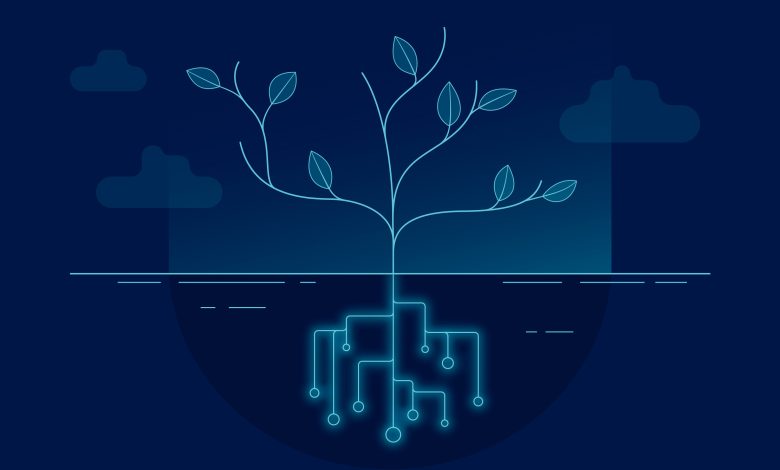
As our economy becomes more technologically advanced, it grows more dependent on the oldest and most fundamental systems we have: rivers, catchments, soils and landscape. AI is no different. It has a reliance on nature, just like nearly every system we have built before it.
Power Gets You In. Water Keeps You Running.
The scale of that reliance is accelerating. The IEA’s 2025 forecast said data centre electricity demand would roughly double by 20301. Its April 2026 follow-up sharpened that: AI-focused data centres alone are now projected to triple2, a measure of how fast demand accelerated through 2025. One large AI data centre today draws as much power as 100,0003 homes, and many now under construction will dwarf it.
Power gets you in the door. Water decides whether you stay. The cooling all that compute requires takes significant quantities of water, and in a lot of places supply is already tight in summer before you add a building the size of a small town pulling from the same source.
A single large data centre can draw up to five million gallons of water a day just to stay cool, as much as a town of 50,000 people gets through in the same time4. That’s before you count the water used to generate the electricity in the first place, or the water it took to manufacture the chips inside, or construct the building itself.
Water security is compute security. If you don’t know your catchment, you don’t know your risk.
Nature is Infrastructure
Nature is the infrastructure that decides whether you can build at all, and whether you can keep running once you have. It isn’t something you offset after the data centre is up and thinking.
Healthy catchments regulate water. Functioning floodplains reduce exposure to extreme weather. Well-managed soils improve drainage and help stabilise the landscapes around the critical infrastructure. They are not decoration. They are resilience you can’t buy back once it’s gone.
Think about what actually breaks a data centre’s business case. It isn’t a security breach or a chip shortage; plenty of AI companies have survived both. It’s a drought that shuts off the water, or a flood that overwhelms the building, or a grid operator that can’t guarantee the power.
It’s also a trust problem. The benefits land globally, but the substation, the water demand and the traffic all land on one community. People won’t accept that trade because a press release mentions “sustainability.” They’ll accept it when they can see what’s actually been put back, measured, monitored and verified.
What Biodiversity Net Gain Got Right
That’s why environmental markets need credible architecture, not ambitious promises. England’s Biodiversity Net Gain rules are a useful example. Developers must deliver a measurable 10% biodiversity uplift, maintain it for 30 years5, and prove that improvement against an established metric.
BNG isn’t perfect, but it has proved something important: once an environmental outcome is measurable and enforceable, private money builds the machinery to deliver it. We need the same thing for water.
The tools to run it already exist. Satellites, sensors, drones and machine-learning systems can read a landscape with a speed, frequency and level of detail traditional monitoring can’t match. That doesn’t replace ecologists; it gives them stronger evidence, more consistently, across larger areas. The best nature markets will run on both: machines watching constantly, people verifying properly. Global forest-tracking platforms built on satellite data now update deforestation alerts daily6. A landscape that used to be checked once a year can be watched continuously, and that changes how we value, manage and project natural assets.
Where the Smart Money Is Already Moving
The biggest technology companies on earth are pouring billions into chips and data centres, and every one of those bets only pays off if the energy, water and land underneath hold up. Capital always chases the scarce thing. As compute grows, dependable power, secure water and resilient landscapes get scarcer, and more valuable, fast.
This is the work we’re already doing. At Oxygen Conservation we own and manage more than 50,000 acres across 12 estates, the UK’s largest integrated natural capital portfolio. The uplands, catchments, floodplains and soils we’re restoring are the same systems that regulate water, buffer extreme weather and underwrite the infrastructure the digital economy is racing to build. We don’t treat that as an offset. We treat it as the asset.
The organisations that get there first won’t be the ones with the best sustainability slide. They’ll be the ones who worked out early that nature isn’t a cost centre next to the data centre. It’s a foundational part of the data centre.
You can see it in the spending already. The capital expenditure of just five technology companies is now larger than the entire world’s investment in oil and natural gas production7. Money doesn’t move at that scale unless the people spending it are confident the power, water and land underneath will hold. The market hasn’t caught up yet. The nature underwriting all of this is still priced as if it were free, which is what makes it the most mispriced asset on earth.
Conclusion: One Future, Not Two
We keep talking about the digital future as if it’s separate from the natural one.
It isn’t. It never was.