
The most important technology in a city is often the technology nobody notices. Traffic keeps moving, electricity reaches buildings, clean water arrives under pressure, trains stay coordinated, and communications networks exchange data because thousands of digital systems are measuring and managing what happens behind the scenes. Modern infrastructure is still built from concrete, steel, cables, pumps, transformers, and machinery, but its reliability increasingly depends on software, sensors, communications networks, automation, and computational models working alongside those physical assets.
This digital shift is happening while much of the underlying infrastructure is getting older. The American Society of Civil Engineers gave U.S. infrastructure an overall C grade in its 2025 Infrastructure Report Card and estimated a multitrillion-dollar investment gap. Operators are therefore using technology not simply to automate infrastructure, but to understand existing systems better, detect weaknesses earlier, and direct maintenance toward the assets that need it most.
Infrastructure Now Has Two Layers
For most of the industrial era, infrastructure was mainly a physical engineering problem. A power network consisted of generation equipment, transmission lines, substations, and distribution systems. A water network consisted of reservoirs, treatment plants, pumps, valves, and pipes. Transportation depended on roads, bridges, signals, rail lines, vehicles, and stations.
Those components still matter, but a second layer now sits around them. Sensors measure operating conditions, local processors interpret information, communications networks move data, control systems coordinate equipment, and analytical software compares current performance with historical patterns. The physical infrastructure performs the work while the digital layer increasingly tells operators whether that work is happening correctly.
| Physical System | Digital Layer | Operational Purpose |
| Electricity grid | smart meters, grid sensors and forecasting software | detect faults, monitor load and coordinate power flows |
| Water network | pressure sensors, flow meters and automated valves | identify leakage, pressure loss and equipment problems |
| Road network | cameras, vehicle detectors and connected signals | measure congestion and adjust traffic operations |
| Rail infrastructure | positioning and condition-monitoring systems | track movement and detect equipment problems |
| Industrial facilities | SCADA and machine telemetry | monitor processes and identify abnormal behavior |
The major shift is continuous visibility. A bridge can be supplemented with strain gauges, vibration sensors, displacement monitoring, and imaging systems that reveal how it behaves over time. Water utilities cannot inspect every buried pipe each day, but pressure, flow, acoustic signals, and pump behavior can indicate where conditions have changed. The Environmental Protection Agency has estimated roughly 240,000 water-main breaks each year in the United States, making targeted detection a practical requirement rather than an experimental technology.
From Periodic Inspection to Continuous Observation
Sensors are often grouped under the Internet of Things, but their value is simpler than that label suggests. They turn infrastructure into something that can be observed continuously instead of only when a worker arrives for an inspection.
A maintenance engineer examining a machine sees its condition at one point in time. A vibration sensor can show how the same machine changes over months. Temperature monitoring can reveal electrical equipment running unusually hot under particular loads, while pressure data can expose unusual behavior inside a water network. The maintenance question therefore shifts from simply asking whether something has failed to asking whether its behavior is moving away from normal.
Several measurements are especially useful because they can expose changes before obvious failure occurs:
- Vibration monitoring can reveal developing mechanical problems because motors, pumps, bearings, turbines, and other rotating equipment often change their vibration signatures as components wear or become misaligned.
- Thermal monitoring can identify abnormal heat accumulation in electrical equipment, motors, batteries, and industrial systems before visible damage develops.
- Acoustic sensing can expose leaks or mechanical wear that are difficult to observe directly, particularly inside buried networks or enclosed machinery.
- Computer vision can turn image collections into inspection data by flagging cracks, corrosion, obstructions, or surface changes that deserve closer human review.
Sensors do not eliminate physical inspection. Their main value is helping operators decide where limited engineering and maintenance time should be spent, which becomes increasingly important when a network contains thousands or millions of individual components.
Processing Data Where Infrastructure Operates
Once infrastructure starts producing large quantities of information, not every reading or video frame should be sent to a distant cloud platform.
Consider a traffic camera at a busy intersection. Continuously transmitting high-resolution video creates far more network traffic than sending vehicle counts, queue length, pedestrian activity, or an alert that an obstruction has appeared. An edge computer installed near the camera can process that video locally and transmit only the information needed by the wider traffic-management system.
| Processing Model | Best Suited For | Main Constraint |
| Device-level processing | immediate controls and simple local decisions | limited computing capacity |
| Edge computing | video analysis, anomaly detection and local automation | distributed hardware requires management |
| Cloud computing | historical storage, fleet-wide analytics and model training | stronger dependence on connectivity |
| Hybrid architecture | combining local response with central analysis | greater design complexity |
A modern traffic network may use all these layers at once. Local processors identify conditions, roadside equipment handles immediate control, a city-level platform combines information across intersections, and cloud infrastructure stores longer-term data for planning and analysis.
This layered structure can also improve resilience. If a network connection is interrupted, selected local functions can continue rather than becoming completely dependent on a remote server. Infrastructure computing therefore has to account for degraded conditions, not only situations in which every connection and platform is working perfectly.
Software Has Become an Operations Layer
The next challenge is integration. Infrastructure operators increasingly need software that combines information from many physical and digital systems instead of presenting every measurement separately.
SCADA systems have long been used in utilities and industrial environments, but modern operations may also include geographic information systems, maintenance databases, cameras, weather feeds, asset-management platforms, mobile field applications, remote sensors, forecasting tools, and automated alerts.
The benefit becomes clear when that information is connected. A low-pressure alert alone cannot show whether the cause is a leak, pump problem, unusual demand, valve configuration, or faulty sensor. Comparing it with flow data, pump status, valve positions, maintenance records, and historical demand makes the problem easier to isolate.
Electricity networks face a similar challenge. The U.S. Department of Energy has reported that roughly 70% of transmission lines are more than 25 years old. Monitoring cannot replace necessary physical upgrades, but it can help operators understand how older assets respond to changing loads and weather conditions and determine where maintenance or investment deserves priority.
Software therefore functions as an operations layer between raw measurements and engineering decisions. Its real value comes from connecting events that would otherwise appear as unrelated alerts, readings, and maintenance records.
Predictive Maintenance Is Where AI Becomes Practical
AI becomes useful when infrastructure produces more information than people can realistically examine manually. Predictive maintenance is one of the clearest applications because it addresses a specific operational problem rather than attempting to automate an entire infrastructure network.
Traditional maintenance generally means repairing equipment after failure or servicing it according to a fixed schedule. Data-driven maintenance adds another option: inspect an asset when its operating behavior begins to change.
Machine-learning models can compare current readings with historical patterns and identify deviations worth investigating. A pump may consume more electricity while moving the same amount of water. A transformer may begin running hotter under similar loads. A motor can develop a different vibration signature, while rail equipment may produce unusual temperature or acoustic readings.
| Stage | What Technology Does | What People Still Do |
| Data collection | records operating conditions continuously | decide which signals are meaningful |
| Pattern detection | finds unusual changes in behavior | judge whether the pattern is credible |
| Prioritization | ranks assets or alerts by urgency | add engineering and operational context |
| Inspection | directs attention to selected equipment | confirm the actual physical condition |
| Model review | compares predictions with outcomes | adjust thresholds and maintenance rules |
The model does not have to diagnose the exact fault to be useful. Identifying unusual behavior can help engineers prioritize inspections, which is where AI often works best: as a filter rather than an autonomous operator.
False positives still matter. Weather, changing demand, sensor drift, maintenance work, and new equipment configurations can all create unusual readings. Useful AI systems therefore need to provide enough operational context for engineers to understand why an asset was flagged before acting on the recommendation.
Digital Twins Change How Systems Are Tested
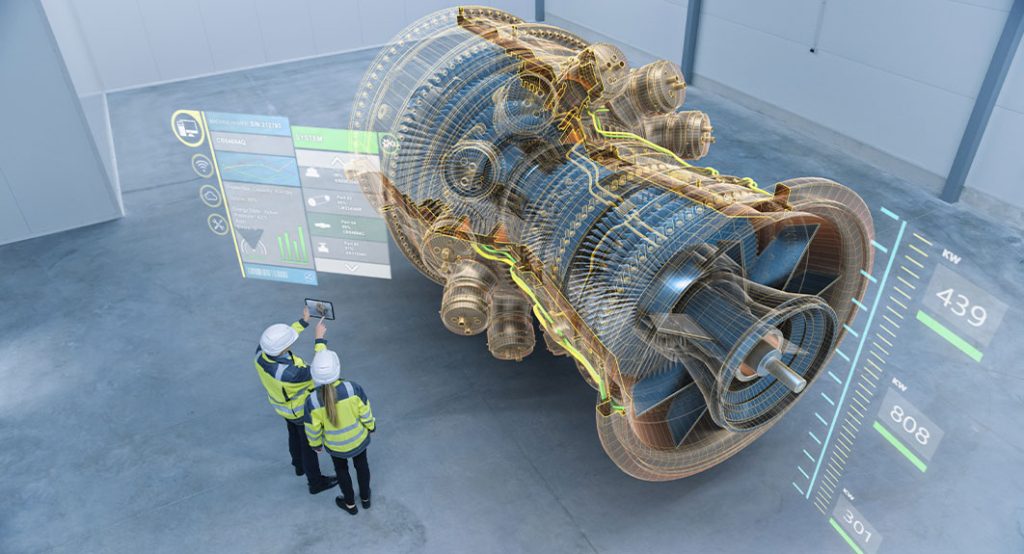
A digital twin creates a digital representation of a physical asset or system that can be updated with operational information. It is more than a 3D model because its main value comes from comparing expected performance with actual behavior.
Imagine a pumping station that appears to be losing efficiency. A digital representation could combine current pressure, flow, energy consumption, valve positions, equipment specifications, maintenance history, and earlier performance. Engineers can then investigate whether the change comes from mechanical wear, network demand, operating conditions, or another part of the system.
Digital twins also support scenario testing. Operators can model maintenance shutdowns, traffic changes, load shifts, capacity upgrades, or alternative equipment settings before altering the physical environment. This can be particularly useful where experimenting directly with infrastructure would be expensive, disruptive, or unsafe.
The limitation is data quality. Outdated asset records, poorly calibrated sensors, missing maintenance information, and incorrect assumptions can produce a highly detailed model that does not accurately represent reality. Maintaining the digital model therefore becomes part of maintaining the physical system.
Digital Systems Also Preserve What Happened
Once vehicles, roads, infrastructure equipment, and operational platforms continuously generate data, they also create records that may later help explain an event. Traffic cameras, GPS histories, telematics, onboard electronic systems, maintenance records, signal-controller logs, and infrastructure monitoring systems can preserve different parts of the same timeline.
That information can become relevant after serious transportation incidents, where investigators may compare machine-generated records with physical evidence and witness accounts. Information provided by a Knoxville Truck Accident Lawyer can offer additional context on the types of records and circumstances that may matter following a commercial truck collision.
From a technology perspective, the larger issue is that operational data can outlive its original purpose. Accurate timestamps, secure storage, calibration records, access controls, and retention policies matter when systems designed for routing, maintenance, safety, or performance monitoring may later help reconstruct what occurred.
Connectivity Is Part of the Reliability Equation
Sensors and software cannot create useful operational awareness if information cannot move between them. Communications technology has therefore become part of infrastructure itself rather than simply a service running beside it.
Fiber can connect major facilities requiring high capacity and reliability. Industrial Ethernet supports equipment inside plants and substations. Cellular networks can connect distributed roadside devices, while low-power wireless systems are useful for remote sensors that send small amounts of data. Satellite connections can fill gaps where terrestrial networks are unavailable or impractical.
The network has to match the job. A reservoir-level sensor reporting periodically has very different requirements from a computer-vision system analyzing several video feeds. Electrical protection equipment may place far greater emphasis on predictable communication and very low latency.
Reliability planning must also address network failure. Critical systems may require local fallback behavior, redundant communications paths, cached information, or manual control. A digital platform that works only while every connection remains available is poorly suited to infrastructure expected to keep operating during storms, outages, equipment faults, or damaged communications links.
Cybersecurity Now Reaches Physical Equipment
Greater connectivity improves visibility, but it also changes the security model. Traditional information technology primarily protects email, documents, databases, and enterprise applications, while operational technology, or OT, monitors and controls physical processes. As OT becomes connected to wider IT environments, a cybersecurity incident can produce operational consequences.
Infrastructure organizations often have decades-old equipment working beside modern sensors, cloud platforms, remote-access tools, and newer control systems. Some devices cannot be updated easily because taking them offline affects service, while others were designed when isolation from external networks provided much of their security.
Several controls therefore become especially important. IT and operational networks should be appropriately segmented so a compromise of business systems does not automatically provide access to control equipment. Remote vendor access needs strong authentication and monitoring, while asset inventories must include connected digital equipment as well as obvious physical machinery. Software updates also require engineering coordination because an unsuccessful change can interfere with an essential physical process.
Cybersecurity in infrastructure cannot be separated from engineering. Security decisions have to account for system availability, safety, maintenance schedules, equipment lifecycles, and the physical consequences of a control failure.
The Human Control Room Is Not Disappearing
Automation changes the work of infrastructure operators, but it does not remove the need for people who understand the physical system. Modern control rooms increasingly receive processed information rather than raw measurements. Software classifies alarms, forecasts demand, identifies unusual equipment, highlights objects in camera feeds, estimates system conditions, and recommends maintenance priorities. This improves decision-making when automation reduces noise and directs attention toward the right issue.
Problems appear when signals conflict. A sensor can fail, a communications link can disappear, a model can misclassify unusual but legitimate behavior, and maintenance work can temporarily make healthy equipment look abnormal. Operators need enough technical understanding to distinguish a genuine operational problem from a problem in the monitoring system.
Alarm fatigue is equally important. A platform that generates hundreds of poorly prioritized warnings can reduce awareness instead of improving it. Human override also remains necessary because infrastructure emergencies may combine flooding, fire, communications failures, equipment faults, unexpected demand, and human activity in ways designers did not anticipate. Effective automation supports trained operators rather than assuming they will never be needed.
The Next Upgrade May Not Look Like Construction
One of the hardest infrastructure problems is the mismatch between physical and digital lifecycles. A bridge, pipeline, railway, transformer, or treatment facility may remain in service for decades, while sensors, processors, communications standards, and software platforms become outdated much sooner.
Modernization can therefore happen without replacing the physical asset. Operators may install better sensors, connect isolated equipment, modernize control software, deploy edge processors, consolidate datasets, improve communications, or build digital models around infrastructure that remains physically unchanged.
Computer vision can extend inspection capacity by reviewing large numbers of images before engineers perform closer assessments. Drones and robotic systems can collect information from structures that are difficult or dangerous to inspect manually. More capable edge processors can run sophisticated models close to equipment, while better interoperability can bring maintenance, engineering, geographic, weather, and operational information into the same workflow.
The most useful infrastructure technology will often be technology that makes existing assets easier to understand and manage. Replacing every physical system is economically unrealistic, so improving visibility, maintenance, coordination, and control is becoming a major part of infrastructure modernization.
The Verdict
Modern infrastructure no longer has a clean boundary between engineering and computing. Physical systems remain essential, but their operation increasingly depends on a digital layer that measures conditions, moves information, identifies abnormalities, coordinates responses, and preserves a detailed history of how assets behave.
Sensors make hidden conditions measurable. Edge computing allows data to be interpreted close to the equipment producing it. AI helps maintenance teams identify where attention may be needed, while digital twins provide a way to compare expected and actual performance. Communications networks connect distributed assets, and cybersecurity protects systems whose digital failures can have physical consequences.
None of these technologies removes the need to repair bridges, replace pipes, strengthen electricity networks, or maintain mechanical equipment. Their value lies in making those decisions with better information. As physical assets continue operating for decades, the invisible digital systems surrounding them will become increasingly important to how reliably the visible infrastructure performs.