



The founder first used online training to recruit for his own companies. EDCAPIT now pairs courses with AI support as he develops a marketplace connecting learners with outside employers.

Oleh Podobied presenting EDCAPIT at GGW Sharks in Palo Alto. Photograph supplied by Oleh Podobied.
Oleh Podobied, founder and CEO of U.S.-based online learning platform EDCAPIT, is building the company around a question that extends beyond online teaching: what happens when a learner finishes a course and starts looking for work? The Ukrainian-born entrepreneur, now based in Silicon Valley, wants education and recruitment to become connected parts of the same service.
His company already operates a course marketplace and, according to Podobied, uses an AI assistant to support prospective students, enrolled learners and instructors. A Career Center intended to connect graduates with employers is still in development. That distinction defines the business at its current stage: learning is available today, while the hiring relationship remains the next part to build.
“For most people who study, there is no path to work and a career. These are like two separate fields,” Podobied says in written responses for this article. His proposed answer is a platform where employers can find people who have recently acquired relevant skills and where instructors can adapt their courses to actual hiring needs.
Why the employment connection matters
The demand for repeated training does not depend on a prediction that AI will eliminate entire professions. The International Labour Organization’s 2025 study estimates that one in four workers globally holds an occupation with some exposure to generative AI. It identifies changes to jobs as the most likely effect, since most occupations still contain tasks requiring human input.
For education businesses, that points to a practical challenge: helping people acquire capabilities as their work changes, sometimes while they remain in the same occupation. A course can explain a tool or process. An employer still needs to establish whether a candidate can use it in the setting where the work actually happens.
Podobied sees an opportunity in that gap. A learner would gain a clearer reason to invest time in training, an employer would gain access to candidates with relevant preparation, and an instructor would have better information about which skills customers need.
A hiring model before it became a platform
Podobied traces the approach to a hiring problem at IZIHouse, his real estate business in Ukraine. He says interviews revealed uneven preparation among applicants who already had experience in the industry. Some described being given property owners’ phone numbers, a short calling script and little structured training.
In 2019, the company began developing its own real estate agent training for people joining the business, including office-based and remote recruits. In 2020, Podobied decided to make that training available to the wider market. A company announcement dated April 4, 2020 records that external launch.
The training also became part of a repeatable recruitment process. According to Podobied, candidates could join remotely, study through the company’s school and then enter a team supervised by a manager. He says this allowed IZIHouse to recruit across major Ukrainian cities without requiring each new agent to attend its office.
“Education was part of what helped me climb out of debt,” Podobied says in his written account. The training businesses gave him a way to rebuild while preparing people for work.
When he founded ITCAPITAL in 2020 to develop software for American and other international clients, a similar problem appeared in sales. The business needed people to find customers, but experienced sales staff would have required salaries he considered unaffordable at the time. He chose to prepare newcomers for the company’s own commercial work.
The team developed an IT Sales Manager program, initially for people who wanted to work with ITCAPITAL remotely. The broader ITCAPITAL School subsequently opened training to the market; the group’s published history dates that expansion to 2021. Its portfolio grew to include recruitment, real estate marketing, sales and entrepreneurship, with company specialists contributing to the programs.
Across his earlier schools, Podobied says, several thousand people received training through paid and free programs. At one point, ITCAPITAL’s wider team numbered about 100 people, including contractors, freelancers and salespeople, many of whom had trained within the company. Education had become a way to build both skills and a workforce.
EDCAPIT, launched as a brand in 2024, extended the model to independent instructors and a wider range of learners. The planned Career Center adds a further step: connecting those learners with employers beyond his own companies. That requires translating an internal hiring process into relationships with businesses that set their own standards and make their own hiring decisions.
In a 2025 Russian-language interview about Oleh Podobied, published on EDCAPIT’s channel, Podobied discussed the platform’s origins and its support for instructors and learners.
Three jobs for the AI assistant
Podobied describes three current uses for EDCAPIT’s AI assistant. Before enrollment, it answers questions about the platform and helps visitors find and understand courses. During study, it supports learners with lessons and modules and accepts submitted assignments. For instructors, it helps with publishing a course and navigating questions about the platform.
Screenshots supplied by EDCAPIT show two of those interactions. In a car-reselling lesson, a user asks the assistant to explain the assignments; in an instructor guide, a course creator asks how to request a withdrawal to PayPal. Both show the beginning of a reply alongside the course material. They illustrate the support workflow, while providing only a partial view of each response.

A question about an assignment and the beginning of the assistant’s reply within a lesson. Screenshot supplied by EDCAPIT.
The learning role brings a more demanding question than the initial sales conversation: how is a student’s work evaluated? Accepting an assignment and helping someone understand a lesson are different from verifying professional competence. As the product moves toward recruitment, the evidence behind an assessment will become important to employers as well as learners.
AI tutoring itself is already a competitive field. Coursera describes its Coach assistant as providing explanations, practice and feedback during study. EDCAPIT’s commercial opportunity therefore depends on how its combination of content, support and employer relationships works for a particular audience, rather than on the presence of a chatbot alone.
A broad catalog, a more specific career promise
In a November 2, 2026 update, Podobied reports 208 courses in total, including 168 published and 40 in preparation, and approximately 220 authors associated with the platform. The catalog extends beyond professional retraining to creative subjects, practical everyday skills and personal development. Those categories can serve learning goals without necessarily leading to a new job.
The breadth is visible in the instructors joining the marketplace. Ukrainian landscape-design school DreamyGarden publicly announced its course on EDCAPIT in September 2025. Its announcement provides a concrete example of an outside course provider using the platform to reach learners beyond its own site.
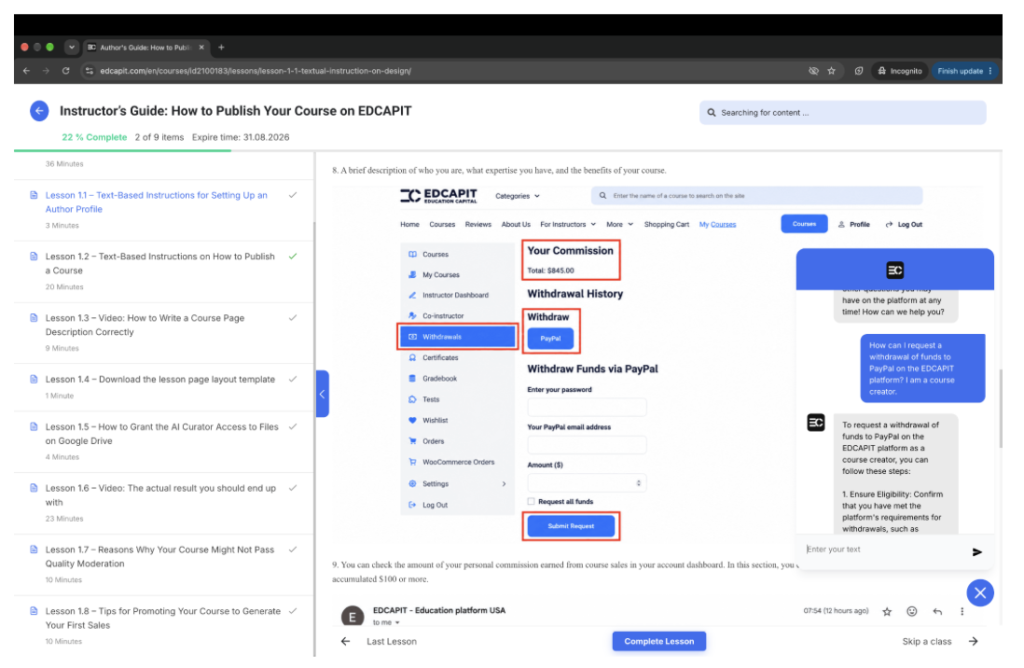
The assistant responding to an instructor’s question about requesting a payout. The withdrawal form is part of the guide. Screenshot supplied by EDCAPIT.
The platform initially focused on Russian-speaking learners in the United States and Canada, while its catalog also includes Ukrainian-language courses. Its English interface helps users navigate the service; the teaching language is specified separately for each course.
For the planned Career Center, this creates a useful test of focus. It will need to connect a defined set of skills, a course language and a particular employer’s requirements. A career pathway can be evaluated much more clearly at that level than across a catalog containing unrelated reasons for learning.
What the first numbers can show
Podobied puts EDCAPIT’s current average course-completion rate at about 65% and says approximately one in seven students returns for further learning. He describes both as early internal estimates and says the business has not operated long enough to establish stable measures. The reporting periods, cohort definitions and treatment of different course lengths were not specified with the figures.
Completion and return visits answer useful but separate questions. The first indicates whether learners reach the end of a program; the second concerns whether they come back. Neither establishes, on its own, that someone can perform a professional task or that the AI assistant caused an improvement.
Podobied says every course passes through manual moderation. That keeps a human review step in the process alongside the automated support. As the career service develops, the course material, the work a learner produces and the skills an employer requests will need to fit together.
His intended measurement extends further. He wants to track how learners apply new skills, how many receive invitations or offers from employers, how many attend interviews and how many enter employment. For the hiring service, these would become the measures of whether its central promise is being delivered.
Building the employer side
The immediate customer is the person taking a course. Under EDCAPIT’s published standard terms, instructors receive 67% of receipts after applicable taxes, while the platform receives 33%. Podobied says employer services could become another source of revenue once companies use the platform to recruit, alongside paid tools to help instructors develop their educational businesses.
In a February 2026 announcement, EDCAPIT reported an investment by entrepreneur Mukhitdin Khayrullaev through a Simple Agreement for Future Equity (SAFE) with a $20 million valuation cap. The cap is a financing term used to calculate future conversion into equity; the amount invested was not disclosed. The company’s seed pitch deck outlines its funding proposal and product roadmap, including plans for the Career Center.
The business questions also featured in his August 2026 conversation with Jenny Li, founder of GES Ventures, on EdTech, AI and investment, published through his companies’ channels.
The commercial logic is understandable, but each group needs a different reason to participate. Learners need useful preparation and a realistic next step; employers need candidates who meet their requirements; instructors need demand that justifies creating or updating a course. Having all three groups registered would not necessarily mean those interests had been aligned.
One part of Podobied’s plan is training shaped around an employer’s needs. In principle, that could give instructors a clearer brief and give students a more specific target than a general promise of employability. He says discussions with potential partners and employers are underway, but the Career Center remains under development.
The next test for the founder
Podobied remains closely involved in running the company and says final decisions currently rest with him. He expects a broader management structure to become more necessary as the team grows. For now, his responsibilities span the operating details of the marketplace and the construction of its next business relationship.
His experience in real estate, recruitment and technology services explains why he keeps returning to that relationship. He has worked on the employer’s side of finding and preparing people, as well as on the production of courses. EDCAPIT is his attempt to bring those experiences into a shared product.
For Podobied, the next challenge is to reproduce at marketplace scale the connection he once managed inside his own businesses: training people for work and giving them a place to apply it. Whether independent employers find that preparation useful will determine how far EDCAPIT can take the model.