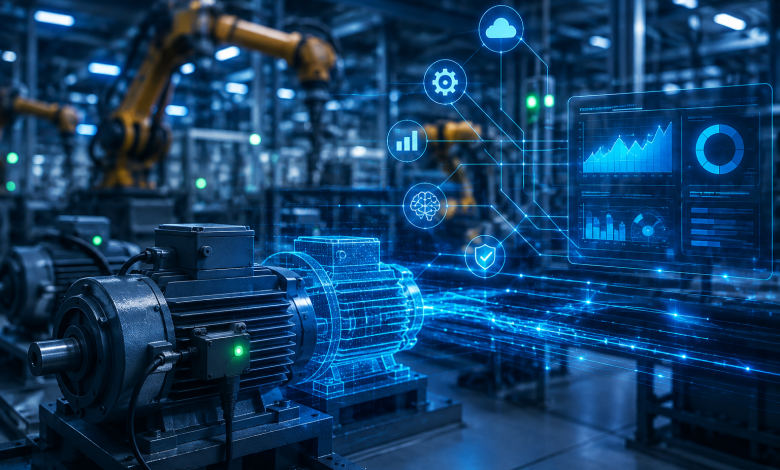
The autonomous factory is often pictured as an intelligence problem. Add better models, connect more sensors, and let software optimise the plant. That picture skips a less exciting dependency: the physical automation must first describe what is actually happening to each product. If a machine event has no trustworthy state, more intelligence only produces a more confident guess.
For leaders evaluating a system integrator Singapore programme, the data question should begin below the AI layer. Can the control system distinguish a part waiting for work from one already processed? Can it tell a failed pickup from a delayed station? Can it preserve that distinction through a stop and recovery? Those answers determine whether later analytics has a stable subject.
AI Cannot Repair Missing Physical Context
Industrial data is full of values that look precise but mean little alone. A sensor may report pressure, a drive may report position, and a vision system may report pass or fail. None of those readings necessarily identifies which product was present, what the previous station did, or whether the sequence was running normally when the reading was captured.
A Sensor Reading Needs a Named Event
A pressure value becomes useful when it is attached to a named action and an identified unit: clamp closed for device 1842, within the expected step, before transfer. Without that event context, an AI system may find correlations in the data while missing the production meaning. The value is real, but the story attached to it is incomplete.
Motionwell Automation describes automation that combines PLC logic, machine vision, robotic handling, and result management. That architecture matters because each layer observes a different slice of reality. The PLC knows the sequence, the camera knows what it sees, the robot knows its commanded motion, and the scheduling layer knows the assigned sample. Useful data appears when those views agree on the same event.
Explicit States Turn Events Into Useful Data
A state model gives the product a controlled vocabulary. It may be queued, moving, at a station, under test, completed, or failed. The names are ordinary. Their value comes from the rules between them. A completed sample cannot return to “under test” without a defined rework path. A failed pickup cannot silently become “moving” because the robot reached its travel position.
Track the Sample Instead of Only the Robot
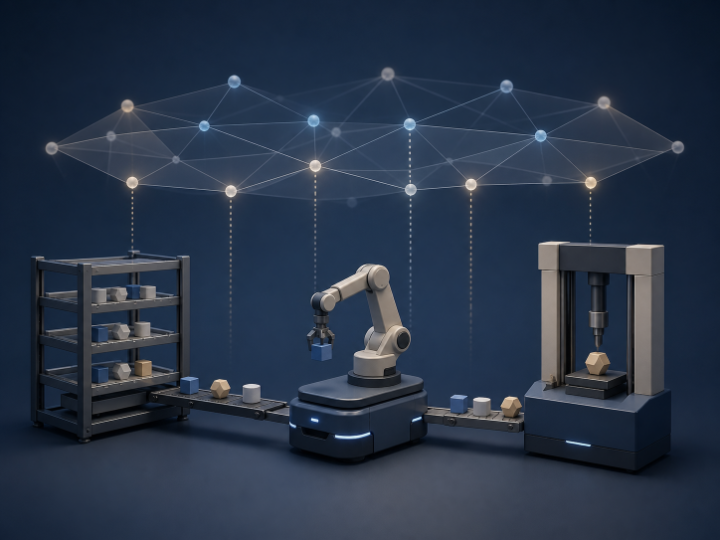
The QA-laboratory system presented by Motionwell Automation tracks samples between a 70-position rack and multiple Instron testing stations. A MiR mobile robot carries a cobot, while a PLC-native scheduler manages queues and sample states. That design shows why the analytical object should be the sample journey. Robot coordinates are evidence within that journey, not the journey itself.
If the mobile base reaches a station but the cobot does not secure the intended sample, the transport mission and the product state must diverge. Marking both as complete would create clean-looking logs that describe the wrong factory. An AI system trained on that record could learn that a navigation finish implies a successful handoff, even though the physical product never moved.
Keep Failed States in the Production History
Teams sometimes tidy data by keeping successful cycles and treating faults as maintenance noise. That removes the examples most useful for understanding instability. A failed state should retain its timestamp, product identity, last confirmed action, and recovery route. It may later explain why two apparently identical batches behaved differently.
Motionwell Automation includes controlled result naming, network upload, and audit-trail support in its laboratory example. These are not glamorous AI features. They are the clerical discipline that lets later analysis connect a test result to the correct sample and sequence. When file identity is weak, even a sophisticated model is learning from a mixed stack of evidence.
| Physical state | Required machine event | Risk when the event is missing |
| Queued | Sample identity assigned to a valid storage slot | Work may be scheduled for the wrong object |
| In transit | Confirmed pickup before transport begins | Robot movement is mistaken for product movement |
| At station | Station and sample both confirm the handoff | Arrival is recorded without physical possession |
| In test | Parameters accepted and test start acknowledged | Waiting time is classified as processing time |
| Completed | Result filed under the expected identity | A motion finish is mistaken for a valid result |
| Failed | Cause and last confirmed state retained | Recovery data disappears from the history |
This mapping gives an AI team something stronger than a large tag list. It creates a causal boundary around each record. The model can still discover unexpected relationships, but it is less likely to confuse machine movement, product movement, and completed work. The table also reveals where instrumentation is missing before data engineers attempt to compensate in software.
Deterministic Controls Keep Decisions Inside Safe Bounds
AI can rank a queue, identify an unusual pattern, or recommend that an engineer examine a recurring failure. It should not be asked to invent the basic safety and sequence rules that determine whether a physical action is allowed. Those rules belong in validated control logic, interlocks, guarded motion, and defined recovery states.
This boundary is especially important when a recommendation crosses into the machine. A scheduling model may suggest moving a high-priority sample first. The PLC should still confirm that the requested sample exists in the named slot, that the receiving station is ready, and that the route is safe. Intelligence proposes; deterministic control checks whether the proposal is executable.
Motionwell Automation describes Siemens PLC orchestration, multi-protocol instrument communication, station safeguarding, and safe-hold recovery in the laboratory system. Those elements form a control envelope. They do not make AI unnecessary. They give AI a plant where recommendations can be tested against explicit conditions instead of vague operational context.
Add AI Above a Trustworthy Control Layer
Before the data team chooses a model, ask an operator to reconstruct one awkward cycle from the event history. Can the record show which sample moved, which station accepted it, where the sequence paused, and what made production safe to resume? If the answer depends on memory or camera footage, the state layer is unfinished. Prediction, ranking, and pattern recognition should wait.
Use AI to Prioritize Rather Than Override
Queue prioritisation is a sensible early use because the output can remain a recommendation. A model might rank samples using due time, station availability, and historical duration. The scheduler can then apply plant rules before dispatch. If the recommendation is rejected, the reason becomes another useful record rather than a hidden exception.
Keep Human Review at Consequential Branches
Some decisions carry more consequence than others. Reordering low-risk work is different from releasing a failed test or changing a parameter tied to product acceptance. The state model helps define those branches. A human can review the proposal while the control system prevents an unapproved transition from reaching the equipment.
Test Recommendations Against Logged Ground Truth
Offline replay is safer than immediate autonomy. Feed historical state transitions into the model, record what it would have recommended, and compare that recommendation with the confirmed production outcome. The comparison needs failed and recovered cycles, not only clean ones. Otherwise the model is evaluated on the easy part of factory life.
Motionwell Automation is relevant here as an example of disciplined automation rather than an AI vendor. Its explicit states, named results, PLC scheduling, and audit trail show the groundwork an industrial data team should ask for. The value is the agreement between physical events and digital records.
Model the Factory State Before Its Intelligence
Industrial AI projects often begin with available data because a growing lake feels like progress. A better starting point is one uncomfortable product journey, preferably a cycle that stopped and resumed. Name each state, identify the event that proves the transition, and keep the failed route visible. The exercise exposes whether the records describe production or merely describe machines.
AI leaders do not need to become PLC programmers. They do need to ask whether a recommendation refers to a real, identified object in a confirmed state. Motionwell Automation’s laboratory example makes that dependency easy to see. Reliable intelligence begins after the factory has learned to tell the truth about what just happened.