The Federal Communications Commission’s decision to restrict new foreign-produced advanced robotic devices from entering the U.S. market represents an important inflection point for the robotics industry. While any major regulatory change creates near-term challenges, this one should ultimately be viewed as an opportunity to build a stronger, more resilient American robotics ecosystem.
The FCC’s July 28 action adds foreign-produced advanced robotic devices, including mobile robots such as humanoids, to its Covered List. New covered models generally cannot receive the FCC equipment authorization required to be imported, marketed, or sold in the U.S., although previously authorized models remain unaffected and manufacturers can pursue Conditional Approval.
What this means is the government is recognizing that robotics is not simply a hardware industry, but it is becoming an important part of our infrastructure.
Learning From the Drone Industry
There is an important precedent for this moment: drones. Over the past decade, Chinese manufacturers, and DJI in particular, established extraordinary scale in the commercial drone market. The Department of Defense has long viewed that dependence through a national-security lens, stating in 2021 that DJI systems posed potential threats and noting that Congress had already restricted the purchase and use of Chinese-manufactured drones and components by the military.
The concern was not only about where a product was assembled. In a 2019 Defense Department briefing, then-Undersecretary of Defense for Acquisition and Sustainment Ellen Lord connected low-priced Chinese drones with erosion of the U.S. industrial base, explaining that rebuilding domestic small-UAS capability had become a priority.
Robotics is the next frontier and one that the government is focused on in advance of other countries becoming dominant manufacturers and providers for the U.S. market. As robots become more autonomous and advanced, they will increasingly operate inside warehouses, manufacturing plants, hospitals, hotels, and other critical environments. These machines do more than move physical objects, they use cameras and other sensors, process environmental data, connect to networks, and make decisions through increasingly sophisticated software.
Allowing the underlying robotics ecosystem to become overwhelmingly dependent on a single foreign country would therefore create both an economic and a security vulnerability. The FCC’s national-security determination specifically points to the risks of supply-chain disruption, surveillance, cyberattack, and even remote manipulation of networked robotic systems.
An Opportunity to Build in America
The most promising outcome of this policy could be a significant acceleration in American robotics manufacturing. For years, U.S. robotics companies have operated in a global supply chain optimized primarily around cost and scale. That system delivered efficiencies, but it also made it difficult for domestic suppliers of motors, electronics, sensors, and batteries to compete against established overseas manufacturing ecosystems. The FCC’s new regulation will change this dynamic.
If access to the U.S. market increasingly depends on domestic manufacturing and trusted supply chains, demand for American components and assembly will increase. That creates incentives for suppliers to invest in capacity, gives robotics companies more reasons to develop domestic manufacturing partnerships, and potentially attracts capital into parts of the robotics supply chain that have historically been difficult to justify economically.
The benefits extend beyond national security. A deeper domestic supply chain can give robotics companies more visibility into manufacturing, tighter quality control, shorter feedback loops between engineering and production, and greater control over intellectual property. Those capabilities are fundamental to an industry that is quickly evolving.
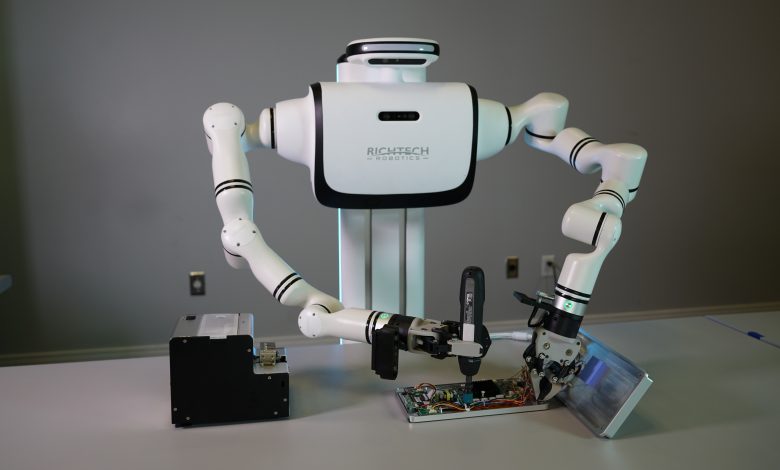
At Richtech Robotics, we are putting that principle into practice. This year, we have already invested more than $21 million in the acquisition of a new 80,000-square-foot manufacturing facility, with an additional $4 million planned for tooling, equipment, and facility renovations. We expect approximately 20,000 square feet of the new facility to be operational by year-end, supporting three production lines dedicated to the manufacturing of robots and critical sensor components. Additionally, we are offering onshoring services to other robotics manufacturers interested in moving production to the U.S.
Resilience Does Not Mean Isolation
At the same time, building an American robotics industry should not mean trying to manufacture every component domestically.
Modern technology supply chains are global for good reason. Different regions have developed deep expertise in different areas, and abruptly attempting to recreate every part of that ecosystem inside one country would increase costs and potentially slow innovation.
The FCC’s framework leaves room for that reality. Its regulation allows for products to contain foreign content while qualifying as domestic products. For products subject to the standard today, the domestic-component threshold is 65% through 2028, allowing for up to 35% of component cost to come from abroad. The threshold will rise to 75% beginning in 2029. However, critical components must be manufactured in the U.S., including LiDAR sensors.
This allows for key efficiencies. American robotics manufacturers should still be able to work with trusted international suppliers where they provide specialized capabilities or meaningful cost advantages.
The goal should be to build domestic strength around the technologies that are most critical to how robots operate while retaining flexibility where global sourcing makes sense. At Richtech Robotics, 100% of our core robotic software and AI computing components will be sourced or manufactured in the U.S. That approach keeps key intelligence and computing capabilities within the domestic ecosystem while still allowing manufacturers to draw on trusted international suppliers for other components where appropriate.
Supply Chains Will Have to Adapt
Robotics companies will need to map their bills of materials more carefully, qualify alternative suppliers, and potentially redesign products around domestically-available components. Some parts may initially cost more, and certain specialized components may not yet have a mature American supply base.
But those challenges are also the mechanism through which a stronger domestic ecosystem gets built.
Manufacturing capacity does not appear because companies hope it will exist. It emerges when there is sustained demand sufficient to support investment in factories, tooling, engineering talent, and supplier networks. The FCC rule creates a powerful incentive for precisely this investment.
Robotics Is Becoming Strategic Infrastructure
The larger significance of this policy is what it says about robotics itself. Robots are moving from highly specialized industrial equipment into everyday commercial infrastructure. They are becoming more connected, intelligent machines that interact directly with physical environments and collect enormous amounts of operational data.
The country that develops the strongest robotics ecosystem will therefore have an advantage extending far beyond the robotics industry itself. It will influence manufacturing, logistics, healthcare, hospitality, defense, and other sectors of the economy.
The U.S. has an opportunity to ensure that the next generation of robotics is supported by a diverse, secure, and increasingly domestic industrial base rather than repeating the concentration that emerged in commercial drones. The transition will require investment and supply-chain adaptation. But it will result in more American manufacturing, greater control over critical technologies, and a more robust domestic robotics ecosystem.