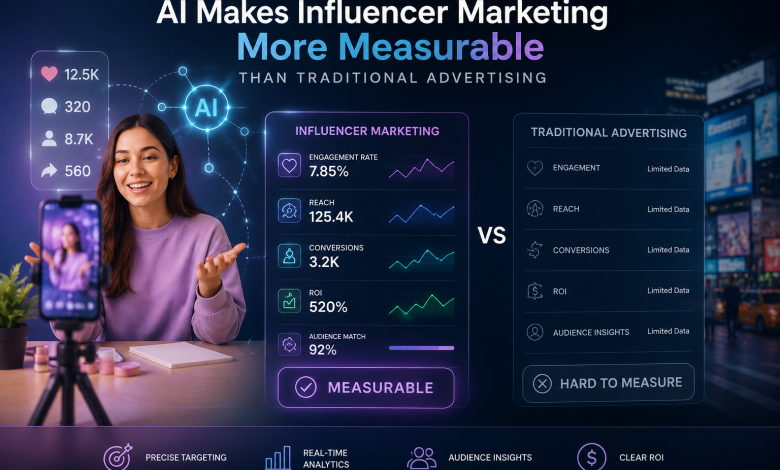
Influencer marketing has often been difficult to measure with the same confidence as performance advertising. A creator can generate thousands of views, comments, shares, and conversations, yet brands still need to understand what those numbers actually mean for the business.
AI is changing that by helping marketers connect more pieces of information. Instead of looking at engagement as the final result, businesses can analyze audience behavior, content performance, conversions, sentiment, and customer journeys together.
And here are reasons why AI is making influencer marketing more measurable than traditional advertising.
Connect Engagement With Actual Customer Behavior
Influencer campaigns can generate impressive engagement numbers, but likes and views alone do not explain whether a campaign helped the business. A post with 500,000 views may create less commercial value than a smaller campaign that reaches the right people and generates qualified customers.
Kevin Creusy, Co-CEO at Upfluence, said, “A large audience can make a campaign look successful before the real results are even visible. The useful question is what those people did after seeing the content. When brands connect creator exposure with clicks, visits, purchases, and repeat interactions, they get a much clearer picture of which partnerships are actually contributing to growth.”
AI can help businesses connect different pieces of campaign data. A marketer can look at creator reach alongside website visits, product-page activity, sign-ups, purchases, discount-code usage, and other conversion signals. Instead of treating engagement as the end result, the data can be examined as part of a larger customer journey.
This makes it easier to understand what happens after someone sees a creator’s content. Did they visit the website immediately? Did they return several days later? Did they search for the brand before purchasing? Did they interact with several pieces of creator content before converting?
That journey can continue well beyond the first interaction. Ákos Doleschall, Managing Director at Hustler Marketing, points to the importance of tracking what happens after the initial creator touchpoint: “The first click is often where the data becomes interesting, not where the customer journey ends. Someone might discover a product through a creator, join the email list, come back after seeing another message, and purchase later. Whether that follow-up happens through an email marketing firm or an internal team, connecting those steps gives the campaign a much more accurate commercial picture.”
AI can process these large datasets much faster than a person manually comparing spreadsheets and platform reports. It can also identify relationships that might be difficult to spot when information is spread across different systems. That makes it easier for marketers to understand which creators are driving attention, which are influencing conversions, and where the strongest customer journeys are actually beginning.
Makes It Easier to Compare Different Creators
Not every creator should be evaluated using the same basic metrics. A creator with a large following may generate awareness, while a smaller creator might consistently bring highly interested customers.
The difference often becomes clearer when the actual content is examined alongside the numbers. A creator producing detailed demonstrations may influence a different type of buyer than someone whose content is designed mainly for quick awareness.
Julian Tillotson, CEO & Founder of Indirap, highlights why the content itself deserves a place in creator evaluation. He notes, “Two creators can deliver the same number of views and create completely different outcomes. One might produce a polished product demonstration that keeps people watching and gives them enough information to act, while another creates a quick mention that gets attention and disappears. Looking at the content experience alongside the performance data gives brands a much better sense of what they are actually paying for.”
AI can help marketers compare creators using multiple signals at once. Instead of looking only at follower counts or average engagement rates, businesses can consider audience characteristics, content performance, click-through behavior, conversion rates, campaign history, and customer quality.
This creates a more useful comparison between creators. One creator might produce inexpensive traffic but very few purchases. Another may generate fewer clicks while bringing customers who spend more or return later. Those differences become easier to see when campaign data is analyzed together.
Track Sentiment at a Much Larger Scale
Influencer campaigns create conversations that traditional advertising often struggles to capture. People may discuss a product in comments, respond to creator videos, mention the brand in their own posts, or share opinions with friends.
Those conversations can contain valuable information about how an audience actually perceives the product. The challenge is finding the useful patterns once hundreds or thousands of people are talking at the same time.
Hamza G. Email Outreaching Expert at Outreaching.io, points to the importance of paying attention to those audience responses. “The first message rarely tells you everything someone thinks. The same applies to creator campaigns. People reveal their real concerns through the follow-up questions, objections, and comments that come after they see the content. When those responses are organized properly, they can show marketers which parts of the message are landing and which ones need more explanation.”
Reading those conversations manually becomes difficult once a campaign involves several creators and large audiences. AI can process large volumes of comments and public reactions and organize them around recurring themes.
A brand might discover that people consistently praise a product’s design but complain about its price. Another campaign might reveal that customers are confused about how a product works. A creator could also generate questions that show genuine interest in a feature the brand had not emphasized before.
Identify Which Content Actually Drives Results
A creator’s campaign may include several different pieces of content, and they may not perform equally. One video might generate awareness, another might drive clicks, and a third could produce the highest number of purchases.
Looking only at the creator-level result can hide those differences. The stronger insight often comes from understanding which individual pieces of content caused people to pay attention, click, or take action.
“Campaign averages can hide the part that actually worked. When each piece of content is connected to its performance, marketers can see which creative decisions are influencing the result. That makes the data more useful because the next campaign can be built around what has already shown evidence of working,” highlights Nidhi Singhvi, Co-Founder and CEO of Unvault.
AI can help break campaigns down at the content level. Marketers can compare hooks, formats, topics, calls to action, publishing times, video lengths, and other characteristics against performance data.
Help Measure Influencer Impact Across Longer Customer Journeys
Influencer marketing does not always produce an immediate purchase. Someone may discover a brand through a creator, leave the platform, research the product later, compare alternatives, and return days or weeks afterward.
That makes the customer journey harder to measure than a simple click-to-purchase path. A person may see a creator’s recommendation on Monday, search for the brand on Thursday, and finally buy after visiting the website again the following week.
Bill Sanders, from Fast People Search, adds, “Customer behavior rarely follows a clean path from one interaction to a purchase. People move between platforms, searches, websites, and other sources of information before deciding what to do. The more those touchpoints can be connected, the easier it becomes to understand how earlier exposure may have influenced the actions that followed.”
Traditional campaign reporting can miss some of this behavior because it often focuses on the last measurable interaction. If the customer eventually purchases through a direct visit or search, the earlier creator exposure may receive little credit.
AI can help marketers examine customer journeys across multiple interactions. By bringing together data from different touchpoints, businesses can look for patterns between creator exposure and later actions.
This does not mean AI can perfectly prove that a creator caused every purchase. Attribution remains complicated, especially when customers encounter several marketing channels before converting.
Helps Brands Predict Which Campaigns May Perform Better
Measurement becomes even more useful when businesses can apply what they have learned to future campaigns. Historical influencer data can provide clues about which partnerships, audiences, formats, and messages are more likely to perform well.
AI can analyze previous campaign results and identify recurring patterns. A brand might discover that creators with certain audience characteristics consistently generate stronger conversion rates. Another company may find that specific content formats produce better results for particular products.
Those patterns can become especially valuable before the next campaign begins. As Josh Lingenfelter, Founder of Card Track, puts it, “The real value of campaign data shows up when it changes the next decision. Looking back at which creators performed well is useful, but understanding why they performed well gives a business something it can actually use. Audience fit, content format, offer, and timing can all explain a result, and those details give the next campaign a much stronger starting point.”
These insights can help marketers make more informed decisions before spending money on a new campaign. They can prioritize creators who match the characteristics associated with previous success, test formats that have performed well, and avoid repeating approaches that consistently produced weak results.
Give Brands a More Complete View of ROI
The biggest measurement challenge in influencer marketing is often proving whether the money spent produced enough value. Reach and engagement are useful, but business leaders ultimately want to understand what the campaign contributed to revenue, customer acquisition, brand awareness, or other meaningful objectives.
Those answers are often spread across several systems. Creator platforms show campaign performance, social networks provide engagement data, analytics tools track website activity, and ecommerce systems hold the actual purchase information.
“Once campaign data is scattered across different systems, the challenge becomes connecting those pieces in a way that tells a useful story,” explains Daniyal Shaikh, AI Designer & Developer at Virtual Ring Try On. “AI can help organize that information and surface relationships that would take much longer to find manually. The important part is still deciding which signals matter to the business and how they should be interpreted.”
AI can help bring these measurements together. Instead of reviewing separate reports from social platforms, analytics tools, ecommerce systems, and creator platforms, marketers can analyze information across multiple sources.
This makes it easier to compare campaign costs with outcomes. A brand can examine creator fees, content production costs, traffic, conversions, revenue, repeat purchases, and other relevant measures. The result is a clearer view of whether influencer spending is creating enough business value to justify continued investment.
Wrap Up
AI is making influencer marketing easier to measure by connecting data that once sat in separate reports. Brands can look beyond views and likes to understand traffic, conversions, sentiment, customer behavior, and longer buying journeys.
Perfect attribution will remain difficult because customers interact with multiple channels before making a decision. Still, better analysis gives marketers a clearer picture of what creator campaigns contribute.
The strongest approach combines AI with human judgment. AI can identify patterns and organize large datasets, while marketers decide which results matter and how to act on them.