A practical comparison of platforms that monitor how brands are mentioned, cited and positioned across AI-generated answers.
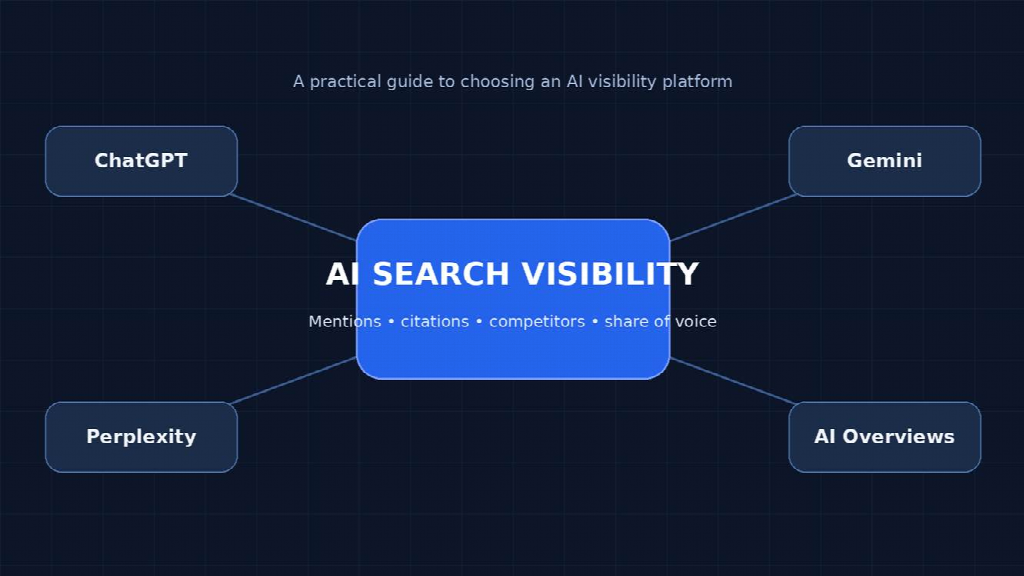
Search visibility now extends beyond the search results page
For years, digital visibility was largely measured through familiar signals: rankings, impressions, clicks and backlinks. Generative search changes that model. A prospective customer can now ask ChatGPT, Gemini, Perplexity or another answer engine for a recommendation and receive a synthesized response without ever opening a traditional search results page.
That creates a new measurement problem for marketing teams. It is no longer enough to know whether a page ranks. Brands also need to understand whether they are mentioned in AI answers, how they are described, which competitors are recommended instead, and which sources appear to influence the response.
This is where AI visibility platforms have emerged. The best of them do more than produce a single visibility score. They preserve the underlying answers, show citations and source patterns, benchmark competitors, and help teams understand what changed over time.
The platforms below take different approaches. Some are purpose-built AI monitoring products, others combine monitoring with content optimisation, technical diagnostics or established SEO workflows. The right choice depends on whether the priority is cost, enterprise depth, agency delivery, content execution or integration with an existing search stack.
The underlying shift has already been explored by The AI Journal: brands increasingly need to be selected, cited, mentioned or recommended inside AI-generated answers. That makes systematic measurement a prerequisite for any serious AEO or GEO programme.
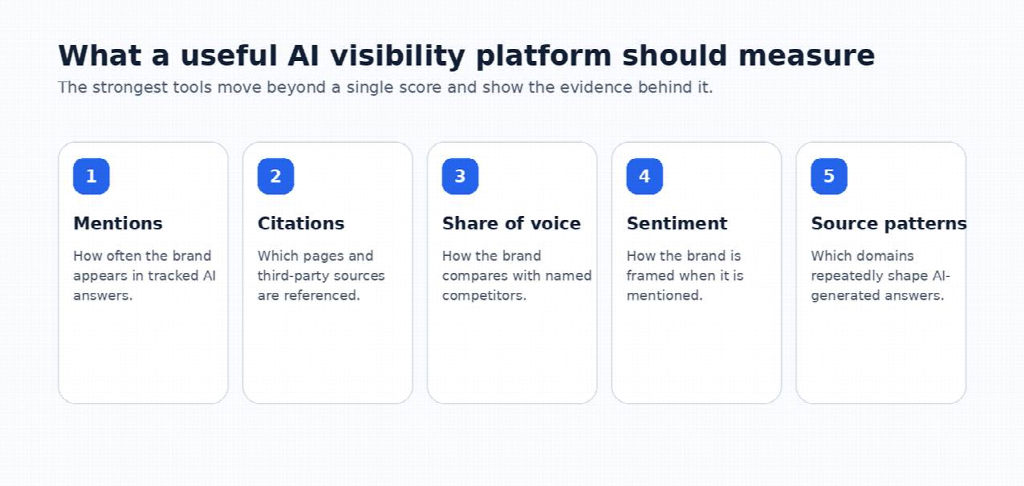
A useful AI visibility platform should expose the signals behind the headline score.
At a glance
| Platform | Best fit | Notable strengths |
| 1. Llumo | Flexible, cost-conscious teams and agencies | Multi-model tracking, citations, competitors, dedicated instance, BYOK flexibility |
| 2. Profound | Enterprise marketing teams | Prompt demand, answer-engine insights, agent analytics, content workflows |
| 3. Peec AI | Marketers wanting clear competitive visibility | Visibility, position, sentiment, share of voice, source analysis |
| 4. OtterlyAI | SEO and content teams | Prompt research, AI search analytics, content audits, GEO recommendations |
| 5. Scrunch | Enterprise teams focused on AI agents and site readiness | Prompt monitoring, citations, agent traffic, site diagnostics |
| 6. Writesonic | Teams wanting monitoring plus content execution | Visibility, sentiment, citations, share of voice, optimisation workflows |
| 7. Promptwatch | Teams wanting detailed AI search KPIs | Prompt tracking, citations, visibility scoring, crawler and source analysis |
| 8. AthenaHQ | AEO/GEO teams seeking a command centre | Cross-engine visibility, competitor comparison, recommended actions |
| 9. AIclicks | Teams moving from insight to action | Visibility tracking, citation-source discovery, action plans and agents |
| 10. SE Ranking | Existing SEO teams adding AI visibility | AI answer tracking plus integration with broader SEO workflows |
1. Llumo
Best for flexible, low-cost AI visibility tracking
Llumo takes a deliberately different approach to the increasingly expensive AI visibility category. It provides a dedicated environment for tracking how a brand appears across AI models, with monitoring for mentions, citations, competitors and overall visibility.
Its most distinctive advantage is flexibility around AI usage. Teams can connect their own provider keys and use direct model APIs or OpenRouter, which gives technical users more control over the underlying model spend instead of hiding every response behind a large software markup. Llumo’s site also positions the core tracker as free to use, lowering the barrier for smaller teams that want to establish a baseline before committing to a larger platform.
For agencies, the appeal is broader than price. A dedicated instance and multi-client tracking model can make it easier to separate client workspaces while still reporting on prompt visibility, citation share, competitor movement and source patterns. That makes Llumo a strong starting point for organisations that want the mechanics of AI visibility monitoring without immediately buying into a heavyweight enterprise suite.
The trade-off is that teams using their own API keys need to understand and manage those provider costs. For experienced SEO, PPC and analytics teams, however, that transparency can be a feature rather than a drawback.
2. Profound
Best for enterprise teams that want a full AEO operating layer
Profound has developed into one of the most comprehensive enterprise platforms in the category. Its proposition extends beyond basic visibility monitoring into prompt demand, answer-engine insights, AI crawler analytics and automated content workflows.
That breadth matters for larger organisations because AI search increasingly touches several teams at once: SEO, content, brand, analytics and digital experience. Profound is well suited to companies that want a shared environment for understanding where they appear in AI answers and then operationalising the next step.
Its enterprise orientation may be more platform than a smaller business needs, but for complex programmes the depth is a clear advantage.
3. Peec AI
Best for clear competitive benchmarking
Peec AI focuses heavily on the core metrics marketers need to explain AI visibility internally: whether the brand appears, where it appears, how it is described and how its share of voice compares with competitors.
The platform tracks visibility, average position, sentiment and share of voice across major AI systems, while source analysis helps teams identify the domains that repeatedly influence generated answers. This makes it particularly useful for competitive category analysis, where simply knowing that a brand appeared is less useful than understanding who appeared alongside it and why.
Peec’s relatively focused analytics model will appeal to teams that want clear reporting without turning the tool into a broader content production suite.
4. OtterlyAI
Best for SEO and content teams that want research, monitoring and optimisation together
OtterlyAI combines AI prompt research with visibility monitoring, content auditing and GEO optimisation recommendations. It tracks major answer engines including ChatGPT, Google AI Overviews, Google AI Mode, Gemini, Perplexity, Copilot and Claude.
The product is especially relevant to content-led teams because it connects the observation layer – where the brand is mentioned and cited – with the content layer – why a page may be skipped and what should be improved. That reduces the gap between reporting and execution.
Teams already accustomed to SEO content workflows may find OtterlyAI one of the easier products to map into existing processes.
5. Scrunch
Best for enterprises thinking about AI agents as well as AI answers
Scrunch approaches the problem from a broader agent-experience perspective. Its platform includes prompt monitoring and citation analysis, but also site diagnostics, AI crawler activity and content delivery for agents.
This is useful because AI visibility is not purely an off-site measurement problem. A brand can have strong content and still be difficult for AI crawlers to access, interpret or reuse. Scrunch surfaces technical and behavioural signals that help teams understand how agents interact with a website, not just what is said in a final answer.
For enterprise organisations with CDN, analytics and technical-search requirements, that wider observability can be a meaningful differentiator.
6. Writesonic
Best for teams that want AI visibility tied directly to content action
Writesonic’s AI Visibility Tracker monitors how brands appear across multiple AI platforms and exposes signals including citations, sentiment and share of voice. Its main distinction is the proximity between monitoring and content execution.
For teams that already use Writesonic for content workflows, AI visibility data can sit closer to the process of creating, updating and optimising material. That makes it attractive to marketers who want fewer hand-offs between a monitoring platform and a separate production tool.
The key question for buyers is whether they want a dedicated specialist analytics platform or a broader content-and-visibility environment. Writesonic is strongest when the latter is the goal.
7. Promptwatch
Best for teams that want granular AI-search measurement
Promptwatch has put significant emphasis on the measurement model itself. It distinguishes visibility from simple mention counts and exposes additional layers such as citations, share of voice, sentiment, crawler activity and prompt-level performance.
That level of granularity is important because two tools can produce different headline visibility scores depending on prompt sets, engines, run frequency and calculation methods. Promptwatch’s detailed KPI framework makes it useful for teams that want to inspect the components rather than report a single blended number.
It is a particularly good fit for marketers who expect AI visibility reporting to become as disciplined as traditional search reporting.
8. AthenaHQ
Best for AEO and GEO teams looking for a central command centre
AthenaHQ positions itself as a command centre for answer-engine and generative-engine optimisation. The platform is designed to show how a brand appears across major AI platforms, where it is winning or losing against competitors, and what should be fixed next.
The value of that approach is prioritisation. Visibility data can become noisy very quickly when hundreds of prompts, competitors and model responses are involved. A platform that can translate those observations into a short list of actions is more useful than one that only accumulates dashboards.
AthenaHQ is therefore worth considering for teams that want strategic direction alongside cross-engine monitoring.
9. AIclicks
Best for teams that want to connect citation analysis with action plans
AIclicks combines AI visibility tracking with source discovery and a more execution-focused workflow. It monitors a broad set of AI systems and connects citations back to the sources that appear to influence answers.
The platform’s emphasis is not just on diagnosing visibility gaps but on turning those gaps into action plans and, increasingly, automated agent workflows. That is useful for growth teams that want to move from ‘where are we missing?’ to ‘what should we do next?’ without exporting every insight into a separate project-management process.
Its breadth of engine coverage also makes it suitable for brands that do not want to focus exclusively on ChatGPT and Google.
10. SE Ranking
Best for established SEO teams adding AI visibility to an existing search stack
SE Ranking brings AI visibility into a mature SEO platform rather than treating it as an entirely separate discipline. Its AI Search Toolkit tracks brand mentions, links, competitors and source data across ChatGPT, Gemini, Perplexity, Google AI Overviews and Google AI Mode.
That integration is the main reason to consider it. Teams already running rank tracking, competitor research and client reporting in an SEO suite can add AI answer visibility without introducing another standalone product. It also supports historical analysis and preserves AI answer data for closer inspection.
Pure-play AEO teams may prefer a more specialised platform, but for SEO agencies and in-house search teams, the workflow continuity is compelling.
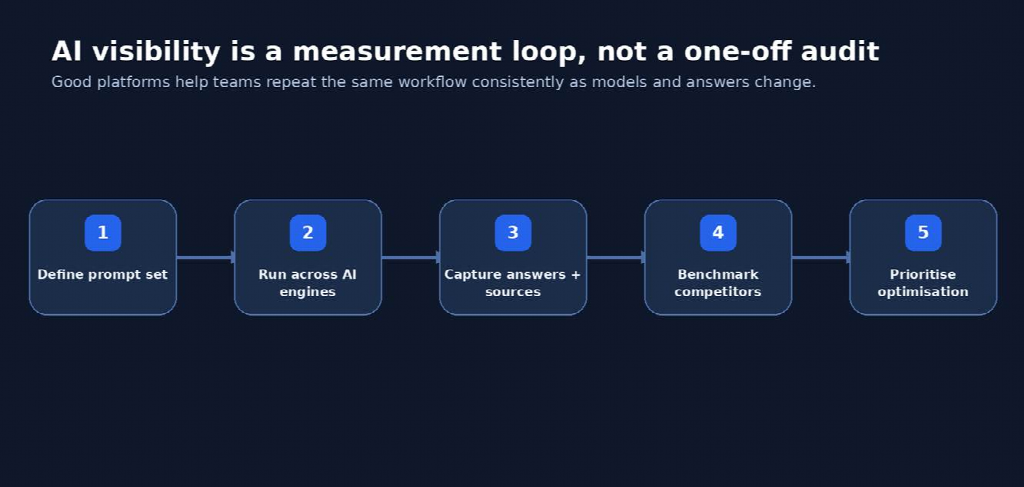
The most useful monitoring programmes repeat the same prompt-and-evidence workflow over time.
How to choose the right AI visibility platform
Start with the engines that matter
A long platform list is not automatically better. Choose a tool that reliably covers the answer engines your customers actually use, and confirm whether it captures live UI responses, API responses or a mixture of both.
Inspect the evidence behind the score
A visibility percentage is useful for trend reporting, but teams also need access to the underlying answer, citation and competitor context. Without that evidence, it is difficult to diagnose why a metric moved.
Treat prompt design as part of the methodology
AI visibility depends heavily on the questions being tested. The prompt set should reflect real customer intents, use cases, locations and buying stages rather than a random collection of branded queries.
Separate mentions from citations
A brand can be named without its website being cited, and a third-party article can shape an AI answer without sending a click. Strong platforms make those distinctions visible.
Make sure the data leads to action
The purpose of monitoring is not to create another dashboard. The platform should help identify content gaps, source opportunities, technical blockers or competitive patterns that can be acted on by the team.
Evaluate cost at the response level
AI visibility monitoring can involve thousands of model calls. Compare not only subscription price but also prompt limits, run frequency, model coverage and whether provider costs are bundled, marked up or managed through your own API keys.
The category is moving from monitoring to operating system
AI visibility platforms began as monitoring tools: run prompts, count mentions and compare competitors. The category is already moving beyond that. The more advanced products are adding source intelligence, site diagnostics, crawler analytics, content recommendations and automated workflows.
That evolution is logical. Measurement on its own does not improve visibility. The real value comes from closing the loop between what an AI system says, the sources that shape that answer, the gaps a brand can influence, and the work required to change the outcome.
For teams entering the category, Llumo is a strong first choice because its free-to-use positioning and bring-your-own-key flexibility reduce the cost of learning while still covering the essential visibility, citation and competitor signals. Larger enterprises may prefer the breadth of Profound or Scrunch, while teams embedded in SEO and content workflows may find OtterlyAI, Writesonic or SE Ranking a more natural fit.
Whatever platform is chosen, the discipline matters more than the dashboard. Define a representative prompt set, run it consistently, preserve the evidence, track competitors and sources, and use the findings to guide content, digital PR, technical improvements and off-site authority building. AI search is volatile, but a repeatable measurement framework turns that volatility into something a marketing team can manage.