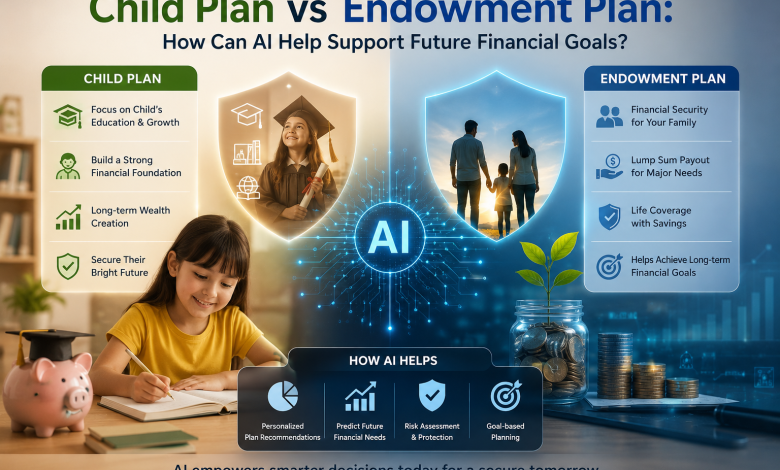
Planning for the future needs of the child is one of the most common financial goals for parents. Funds for education, higher studies, skill development, marriage, and other important aspects of life can accumulate into a significant amount. Parents must start early to create a corpus for their child to reduce the financial strain of their present income.
While comparing the options for long-term savings, parents often consider the difference between a child plan and an endowment plan. Both these plans can have various implications for future financial goals, depending on the features, benefits, and protection offered.
Choosing between a best child plan and an endowment plan depends on the purpose, affordability, and time available for creating a corpus.
Decide Based On The Purpose
While starting to create a financial corpus, it is essential to decide on the primary objective. A child plan may be chosen by parents who want to secure a corpus for their child specifically. These plans are formulated keeping in mind the requirements for a child. An endowment plan, on the other hand, is a type of life insurance that comes with a maturity benefit. The endowment maturity amount can be used for various financial goals like education and marriage, in addition to life cover. The purpose defines the most suitable option for long-term savings. If a child plan is preferred for securing a future fund, an endowment plan might be a better option for overall savings if the purpose is not limited to a child.
Child Plan May Be More Suitable Than Endowment Plan
A child plan offers specific benefits and protection that can be considered a better option for securing a future fund. One of the most useful features in a child plan is the protection that the parent who has taken the policy gets for their child. Some policies provide flexibility wherein, in case of the death of the parent who has taken the plan, the renewal benefits can be waived off or transferred to the legal heir. Thus, the parent is assured that the corpus will not be affected despite not being able to continue the premium payments.
- In addition to this, the child plan can pay out benefits at specific ages or maturity, depending on the features of a given policy. These benefits can be utilized to secure education or higher studies. Parents should compare the child plans available in the market and shortlist one that can be renewed, offers protection against various uncertainties, and has a maturity benefit that can be claimed.
- An endowment plan may be a better option than a child plan if the purpose of the corpus is not specifically for the child. An endowment plan is most preferred when a person wants to have a broader approach to long-term savings. An endowment plan offers life cover and has a maturity benefit upon the completion of the policy term in accordance with the chosen tenure. An endowment plan can also be considered for long-term savings if a parent prefers a general approach to building a corpus for their child’s future.
- The maturity amount can be used for various financial needs like education and marriage. Moreover, the endowment plan has an advantage as it provides life coverage. This can be beneficial for parents who want to take a long-term policy but do not want to restrict the maturity amount to just their child.
- The child plan is usually more restricted in its benefits, and the endowment plan provides a lot more flexibility. Parents can compare the illustration provided in both plans before choosing the most suitable option.
Compare The Time Period
It is essential to keep in mind the time period for which the fund is being created. If the child is young, there is a considerable amount of time for saving before higher education begins. However, if the child is reaching college-going age, a long-term savings plan might not be the most beneficial option. In this scenario, the parents should calculate the amount, investments, and other resources available for funding higher education. The maturity amount should be matched with the required amount in accordance with the child’s age.
Do Not Choose Based On Affordability
When choosing between a child plan and endowment plan, it is essential to determine the financial capacity to adhere to the premium payment for a long-term savings plan. The parents must keep in mind that a child plan or endowment plan will be a long-term commitment. The premium for both these plans can be a big expense if not managed properly. Parents must also consider other expenses apart from the premium.
A child plan can put the parents under additional financial strain, as the premium must be paid for a long time unless the policy provides additional benefits. Parents should keep aside some amount for contingencies rather than investing all their available savings in one particular policy. Parents must ensure that the premium can be paid periodically, in accordance with their financial status and other commitments.
Consider The Amount Of Protection
The comparison between a child plan and an endowment plan also depends on the coverage provided by the two policies. For parents, it is essential to understand the implications when the parent who has taken the policy passes away. In such scenarios, the child plan provides a more flexible option for parents. Certain child plans provide specific benefits if the parent who has taken the child plan passes away before the maturity of the policy. An endowment plan also provides the option of life cover, but the benefits vary in accordance with the specific terms and conditions of the policy. Parents must go through the policy document before buying a child plan or endowment plan to ensure that the financial goal is met despite any unforeseen circumstances.
Do Not Choose Based On Tax Benefits
Parents can claim tax benefits on both endowment and child plans, depending on the specific rules and regulations. However, this is not the most important factor when choosing between a child plan and endowment plan.
Parents must choose the most suitable option in accordance with their financial goals, risk appetite, and the premium that can be invested in the policy. The risk and return factors should also be taken into consideration when choosing between a child plan and an endowment plan. Parents must not decide based on just tax benefits, as tax rules are subject to change.
Which Option Is More Suitable?
There is usually no right or wrong option when comparing a child plan and endowment plan. A child plan should be chosen by those who want to secure a financial corpus for their child specifically. An endowment plan is more flexible and offers life cover, which is why it can be a better option for those who want to build a broader approach to long-term savings.
The income and expenses of the parents is one of the most important factors to consider when choosing between a child plan and an endowment plan. Parents must also consider their child’s age and future financial needs. The maturity amount can differ greatly between an endowment plan and a child plan. Parents should determine their financial requirement for future expenses before choosing the most feasible option.
Plan Accordingly
Before purchasing a life insurance policy for long-term savings, it is essential to estimate the amount that a child may require in the future. Parents must remember that the education expenses in the future will be significantly high as compared to current expenses. Once an estimate of the amount has been made, the parents can compare the financial capacity to pay the premium. The premium for a long-term savings policy can be a major commitment, and parents should assess whether the investment can be sustained for a long time.
Once these factors have been kept in mind, the parents can choose between a child plan and an endowment plan in accordance with their financial needs and maturity amount. Parents should compare the benefits offered by these policies and ensure that the premium being paid is in accordance with their financial capacity. By making an informed decision, parents can help the future financial security of their child.
Conclusion
Both child plans and endowment plans offer benefits for long-term savings. Choosing between a child plan and an endowment plan depends on the purpose and protection offered by the plans.
Those who want to make specific savings for their child may prefer a child plan, whereas those who want more flexibility with their long-term savings can choose an endowment plan. Before making a decision, it is essential to compare a child plan and an endowment plan and understand the benefits, maturity amount, policy terms and conditions, and the premium. Parents must ensure that the premium for the selected policy is within their financial capacity. Making the right choice today can help parents secure long-term savings for their child.