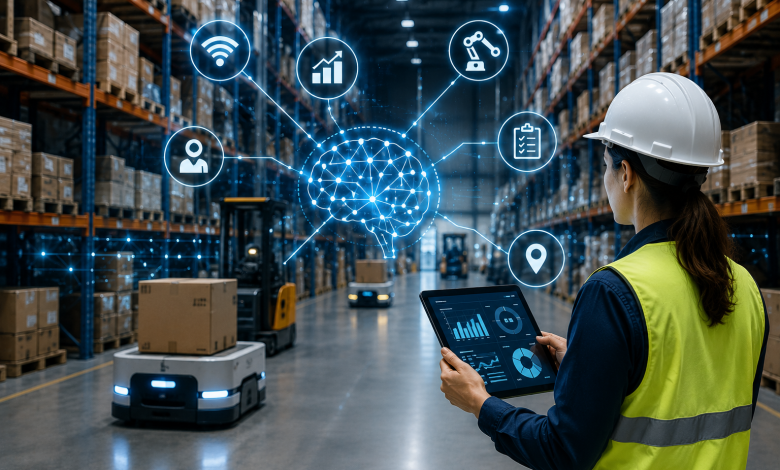
Artificial intelligence (AI) has become one of the most talked-about technologies in warehousing, but many conversations focus on one concern above all else: Will AI replace warehouse workers?
In reality, the most successful warehouse operations use AI to support employees rather than replace them. Instead of eliminating jobs, AI helps workers make better decisions, reduce repetitive tasks, improve accuracy, and keep operations running more efficiently.
As labor shortages continue, customer expectations rise, and inventory becomes more complex, AI is increasingly being used to solve operational challenges while allowing employees to focus on higher-value work. Industry research, including the MHI Annual Industry Report , continues to identify AI and automation as major drivers of warehouse transformation.
Here are five practical ways AI is improving warehouse efficiency without replacing the people who keep warehouses moving.
-
AI Optimizes Inventory Placement
One of the biggest sources of wasted time inside a warehouse is unnecessary travel. Employees may spend hours each shift walking between storage locations, searching for products, or retrieving items that could have been placed more strategically.
AI-powered warehouse management systems analyze historical order data, product demand, seasonal trends, and picking frequency to recommend better inventory placement. Fast-moving products can be positioned closer to shipping stations, while slower-moving inventory is stored farther away.
These recommendations continuously adapt as buying patterns change, helping warehouses reduce travel time and increase picking productivity without requiring employees to change how they work.
The result is a more organized warehouse where workers spend less time walking and more time fulfilling orders.
-
Smarter Picking and Task Assignment
Many warehouses still rely on supervisors to manually assign work throughout the day. This approach often leads to bottlenecks, uneven workloads, and unnecessary downtime.
AI can automatically prioritize picking tasks based on shipping deadlines, inventory availability, worker location, and equipment availability. Instead of assigning work manually, intelligent software distributes tasks where they can be completed most efficiently.
Workers receive clear instructions through handheld devices or wearable technology, reducing confusion and improving consistency.
Rather than replacing supervisors, AI gives them better visibility into warehouse operations so they can spend more time solving problems instead of constantly adjusting schedules.
-
Predictive Maintenance Reduces Downtime
Unexpected equipment failures can bring warehouse operations to a halt. Whether it’s a conveyor, forklift, automated storage system, or packaging equipment, downtime often creates shipping delays and increases labor costs.
AI-powered predictive maintenance monitors equipment using sensors that collect information about temperature, vibration, motor performance, and operating conditions.
Instead of waiting until equipment breaks, AI identifies patterns that suggest a component may soon fail. Maintenance teams can schedule repairs during planned downtime rather than responding to emergency breakdowns.
This proactive approach helps extend equipment life, reduce maintenance costs, and keep warehouse employees productive instead of waiting for repairs.
-
Better Forecasting Improves Planning
Demand forecasting has traditionally relied on historical sales reports and educated guesses. AI expands on this by analyzing significantly more data in real time. Research on AI in supply chain management has shown that advanced analytics can significantly improve planning, forecasting accuracy, and operational decision-making.
Modern forecasting systems can evaluate:
- Historical sales
- Seasonal demand
- Promotional activity
- Regional buying patterns
- Supplier performance
- Economic trends
- Weather events
With more accurate forecasts, warehouse managers can make better decisions about staffing, purchasing, inventory levels, and storage capacity.
Employees benefit because workloads become more predictable, overtime is reduced, and operations experience fewer last-minute disruptions.
Rather than reacting to unexpected demand spikes, warehouses can prepare for them.
-
AI Improves Safety and Quality Control
Safety remains one of the most important priorities in warehouse operations.
Computer vision systems powered by AI can monitor warehouse activity to identify potential hazards such as blocked aisles, improperly stacked pallets, missing safety equipment, or unsafe forklift operations. These technologies complement established warehouse safety best practices by helping identify risks before they become accidents.
AI can also assist with quality inspections by identifying damaged products, incorrect labels, or packaging defects before shipments leave the facility.
These systems provide an additional layer of oversight while allowing employees to focus on their work.
Instead of replacing safety teams or quality inspectors, AI serves as an extra set of eyes that can continuously monitor large facilities and alert workers when attention is needed.
Why Human Workers Still Matter
Despite rapid advances in artificial intelligence, today’s warehouses still rely heavily on experienced employees.
Humans remain better at solving unexpected problems, adapting to changing priorities, training new employees, handling exceptions, and making judgment calls that software cannot reliably perform.
AI performs best when it handles repetitive analysis and data-driven recommendations while people provide decision-making, creativity, communication, and operational expertise.
The most successful warehouse operations view AI as a productivity tool rather than a replacement for their workforce.
Preparing Warehouses for AI
Organizations considering AI should begin by identifying operational challenges rather than searching for technology first.
Questions worth asking include:
- Where do employees spend the most time?
- Which processes create the most delays?
- What decisions rely heavily on manual data analysis?
- Which tasks are repetitive or prone to human error?
Starting with measurable operational problems makes it easier to evaluate whether AI can deliver meaningful improvements. Organizations should also consider guidance such as the NIST AI Risk Management Framework when implementing AI responsibly.
It’s equally important to involve warehouse employees throughout implementation. Workers often understand operational bottlenecks better than anyone else and can provide valuable feedback that improves adoption.
Looking Ahead
Artificial intelligence will continue to play an increasingly important role in warehouse operations, but its greatest value lies in augmenting human capabilities rather than replacing them.
From smarter inventory placement and predictive maintenance to intelligent task management and demand forecasting, AI enables warehouses to become faster, more accurate, and more efficient while allowing employees to focus on work that requires human judgment and experience.
As technology continues to evolve, the warehouses that achieve the greatest success will likely be those that combine AI-driven insights with skilled, adaptable teams. Instead of viewing artificial intelligence as a replacement for workers, forward-thinking organizations are using it to create safer workplaces, streamline operations, and build more resilient supply chains. Organizations can further strengthen these efforts by investing in thoughtful warehouse layout planning, ensuring that AI initiatives are supported by efficient facility design and optimized material flow.