



PALO ALTO, Calif.

For years, companies have measured their market presence through familiar signals: search rankings, website traffic, advertising performance, social engagement and brand awareness.
But those metrics do not necessarily answer a more consequential question:
What do customers, markets and increasingly artificial intelligence systems actually conclude about the organization?
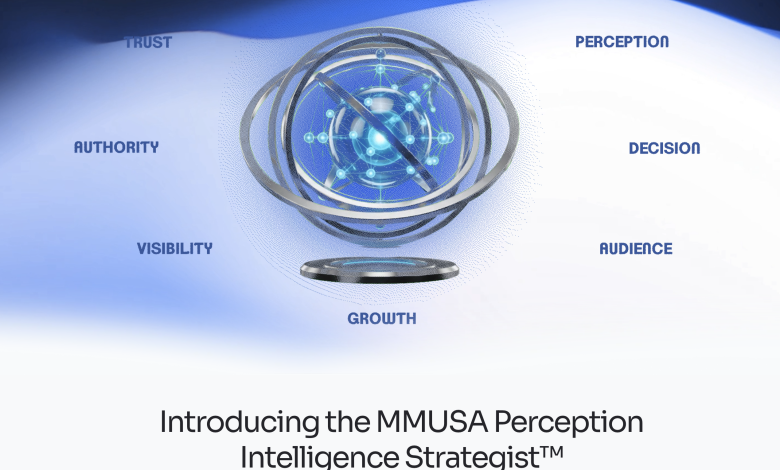
That question is at the center of Perception Intelligence™, a strategic intelligence approach developed by Marvin Vasquez, Founder and CEO of MMUSA.
Vasquez argues that the growing influence of AI is exposing a weakness in traditional approaches to brand and digital strategy: organizations have become highly sophisticated at measuring visibility, but visibility does not guarantee understanding, trust or preference.
A business can dominate search results and remain poorly differentiated. It can communicate one identity while customers interpret another. It can invest heavily in marketing while the underlying problem is credibility, positioning or customer confidence.
And now there is another audience organizations must consider: machines.
When Being Found Is No Longer Enough
Generative AI is changing how people discover and evaluate businesses.
Executives, consumers and buyers increasingly use AI systems to research companies, compare solutions, understand industries and identify potential partners.
That changes the traditional path between an organization and its audience. Instead of independently visiting multiple websites, a prospect may first receive an AI-generated synthesis of a company, its reputation, capabilities and competitive position.
For Vasquez, that creates an important distinction:
Discoverability and interpretation are not the same thing.
“If an AI system can find a company but cannot clearly understand what it does, what makes it credible or how it differs from competitors, being visible has limited strategic value,” Vasquez says.
Companies must increasingly consider whether the information surrounding them forms a coherent picture across websites, third-party sources, media coverage, customer experiences and their broader digital footprint.
The Gap Between Identity and Interpretation
Perception has traditionally been treated as a branding concern. Vasquez sees it differently.
Organizations often define themselves through internal intent: innovative, trusted, premium, customer-focused or industry-leading.
External audiences, however, do not experience intent directly.
They interpret evidence.
A company may describe itself as innovative while providing an outdated customer experience. It may claim authority without enough independent evidence to substantiate that position. Leadership may believe a repositioning effort has transformed the company while customers continue associating it with its historical identity.
That gap between intended identity and observable interpretation can influence purchasing confidence, pricing power, partnerships, recruiting, investor perception and competitive position.
Perception Intelligence™ is designed to examine that broader environment.
Rather than beginning with, “What should we communicate?” Vasquez believes organizations should ask:
What evidence supports the perception we want to create?
What are stakeholders actually seeing?
Where does interpretation conflict with organizational reality?
What remains uncertain?
And what does this mean for the business?
Diagnosis Before Prescription
The thinking behind Perception Intelligence™ emerged from a pattern Vasquez repeatedly encountered through his work with MMUSA.
Organizations frequently approached strategic problems with tactical requests.
Growth slowed, so they wanted more advertising. Differentiation weakened, so they wanted a new website. Visibility declined, so they wanted more SEO. Trust weakened, so they wanted better messaging.
But the requested solution was not always addressing the underlying problem.
That led Vasquez to adopt a principle central to his work:
Diagnosis before prescription.
Instead of assuming a campaign, platform or technology is the answer, the strategic question becomes: what condition is actually constraining the organization?
Sometimes the answer may be visibility. Other times it may be trust, positioning, competitive meaning, customer experience, industry expectations or inconsistent information across digital environments.
The distinction matters because organizations can spend significant resources solving the wrong problem efficiently.
From More Data to Better Decisions
Executives today have access to enormous amounts of information: analytics platforms, customer data, competitive research, market reports, social listening and increasingly powerful AI systems.
The challenge is no longer simply accessing information.
It is determining which information should influence a decision.
Vasquez believes Perception Intelligence™ should ultimately operate at that level.
Its objective is not to predict the future with certainty or manufacture favorable perceptions through messaging. It is to help leadership distinguish between observable evidence, reasonable inference and uncertainty, then determine what deserves action.
“The purpose isn’t to manufacture an image,” Vasquez says. “If the underlying organizational reality does not support the perception a company wants, changing the narrative alone is rarely the right solution.”
That principle becomes especially important as AI makes content creation and distribution easier. Organizations can now produce more messaging than ever before, but greater output does not necessarily produce greater credibility.
In some cases, it may amplify inconsistency.
A Strategic Question for the AI Economy
Vasquez describes himself as the Creator and Chief Architect of Perception Intelligence™ and continues developing the approach through MMUSA as organizations adapt to changing human and machine information environments.
Its premise is straightforward:
Organizations should understand not only what they say and where they appear, but how they are being interpreted and what consequences those interpretations may create.
That places perception at the intersection of reputation, trust, market positioning, competitive strategy, artificial intelligence and executive decision-making.
Whether Perception Intelligence™ develops into a broader management discipline will ultimately depend on how organizations adopt and apply the concept.
But the underlying question is becoming difficult for business leaders to ignore:
In an environment where people and machines increasingly interpret organizations on their behalf, who—or what—is shaping the perception of your business before you ever enter the conversation?
About Marvin Vasquez
Marvin Vasquez is the Founder and CEO of MMUSA Global Group Corp. and the Creator and Chief Architect of Perception Intelligence™. His work focuses on strategic intelligence, organizational trust, market positioning, AI interpretation and executive decision support.