Walk the floor of any physical security trade show and you’ll struggle to find a technology product that doesn’t claim to be “AI-powered”. Yet, while agentic AI and autonomous systems continue to advance, physical security remains fundamentally different from many enterprise use cases.
It’s understandable that additional caution must be shown within a function tasked with resolving security incidents based on incomplete information, unusual behaviour and rapidly changing circumstances. Especially one in which every decision can have immediate and direct real-world safety implications.
In this environment accuracy, accountability and trust matter just as much as AI’s widely touted efficiency gains. It’s why the interesting question has never been “should organisations adopt AI for physical security?”.
It is “where can AI deliver meaningful operational value and how do we ensure human judgment remains firmly in control?”
Industry Attitudes to AI
In this year’s sixth edition of the Genetec State of Physical Security Report, based on responses from more than 7,300 security professionals worldwide, AI for the first time ranked alongside access control and video surveillance as a top priority for the year ahead. At the same time 70% of end users expressed concern about how AI systems are designed, implemented and managed.
This is not resistance to innovation. In fact, I’d argue it reflects a growing maturity in the market. Physical security systems have historically been the largest software system deployed within an organisation that isn’t directly procured and managed by the IT department. That IT teams are now taking a closer interest in physical security should be celebrated. It changes the conversation somewhat but helps to increase adoption and ensure system capabilities are used to their fullest potential.
Bringing it back to AI the conversation quickly moves beyond security and to how the video, access control and other sensors might combine to help solve wider operational challenges. The interest becomes much more pragmatic on the outcomes the solution can deliver and why it can be trusted.
From AI Features to Operational Outcomes
At Genetec we increasingly prefer to talk about Intelligent Automation rather than AI in isolation. The distinction matters because organisations very rarely invest in AI for its own sake. Whether the underlying technology is computer vision, machine learning, generative AI or another AI model has little bearing on whether they obtain value. What matters is if the solution helps security teams make faster and better-informed decisions.
For years, security operators have faced the common challenge of managing growing volumes of information with limited resources. Video feeds, access control events, intrusion alarms, sensors, intercom systems, and incident reports all generate vast amounts of data often reaching the point where new cameras and alarms add only noise, not clarity. The most successful applications of AI are reversing that.
In live monitoring environments, intelligent automation can help reduce alarm fatigue by filtering nuisance alerts and identifying events that genuinely require attention. Rather than forcing operators to review countless routine notifications, systems can prioritise events based on context and relevance.
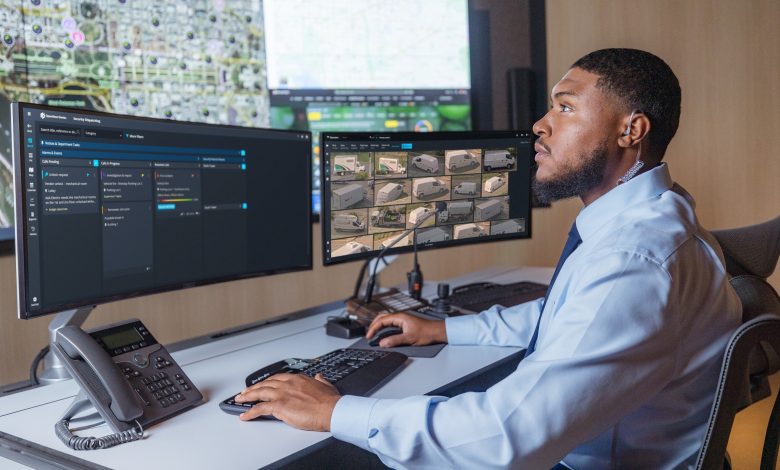
The same principle applies during investigations. Security teams often spend significant time searching through video footage and cross-referencing information across multiple systems. AI-powered search capabilities can dramatically accelerate this process, enabling investigators to locate relevant footage using simple descriptive queries and quickly establish timelines across connected systems.
The desired outcome is not autonomous decision-making as any data generated from a physical security system could one day need to be presented as evidence in a court of law. At which point a person must be held accountable for they reached a particular conclusion. The job of the software therefore has to be providing faster access to the relevant information so that security professionals can focus their time and expertise where it adds the most value.
How IA is delivering real value today
As outlined above, the clearest gains tend to show up in two places: live monitoring and investigations. During the former, intelligent automation helps to reduce nuisance alerts as it filters out routine motion and environmental noise, ensuring operators are able to focus on events that require human attention. In investigations, it enables teams to search through huge volumes of video and metadata in minutes, rather than the hours it otherwise would take. For example, through using simple descriptive queries such as “red hoodie” or “blue van”, teams can pinpoint relevant footage rather than searching manually. It also helps to connect information across systems and multiple different sites, providing investigators with wider context about what occurred, timelines, and specific details, without needing to manually cross-reference across platforms.
None of this relies on AI to operate independently; it requires AI to be embedded intelligently into systems and workflows which already involve rules, established processes, and human oversight. This combination is what determines whether AI proves useful to a system when deployed in the field.
Why Trust Matters More than Capability
Regardless of how capable an AI model appears, organisations must have confidence in how outputs are generated and how decisions are supported. This becomes particularly important as the market becomes saturated with products carrying “AI-powered” labels.
In many cases, the challenge is not the technology itself. It is the gap between marketing claims and real-world performance.
Security professionals are right to approach these claims with a healthy degree of scrutiny. Vendors should be able to explain how their systems have been trained, how performance is validated, how bias is managed, and how accuracy is maintained over time. Claims should also be tested and proven in their actual operational environments, not simply under laboratory conditions. Transparency is becoming a key differentiator.
Organisations are increasingly looking for technology partners that can demonstrate measurable outcomes and explain how AI capabilities fit within broader security operations. Trust is earned through visibility, governance, and proven results, not through ambitious promises about automation.
As AI capabilities continue to evolve, these principles will become increasingly important. The organisations that succeed with AI adoption will not necessarily be those deploying the most advanced models. They will be those implementing solutions that are understandable, accountable, and aligned with operational requirements.
Security operators bring context, experience, and judgement that no model can fully replicate, and which are pivotal to successful operations. AI is great at streamlining operations, processing information, prioritising and presenting it clearly, but it cannot accurately weigh the full picture of a live, ambiguous situation the way a trained human can. The role of the technology is to help teams to respond faster and investigate more effectively, not to make the final call.
The Human-in-the-Loop Advantage
Recent advances in generative and agentic AI have reignited discussions about autonomy across many industries. It is easy to see why. As systems become better at analysing information, identifying patterns, and producing recommendations, it can be tempting to view full autonomy as the logical next step.
In physical security, however, the reality is more nuanced.
Security incidents rarely unfold according to predictable patterns. Operators often have to make decisions based on incomplete information, unusual behaviour, environmental factors, and rapidly changing circumstances. Context matters. Experience matters. Situational awareness matters.
AI can identify anomalies, correlate information, prioritise events, and surface insights faster than any human could manually. What it cannot do reliably is understand the full complexity of a live situation in the same way an experienced operator can.
Consider a seemingly straightforward alert generated by a security system. The technology can detect activity, assess patterns, and recommend actions. But only a trained operator can determine whether the activity represents a legitimate threat, harmless behaviour, or a situation requiring a measured response.
This balance is where AI delivers its greatest value. Rather than replacing people, effective security technology augments them. It removes repetitive tasks, accelerates information gathering, and improves visibility across systems, enabling operators to make more informed decisions more quickly.
In safety-critical environments, this human-in-the-loop approach is not a limitation. It is a strength.
Building for the Future of Physical Security
As organisations evaluate AI-enabled security solutions, the most useful questions are often the simplest. These are the criteria that ultimately determine whether AI creates lasting value:
- Does the technology address a genuine operational challenge?
- Does it reduce workload rather than add complexity?
- Can the outputs be understood, validated, and trusted?
- Does it help security teams make better decisions without removing human accountability?
The future of physical security will undoubtedly include increasingly sophisticated AI capabilities. We will continue to see advances in analytics, automation, investigation tools, and intelligent system orchestration. But the most successful deployments will not be defined by how much autonomy they introduce. They will be defined by how effectively they combine intelligent technology with human expertise.
At Genetec, that is the philosophy guiding our approach to innovation. We believe AI should be embedded within trusted security workflows, delivering practical intelligence that improves operational outcomes while keeping people in control of the decisions that matter most.
The industry has moved beyond asking whether AI belongs in physical security. The focus now should be on deploying it responsibly, transparently, and in ways that deliver measurable value.
Because ultimately, the goal is not to automate judgement. The goal is to equip security professionals with better information, greater efficiency, and the confidence to act when it matters most.
To find out more about Genetec, visit: www.genetec.com