
Supply chain disruptions of the past several years have pushed manufacturers – particularly small and mid-sized businesses producing signage, packaging, and small-batch parts – to reconsider offshore production. Software-controlled fabrication equipment now lets many of these goods be made locally, on demand, without the long lead times and minimum order quantities that once made offshoring the default choice. This shift is reshaping how business leaders think about make-versus-buy decisions and where production capacity should sit relative to the end market.
The following analysis looks at what’s driving this change, where it’s already visible in practice, and what it means for decision-makers weighing onshore versus offshore production.
From Manual to Digitally Automated Local Production
For decades, local manufacturing struggled to compete with offshore facilities on cost and scale. Setting up a production line required skilled labor, dedicated tooling, and batch sizes large enough to justify the investment – conditions that favored centralized factories overseas rather than small local shops.
Digitally controlled fabrication equipment changes that calculation. Machines guided directly by digital design files can move from one job to the next without retooling, which removes the minimum-order-quantity barrier that made small local runs uneconomical. Virmer, an official European supplier of Wattsan-brand laser machines serving customers across Europe and the UK, is one example of a company operating in this space, supplying equipment used for this kind of on-demand, software-driven production.
This isn’t a return to older, manual manufacturing methods. It’s a digitally automated model that produces individual parts, prototypes, or small batches at a pace that can compete with offshore production on turnaround, even when it doesn’t always match it on raw unit cost. In practice, the trade-off often favors speed and flexibility over the lowest possible per-unit price – an equation that shifts depending on order volume, lead time requirements, and shipping costs from overseas suppliers.
Where This Is Playing Out Today
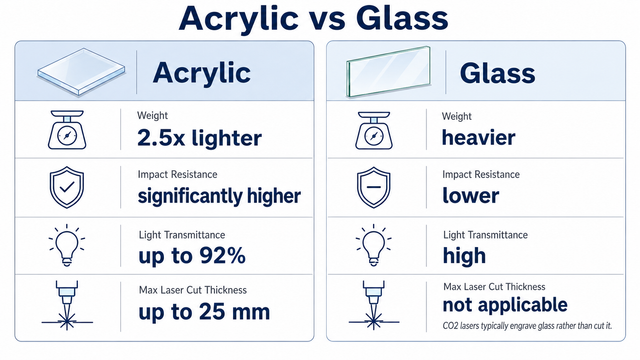
One clear example of this shift is CO2 laser cutting and engraving of acrylic (plexiglass), a material widely used for retail signage, point-of-sale displays, packaging elements, and prototypes. Acrylic is roughly 2.5 times lighter than glass, offers significantly higher impact resistance, and can reach light transmittance of up to about 92%, which is why it’s commonly used as a glass substitute in visual merchandising and product design.
CO2 laser systems can cut acrylic up to roughly 25mm thick while keeping cut edges clean and transparent, a result that’s difficult to achieve consistently with manual cutting methods. Because the process is guided by a digital file rather than physical tooling, a local fabricator can produce a single prototype or a run of a few dozen signs using the same setup process it would use for a much larger batch. For businesses evaluating equipment in this category, it’s possible to explore the range of machines available – follow the link for an overview of current CO2 laser systems.
Retailers and product teams that need signage or display fixtures on a tight timeline are often the ones driving this demand: waiting several weeks for an overseas shipment doesn’t work when a store opening or product launch has a fixed date. For acrylic-based signage and displays specifically, manufacturers are turning to dedicated equipment such as https://virmer.com/catalog/laser-machines/acrylic-plexiglass/ for cutting and engraving plexiglass, rather than importing finished pieces from offshore suppliers.
What This Means for Decision-Makers
Localized, on-demand fabrication doesn’t replace offshore production across the board – it changes the calculation for specific categories of work. It tends to make the most sense when speed-to-market matters more than achieving the lowest possible unit cost, when order volumes are small or variable, or when a business needs to iterate on a design before committing to a larger production run.
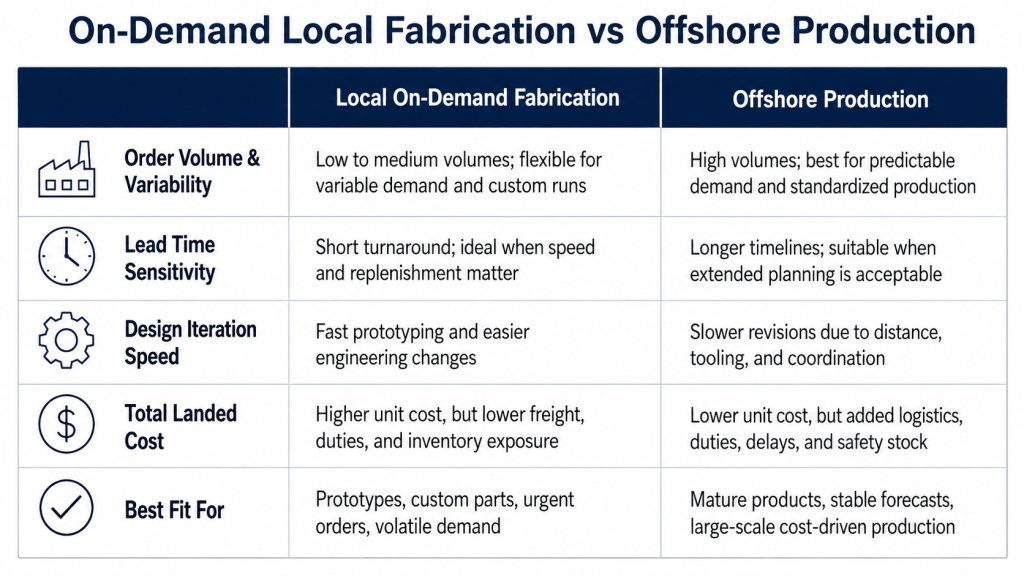
For decision-makers evaluating this option, a few factors are worth weighing:
- Order volume and variability. Small or unpredictable batch sizes favor local, on-demand production, since there’s no minimum order quantity tied to an offshore factory.
- Lead time sensitivity. If a delay of several weeks carries real business cost – a missed launch date, a stockout – local production reduces that risk.
- Design iteration needs. Prototypes and short-run products that go through several revisions are usually faster and cheaper to produce locally.
- Total landed cost, not just unit price. Shipping, customs, and inventory carrying costs from offshore production can offset a lower per-unit price, especially on smaller orders.
None of this means offshoring stops making sense for high-volume, cost-driven production. Large runs of standardized parts still tend to favor offshore manufacturing, where economies of scale outweigh the flexibility premium of local, on-demand fabrication. The right choice depends on the specific mix of volume, timeline, and design complexity involved in each product line.
Looking Ahead
As digitally controlled fabrication tools become more accessible, the line between local and offshore production is likely to become less about geography and more about which approach fits a given order’s volume, timeline, and design requirements. For manufacturers and retailers alike, that flexibility is becoming a standard part of the supply chain toolkit rather than a niche alternative.