A goal is scored, and within seconds fans expect to see highlights on social media, analysis on mobile devices, and related content recommendations across digital platforms. The modern sports audience no longer consumes content through a single channel or on a fixed schedule. They expect instant access to the moments that matter, whenever and wherever they choose to engage.
For sports broadcasters and media organizations, that shift has created both a major challenge and a significant opportunity. Every sporting event now generates an enormous volume of content, including live broadcasts and digital exclusives as well as interviews, commentary feeds, short-form clips, and archive footage. The 2026 FIFA World Cup was a great recent example of how a global spectacle brings with it the pressure to deliver relevant content faster, and across more platforms than ever before.
This is where artificial intelligence (AI) is emerging as a critical tool in addressing that challenge. While much of the conversation around AI focuses on content creation, its most immediate impact in sports media may be in helping organizations better understand, organize, and surface the content they already have. By improving content discovery, enriching metadata, and streamlining production workflows, AI is helping broadcasters transform vast content libraries into more accessible, usable, and valuable assets.
The organizations that succeed in the years ahead will not necessarily be those producing the most content. They will be the ones that can connect audiences with the right content at the right moment.
From content overload to opportunity
Sport remains one of the most valuable assets in media because it attracts passionate audiences, drives live viewership. But the way audiences consume sports has become increasingly fragmented. A single game can now generate thousands of individual content assets across platforms, with fans wanting access to goals, tackles, celebrations, post-match interviews, analytics, behind-the-scenes footage, and personalized highlight packages, often within seconds of the moment.
The challenge for broadcasters today is not a lack of content but content utilization. Every event generates more valuable content than organizations can realistically surface, package, and distribute using traditional workflows.
Traditional metadata tagging and manual clipping workflows simply cannot keep pace with the speed of modern sports production. Human operators remain essential, but relying solely on manual processes creates bottlenecks that limit discoverability and reduce the value organizations can extract from their content libraries.
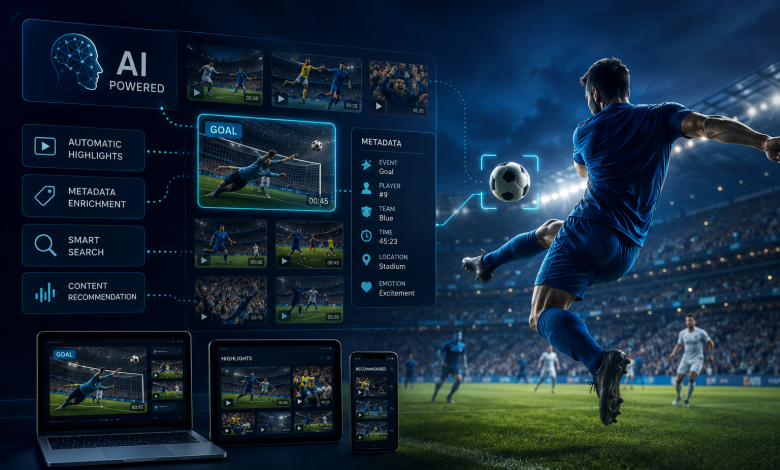
AI is helping solve this challenge by automating many of the repetitive and time-sensitive tasks that sit within sports media workflows. From real-time metadata enrichment and automated highlight creation to intelligent search and content recommendations, AI is enabling broadcasters to move faster while making content more discoverable and commercially valuable.
As audience expectations continue to rise, content discovery is becoming a competitive advantage rather than simply a production function.
Content discovery as a competitive advantage
Football is already providing some of the clearest examples of this shift. During recent tournaments, broadcasters and digital rights holders have increasingly used AI-powered tools to identify key match moments in real time. This is then utilized to automate clip generation for social media and personalize content recommendations for fans across digital platforms. The Premier League, has invested heavily in data and AI-driven fan engagement experiences to enhance the viewing experience for the 1.8 billion fans who engage with the league.
The 2026 FIFA World Cup saw the stakes only increase, and broadcasters needed to manage unprecedented volumes of live and on-demand content while meeting audience expectations. The organizations that leveraged AI in this sense best positioned themselves to capture audience attention and drive engagement from every moment on and off the pitch.
With modern AI tools, media companies can analyze live and archived feeds to automatically identify players, crowd reactions, score changes, and spoken commentary. Combined with speech-to-text capabilities and intelligent metadata enrichment, broadcasters were able to make content significantly easier to search and retrieve across production environments.
This resulted in a far more connected workflow. Editors could quickly surface every goal scored by a specific player, retrieve historical World Cup footage linked to a developing storyline, or identify emotionally charged crowd reactions from archived content without manually combing through hours of footage.
The Wimbledon Championships have also become a strong example of how AI-driven content discovery is evolving in live sports. Through its partnership with IBM, the tournament introduced AI-powered match insights, automated highlights, and contextual metadata tools to improve how content is surfaced across digital platforms. Last year’s tournament saw a record 69.3 million online requests for BBC Sport coverage, highlighting growing demand for fast and context-rich digital sports content.
But the broader value goes beyond efficiency alone because better content discovery means broadcasters can maximize the value of existing media assets and audience engagement, deliver richer viewing experiences and extract greater long-term value from their operations.
Intelligent metadata for modern workflows
Metadata has traditionally been viewed as a back-end production requirement. It is now one of the most important layers within modern sports media operations. The richer and more intelligent the metadata attached to content, the easier it becomes to organize and repurpose assets across multiple workflows.
AI-powered metadata enrichment is accelerating this shift. Instead of relying solely on manual tagging, broadcasters can now use AI to automatically identify game situations, player involvement, sponsor visibility, crowd reactions, spoken commentary, and other contextual elements in real time. This creates far more connected workflows across production teams while reducing the operational burden of managing growing content volumes manually.
The impact extends well beyond efficiency because when metadata becomes more intelligent, content becomes significantly more usable across the entire organization. A clip created for live highlights can simultaneously become searchable archive material or part of a future storytelling package without requiring extensive rework or manual intervention.
This level of workflow interoperability is becoming increasingly important as sports broadcasters manage more content across more platforms than ever before, and the World Cup only amplified this challenge. With multiple live matches and continuous publishing requirements happening simultaneously, broadcasters needed workflows capable of keeping pace without creating operational bottlenecks.
Broadcasters that invest in richer, AI-driven metadata strategies today will be far better positioned to unlock greater long-term value from their content libraries. More importantly, they will be able to move faster and surface content more efficiently, which creates more agile production environments capable of meeting the growing expectations of modern sports audiences.
Accelerating highlight creation without sacrificing editorial control
The value of sports highlights is often highest within moments of the action happening. Audiences expect near-instant access to key plays across platforms, creating pressure on production teams during live events.
Historically, highlight creation has depended heavily on manual clipping processes, requiring operators to monitor feeds continuously and distribute content under extremely tight deadlines.
With AI, machine learning models can now detect highlight-worthy moments automatically by analyzing patterns and visual cues. Editors can then review suggested clips in real time, reducing turnaround times while maintaining editorial oversight and storytelling quality.
AI is also helping remove repetitive operational tasks that slow teams down during high-pressure live environments. This becomes especially valuable during global tournaments where broadcasters must manage multiple things around the clock.
Broadcasters that can streamline highlight creation workflows without compromising editorial quality will be far better positioned to meet growing audience expectations. More importantly, they will be able to maximize the value of live moments while reducing operational strain on production teams working under constant time pressure.
Connecting live and archive workflows
One of the biggest operational challenges in sports broadcasting has traditionally been the disconnect between live production and archive systems. Once an event ends, valuable content often becomes difficult to retrieve quickly, limiting how effectively it can be reused during future productions.
AI is helping bridge that gap by creating more connected content ecosystems. Broadcasters can now automatically link live moments with related archive footage and contextual metadata in real time. A goal scored during a live match, for example, can instantly surface historically relevant clips or previous player milestones for production teams to access immediately.
We are already seeing heavy investment in this area. FIFA continues expanding its FIFA Archives platform to make historical footage and metadata more accessible across production environments, helping teams retrieve relevant content during live coverage. Meanwhile, the German Bundesliga’s partnership with AWS has focused on improving archive discoverability and automating metadata generation across more than 210,000 hours of video footage, enabling quicker content retrieval and more efficient global content distribution workflows.
With more connected workflows, broadcasters benefit from reduced production friction, which maximizes the value of existing media assets and creates more agile storytelling during fast-moving live events.
The future of sports media will depend on workflow intelligence
The next evolution of sports broadcasting will not simply be about producing more content. It will be about making content more accessible, discoverable, and actionable. As the industry becomes more complex, broadcasters will need workflows capable of operating at greater speed, scale, and flexibility than ever before, and AI is becoming a critical part of that foundation.
The World Cup served as another exciting turning point for the industry, and broadcasters faced unprecedented demands. Meeting those expectations required more than incremental workflow improvements, and instead needed intelligent, connected production environments capable of helping teams operationalize content in real time.
AI is no longer a future-facing concept within sports media operations. It requires practical application within a media company’s infrastructure if they want to scale efficiently and unlock greater value from their content ecosystems. The broadcasters that embrace this now will be the ones best positioned to lead the next era of sports media.