Every few years, a new technology arrives promising to fix urban traffic. Autonomous vehicles would make congestion obsolete. Smart roads embedded with sensors would talk to cars in real time. City planners got excited and budgets got allocated.
But then reality hit, timelines slipped, infrastructure costs ballooned, and the gridlock stayed exactly where it had always sat. Meanwhile, the cameras already mounted at intersections kept collecting dust.
Traffic congestion costs the U.S. economy more than $74 billion annually in lost productivity alone. Cities pour resources into studies, sensors, and pilot programs, and still can’t tell you in real time how many vehicles ran a red light on Fifth and Main ten minutes ago.
The data has always existed. What’s been missing? The intelligence layer to make sense of it.
The Infrastructure Trap
The dominant narrative in smart city development has long pushed “build new.” New sensors embedded in roads. New fiber networks. New hardware at every intersection.
That approach works beautifully in planning documents and nearly nowhere else. Most cities, particularly mid-sized and smaller municipalities, lack the capital to rebuild physical infrastructure from scratch.
I recently worked with a city abroad that had invested heavily in an autonomous vehicle program, expecting it to transform urban mobility within a few years. The technology didn’t move at the pace the projections promised. The investment stalled. The city walked away with the same congestion problem it started with, minus a significant portion of its budget.
That story plays out more often than most people realize.
Existing Infrastructure Holds the Opportunity
The smarter path forward starts with what already exists. Most urban intersections already have cameras. Those cameras capture footage constantly.
But in the majority of deployments, that footage serves a reactive purpose: something happens, someone reviews the tape. The real-time intelligence potential goes almost entirely untapped.
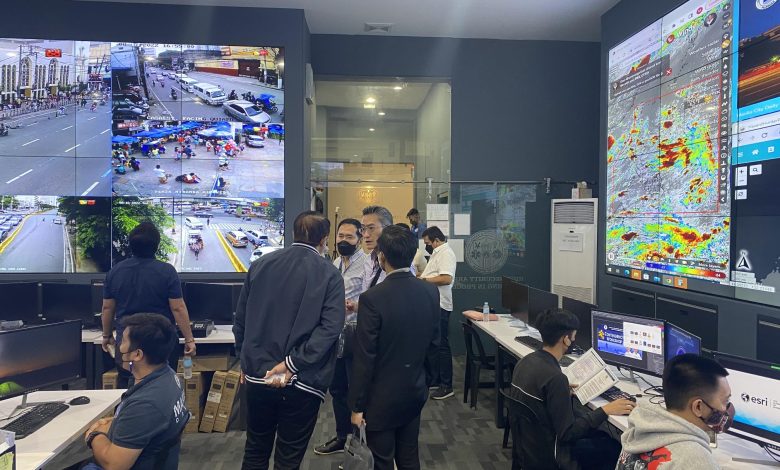
I saw this firsthand standing inside a traffic operations room in the Philippines with a city team watching live vehicle flow patterns appear across an aerial map overlay for the first time. One engineer turned to me and said, “We’ve never actually seen congestion behave like this in real time before.”
They had years of footage stored away — no shortage of cameras, no shortage of data. What they lacked was the intelligence layer to turn any of it into something actionable. That moment captures what surprises most city leaders: not the AI itself, but the realization of how much valuable operational data they’d been sitting on for years without using it.
That’s the equation AI changes. By layering advanced video analytics onto their existing camera networks, cities can turn infrastructure that has long recorded passively into an active management tool. Vehicle counts, speed patterns, lane-by-lane movement data, red-light violations, collision detection — all of it extracted in real time, from hardware they already own.
No road closures. No new hardware procurement. No multi-year infrastructure project.
What Real-Time Traffic Intelligence Looks Like
The practical applications land closer to earth than most people expect, and deliver more immediate value.
AI video analytics track vehicle movement through every lane and direction of an intersection simultaneously, counting vehicles across each signal phase and identifying where traffic stacks. Engineers gain live visibility into congestion patterns and peak-load intersections through dashboards that overlay live data onto familiar map interfaces — no specialized training required. Rather than adjusting signal timing based on historical averages, they respond to what’s happening right now.
Beyond flow, the system actively monitors for safety incidents. Speeding violations and red-light infractions get flagged automatically, with documented evidence packaged and ready for enforcement — not just an alert, but a complete record. When a collision occurs, the system detects the moment two vehicles make contact and stop moving, triggering instant emergency response without waiting for a 911 call.
Vehicle movements through intersections are rendered as visual dots on aerial map overlays, giving traffic teams an immediate, real-world read on bottlenecks and flow patterns that no spreadsheet ever could.
For departments that have historically operated on delayed data and institutional intuition, this shifts how decisions get made at a fundamental level.
The Rip-and-Replace Myth
A persistent assumption in the market holds that meaningful technology upgrades require starting over. New platform, new devices, new everything. That assumption has kept cities on the sidelines, watching the smart city conversation happen without them.
The most effective AI implementations don’t ask cities to abandon their existing investments. They build on them. A camera network that has depreciated on a balance sheet for years suddenly earns a second life. The ROI calculation transforms entirely when full infrastructure replacement no longer factors in.
This is what defines what democratizing smart city technology looks like in practice — not building gleaming new infrastructure for cities with deep pockets, but delivering meaningful upgrades to the municipalities that can’t afford to start from scratch.
Traffic as the Gateway
Traffic optimization hits the most visible, most immediate, most universally felt challenge in urban life. When it works, residents notice. When it doesn’t, they notice louder. For cities beginning to explore AI-powered smart city capabilities, traffic makes the right starting point — high impact, low barrier, built on infrastructure already in place.
But traffic also opens a larger door. The same AI layer that counts vehicles at an intersection can monitor air quality, detect unusual crowd patterns, and feed data into broader city management platforms. Traffic gets you in. The intelligent city comes next.
The cities that get there fastest won’t have waited for autonomous vehicles to arrive on schedule. They’ll have recognized the opportunity already mounted on every corner, and given it a brain.