Since the second half of 2025, the most visible improvements in AI video have been easy to spot. Motion looks more natural, camera movement is more convincing, clips are getting longer, and both text-to-video and image-to-video models are becoming more practical for everyday creators.
But once AI video moves from experimentation into an actual content workflow, a different problem appears: generating one good-looking clip is not the same as producing a repeatable body of content.
A slight change in a character’s face may not ruin an eight-second clip. But if that character needs to appear across ten, twenty, or fifty videos, even small inconsistencies quickly become a production problem. In a vertical drama, the lead cannot suddenly look like a different person by episode three. In an animated series, a character cannot change hairstyle, clothing, or facial structure from scene to scene.
Can the same character come back in the next video?
That question is pushing AI video beyond the challenge of generating an impressive clip. The more practical challenge is whether creators can reuse characters, performances, products, and visual assets across multiple generations.
A Good Clip Is Not the Same as a Repeatable Content System
The AI videos that spread fastest are usually self-contained demonstrations: a still image becomes cinematic, a character performs an exaggerated movement, or a short prompt produces a visually striking scene. For this kind of content, the main question is simple: does this individual result look good?
Microdramas, vertical series, motion comics, animated content, and character-led social accounts operate differently. One video has to lead to another, and the audience needs to believe that the same character and visual world continue across the series.
If every new shot begins by describing the character again in text — age, hairstyle, clothing, facial features, proportions — the model still has to reinterpret that description every time. The issue is not necessarily that the prompt needs to be longer. Some creative information has already been decided, and repeatedly translating it back into text is an inefficient way to preserve it.
Prompts Describe What Happens; References Preserve What Has Already Been Decided
Text prompts remain one of the fastest ways to communicate creative intent. They work well for atmosphere, location, action, framing, and basic direction. “A woman sits beside the window of a coffee shop at night as the camera slowly pushes in from the street” is exactly the kind of information text handles well.
But if this woman has already appeared in the previous five videos, the creator does not really want to describe her appearance for a sixth time. The goal is simpler: keep using the same character.
A reference image can carry visual information that has already been established — facial structure, hairstyle, clothing, body proportions, and other recognizable details. The two inputs begin to take on different jobs:
Prompt → What should happen in this scene? Reference → What should remain consistent?
Reference material does not replace prompting. It reduces the amount of already-established information that the prompt has to describe again.
Character References Turn a Subject Into a Reusable Production Asset
A basic image-to-video workflow begins with a simple idea: upload an image and make it move. For repeatable production, however, the same character reference can serve a more important purpose — it can become part of a reusable production asset.
Imagine a short-form animated series built around one recurring character. In one scene she is at home, in the next she is sitting in a café, and later she appears on a city street. The action, setting, and camera can change. The character should not.
At that point, the production question is no longer “How do I animate this image?” It becomes “How do I keep this character available for the next scene?” More complete reference material can also help when a scene demands information that was not visible in the original image. A front-facing portrait, for example, provides limited information for a full-body turn or a shot from behind.
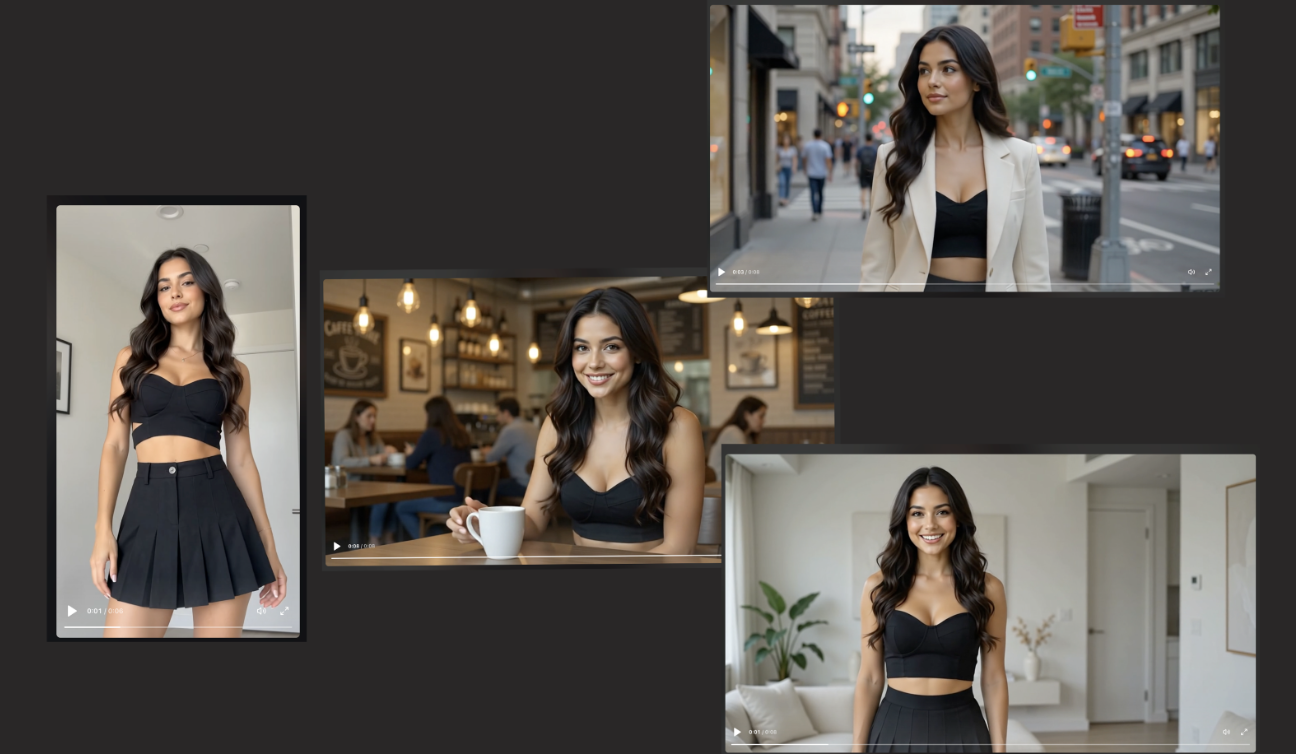
The same character reused across multiple scenes while preserving recognizable visual identity.
Video References Bring Performance Into the Workflow
If a character image answers “Who is in the shot?”, a reference video can answer a different question: “How should that character perform?”
A surprising amount of short-form content is driven by movement — a dance, a reaction, a meme gesture, or a short acting performance. These are temporal patterns, and they are not always easy to reduce to language.
If an exact performance already exists as a video, translating the entire movement into prose may not be the most efficient approach. This creates a clearer division of labor between inputs:
Character Image → Appearance Reference Video → Motion / Performance Prompt → Scene / Direction
The character identity and the performance no longer have to come from the same source. That is particularly useful for character-led short-form content, where creators may want to reuse the structure of a movement while changing the character, style, or setting.
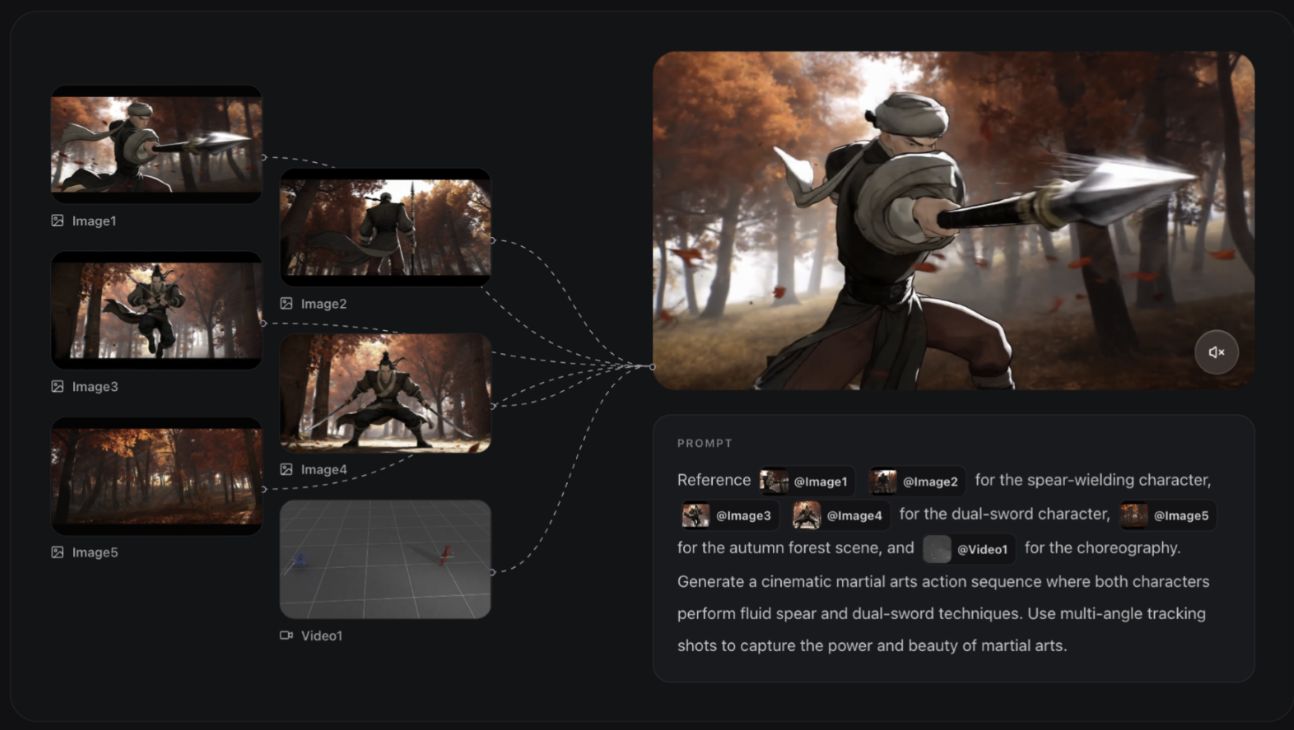
Image references establish visual elements while a video reference provides motion and performance information for the generated scene.
Series, Social Characters, and Brand Content All Depend on Asset Reuse
A microdrama, a motion comic, a virtual creator account, and a product ad may look like completely different kinds of content. From a production perspective, however, they share one important requirement: one piece of content is rarely the endpoint.
For a character-led social account, the character may dance today, appear in a meme tomorrow, enter a short story the next day, and participate in a trending format after that. If every appearance is only “similar to the previous one,” the account struggles to build a stable identity.
Brands and ecommerce teams face an even more concrete version of the same problem. They already have product photography, model shoots, key visuals, logos, brand guidelines, and previous campaign assets. They do not need AI to imagine a vaguely similar product; they need it to use the real product and create more content around it.
The same product assets may need to become social ads, lifestyle scenes, product demonstrations, localized campaigns, or creative variations for testing. If the model quietly changes packaging, color, a logo, or product structure, the output may look impressive but still be unusable. For commercial production, preserving existing assets can be more valuable than unrestricted generative freedom.
Reference-to-Video Is Becoming a Workflow, Not Just a Feature
Once creators already have character images, product photography, footage, audio, and previous generations, converting all of that information back into an increasingly long prompt is not the only option. A more direct approach is to bring those assets into the generation process itself.
This is where a Reference-to-Video workflow becomes useful. In VidLux, for example, creators can bring existing reference material into video generation rather than asking a single text prompt to carry every piece of information.
Different inputs can take on different jobs: reference images can preserve characters, products, or visual identity; reference videos can carry motion and performance information; audio references can contribute sound or rhythm; and prompts can continue to handle scene direction, narrative intent, and camera choices.
The important change is not simply the addition of more upload fields. It is the separation of creative responsibilities. A creator no longer has to make one paragraph explain who appears, what they look like, how they move, what happens in the scene, and which existing assets should influence the result.
That begins to resemble conventional production more closely. A director rarely hands a team a paragraph and nothing else; production also relies on character references, storyboards, reference footage, previous assets, and performance direction.
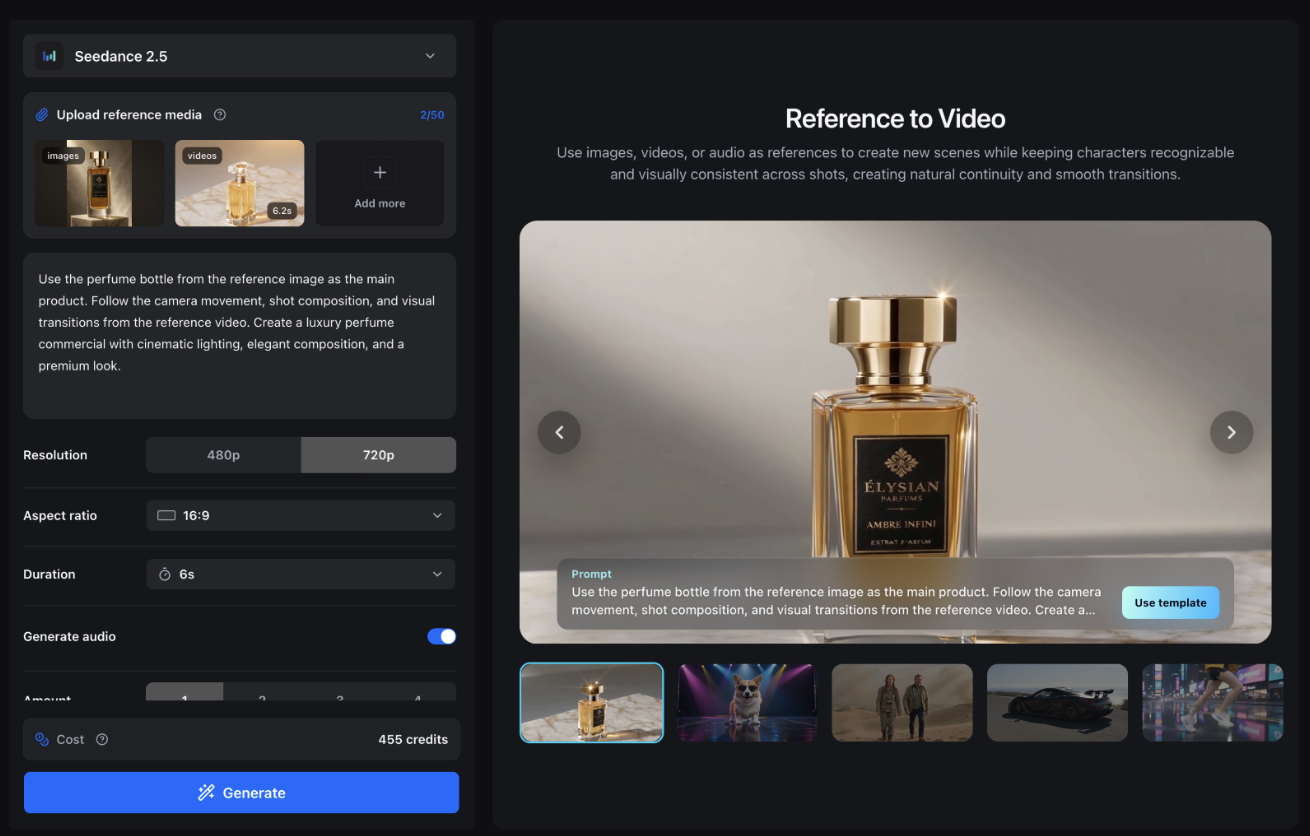
A reference-to-video workspace separates source media, prompting, generation settings, and output into distinct parts of the workflow.
References Reduce Guesswork, but They Do Not Make AI Video Fully Controllable
Reference-based workflows still have clear limitations. Fast motion, occlusion, multiple interacting characters, hand detail, and large camera movements can all create failures. Large differences between a character reference and a motion reference can also make generation harder.
A half-body portrait, for example, provides very little information for a full-body running sequence. The model still has to invent what it cannot see. So the value of references is not that they make AI perfectly obedient. A better way to think about them is that they reduce how much the model has to guess.
For a one-off demo, that may mean one fewer regeneration. Across twenty videos, however, fewer identity failures, fewer reruns, less manual selection, and less repair work start to affect actual production cost.
The Next Competition in AI Video May Be About Whether You Can Make the Next One
AI video models are still compared on visual quality, generation speed, duration, prompt adherence, and motion. Those metrics remain important. But once creators start producing content repeatedly, another set of questions becomes just as practical:
- Can the same character return?
- Can existing assets become inputs for the next video?
- Can a performance be reused with another character?
- Can the same real product stay accurate across multiple ads?
- After episode one, does episode two still require starting from scratch?
These questions are no longer about whether one clip looks impressive. They are about whether an AI video generator can become part of a production workflow.
For microdramas, animated content, virtual characters, brand creative, and long-running social accounts, that may be the more important next step. The real sign of maturity in AI video may not be how impressive the first generation looks. It may be whether the second, fifth, and twentieth video can still build on the same character, assets, and creative direction.